COX’S BAZAR, Bangladesh: Bangladesh has agreed to free land for a new camp to shelter some of the hundreds of thousands of Rohingya Muslims who have fled recent violence in Myanmar, an official said Monday.
The new camp will help relieve some pressure on existing settlements in the Bangladeshi border district of Cox’s Bazar, where nearly 300,000 Rohingya have arrived since Aug. 25.
“The two refugees camps we are in are beyond overcrowded,” said UN refugee agency spokeswoman Vivian Tan.
Other new arrivals were being sheltered in schools, or were huddling in makeshift settlements with no toilets along roadsides and in open fields. Basic resources were scarce, including food, clean water and medical aid.
Still, more refugees were arriving. An Associated Press reporter witnessed hundreds streaming through the border at Shah Puri Dwip on Monday.
“Tomorrow we are expecting an airlift of relief supplies for 20,000 people,” Tan said.
Prime Minister Sheikh Hasina had offered 2,000 acres (810 hectares) near the existing camp of Kutupalong “to build temporary shelters for the Rohingya newcomers,” according to a Facebook post Monday by Mohammed Shahriar Alam, a junior minister for foreign affairs.
He also said the government would begin fingerprinting and registering the new arrivals on Monday. Hasina is scheduled to visit Rohingya refugees on Tuesday.
Aid agencies have been overwhelmed by the influx of Rohingya, many of whom are arriving hungry and traumatized after walking days through jungles or packing into rickety wooden boats in search of safety in Bangladesh.
Many tell similar stories — of Myanmar soldiers firing indiscriminately on their villages, burning their homes and warning them to leave or to die. Some say they were attacked by Buddhist mobs.
On Monday, Bangladesh’s human rights watchdog demanded that atrocities by Myanmar authorities against Rohingya be prosecuted.
“This genocide needs to be tried at international court,” National Human Rights Commission Chairman Kazi Reazul Haque told a news conference in Cox’s Bazar.
“The killing, arson, torture and rape ... by the Myanmar’s military and border guards is unprecedented,” he said.
He said stronger action was needed from the international community, including the United Nations, the Organization of Islamic Cooperation and the Association of Southeast Asian Nations.
He also called on China and India to play a larger role in mitigating the crisis.
In the last two weeks, the government hospital in Cox’s Bazar has been overwhelmed by Rohingya patients, with 80 arriving in the last two weeks suffering gunshot wounds as well as bad infections.
At least three have been wounded in land mine blasts, and dozens have drowned when boats capsized during sea crossings.
The violence and exodus began on Aug. 25 when Rohingya insurgents attacked Myanmar police and paramilitary posts in what they said was an effort to protect their ethnic minority from persecution by security forces in the majority Buddhist country.
In response, the military unleashed what it called “clearance operations” to root out the insurgents. Accounts from refugees show the Myanmar military is also targeting civilians with shootings and wholesale burning of Rohingya villages in an apparent attempt to purge Rakhine state of Muslims.
Before Aug. 25, Bangladesh had already been housing more than 100,000 Rohingya who arrived after bloody anti-Muslim rioting in 2012 or amid earlier persecution drives in Myanmar.
Rohingya have faced decades of discrimination and persecution in Myanmar and are denied citizenship despite centuries-olds roots in the Rakhine region. Myanmar denies Rohingya exist as an ethnic group and says those living in Rakhine are illegal migrants from Bangladesh.
The Dalai Lama said he felt “very sad” about the suffering of Rohingya Muslims, and that those harassing them “should remember Buddha. I think such circumstances Buddha would definitely help those poor Muslims.”
He told reporters on Saturday that he had delivered this message to Myanmar’s leader Aung San Suu Kyi several years ago at a meeting of Nobel Peace Prize laureates.
While Burmese Buddhists in Myanmar also worship the Buddha, they follow a different religious tradition than Tibetans and do not recognize the Dalai Lama as their spiritual leader.
___
Alam reported from Dhaka, Bangladesh. AP writer Ashok Sharma in New Delhi contributed to this report.


![]()
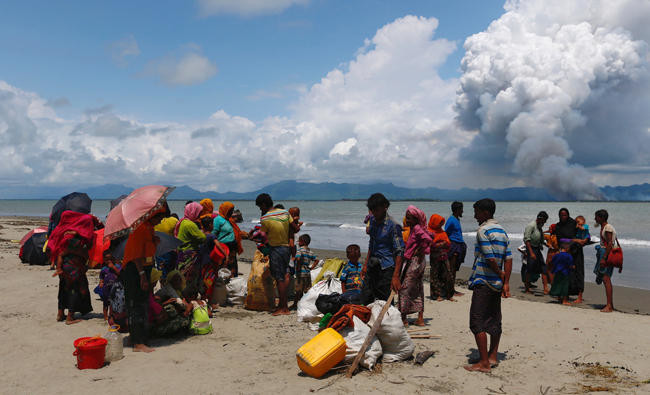
Bangladesh offers land to shelter Rohingya fleeing Myanmar
Bangladesh offers land to shelter Rohingya fleeing Myanmar
Latest updates






© 2026 SAUDI RESEARCH & PUBLISHING COMPANY, All Rights Reserved And subject to Terms of Use Agreement.