

'No deal' on doctor jailed for leading US to Osama bin Laden

1 / 10
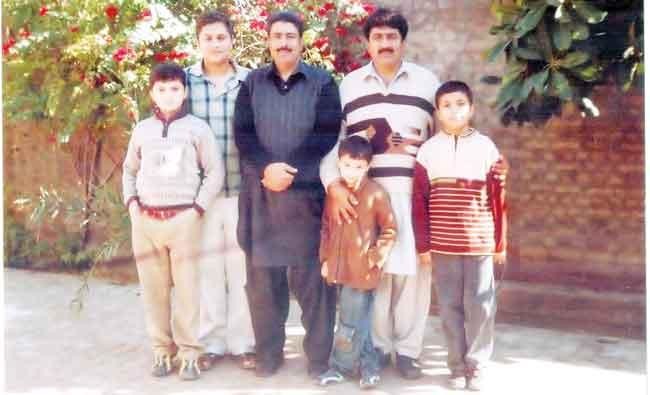
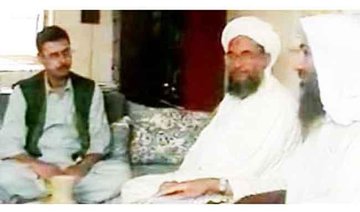
Shakil Afridi, 3rd from left, and Jamil Afridi, Shakeel’s elder brother, with their children.
2 / 10
3 / 10
4 / 10
5 / 10
6 / 10
7 / 10
8 / 10
9 / 10
10 / 10
Updated 11 September 2017
Follow

'No deal' on doctor jailed for leading US to Osama bin Laden

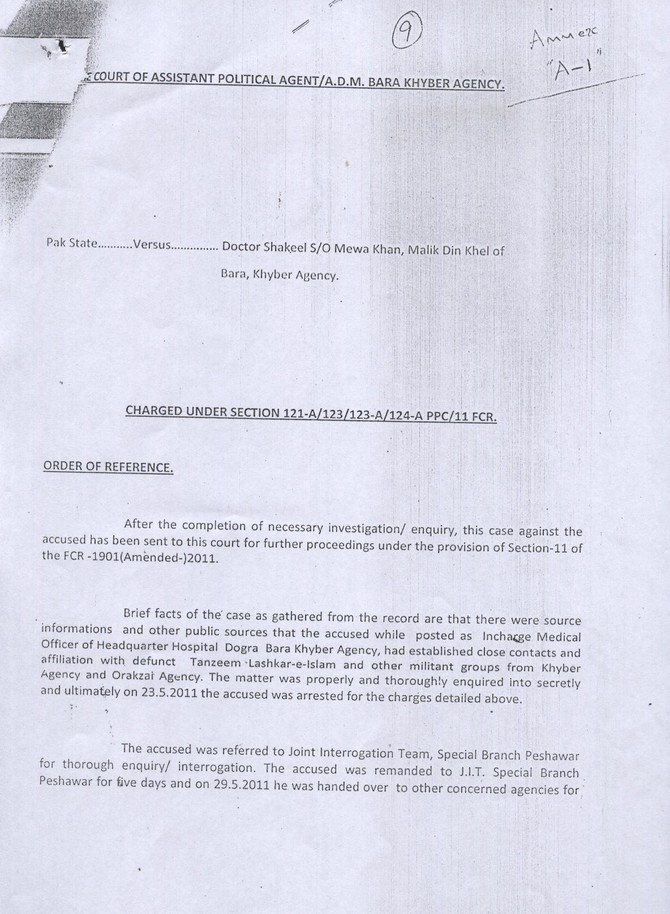
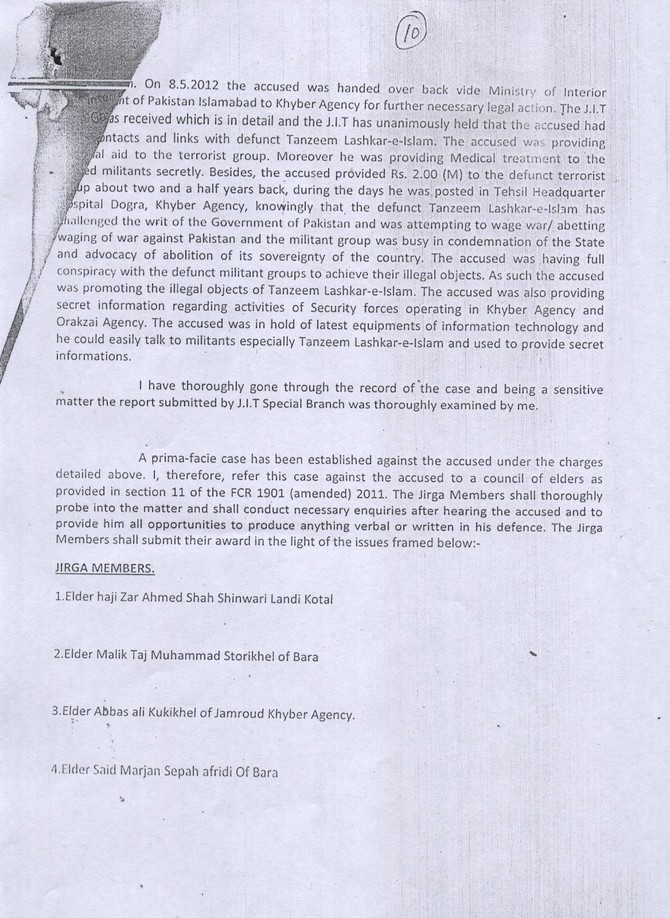
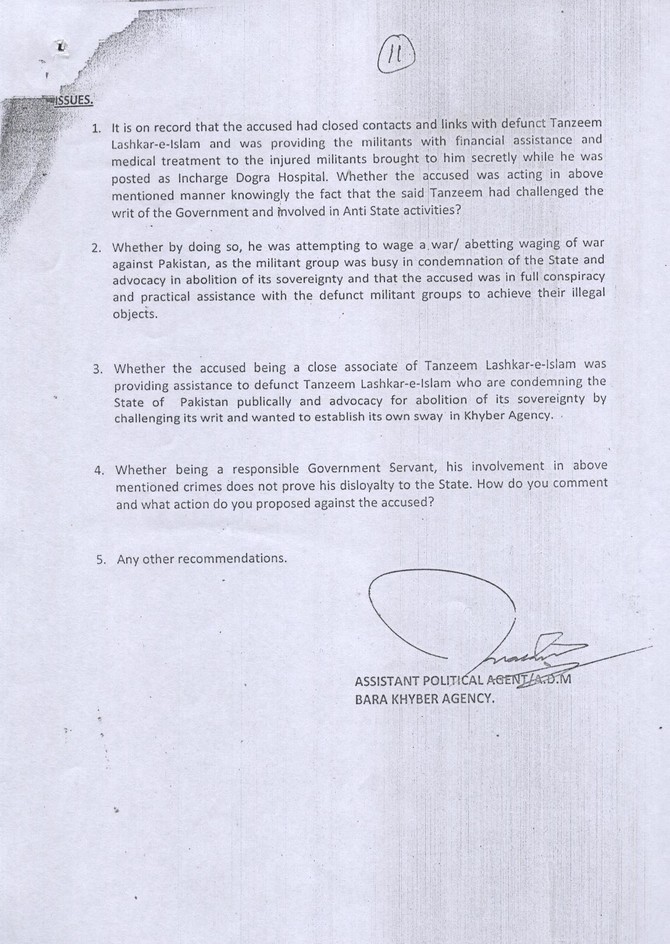
ISLAMABAD: To Americans, he is the hero who helped them hunt down and kill Osama bin Laden. To Pakistanis, he is a villain who betrayed his country. On one thing, however, both countries are agreed; Dr Shakil Afridi will not be released from prison any time soon.
“There’s no deal on Afridi,” a US State Department official said. And a retired Pakistani intelligence officer who helped to investigate the raid in which bin Laden was killed said: “There’s no agreement, and there won’t be for the foreseeable future.”
Indeed, in the opinion of the intelligence officer, the jailed doctor is lucky to be alive. “Had he been convicted of conspiring against the state and aiding a foreign country, he would have been sentenced to death.”
Afridi, 54, helped the CIA to run a fake hepatitis B vaccination program aimed at confirming bin Laden’s presence in Abbottabad, Pakistan, by collecting DNA samples.
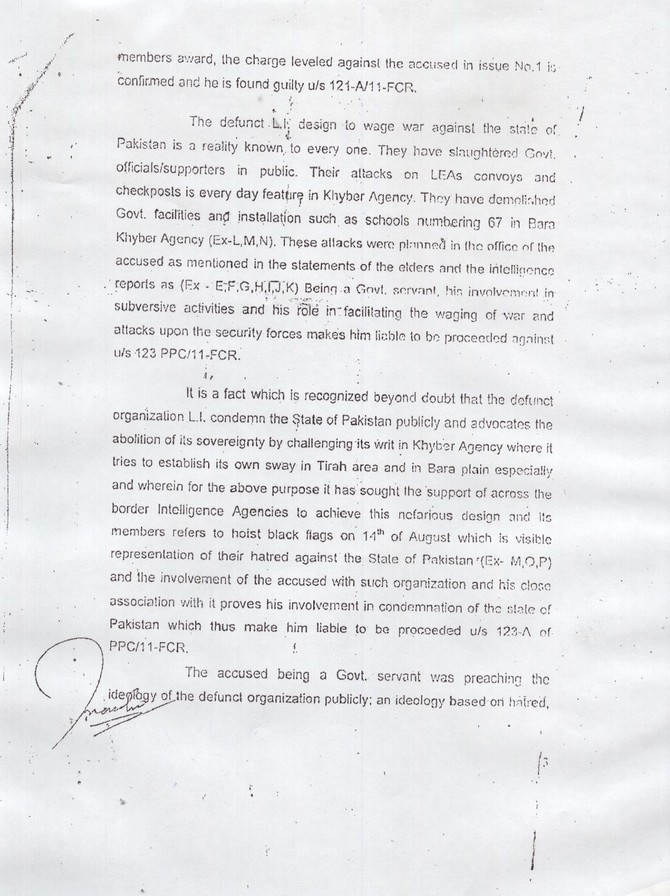
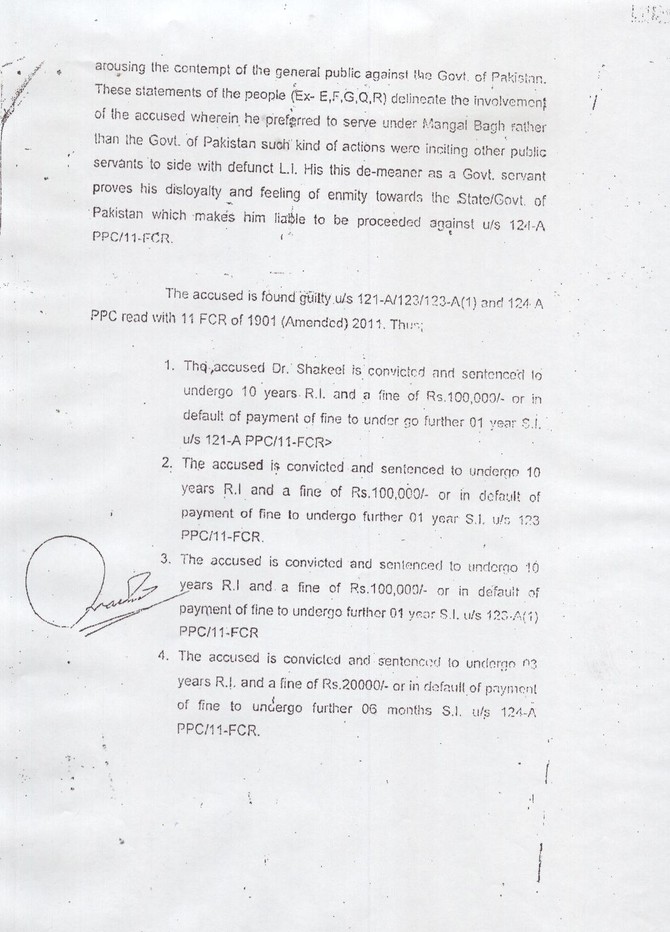
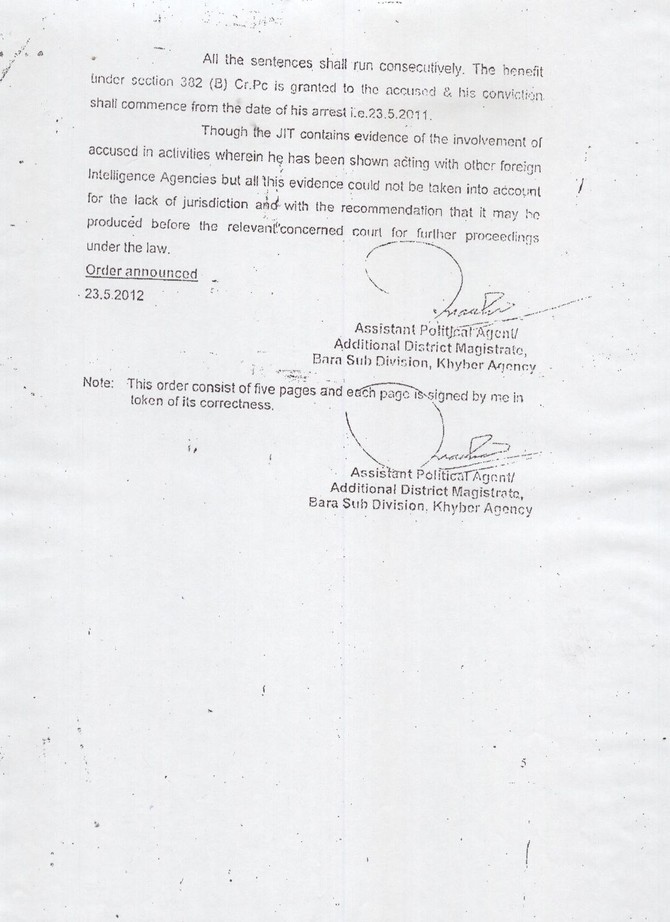
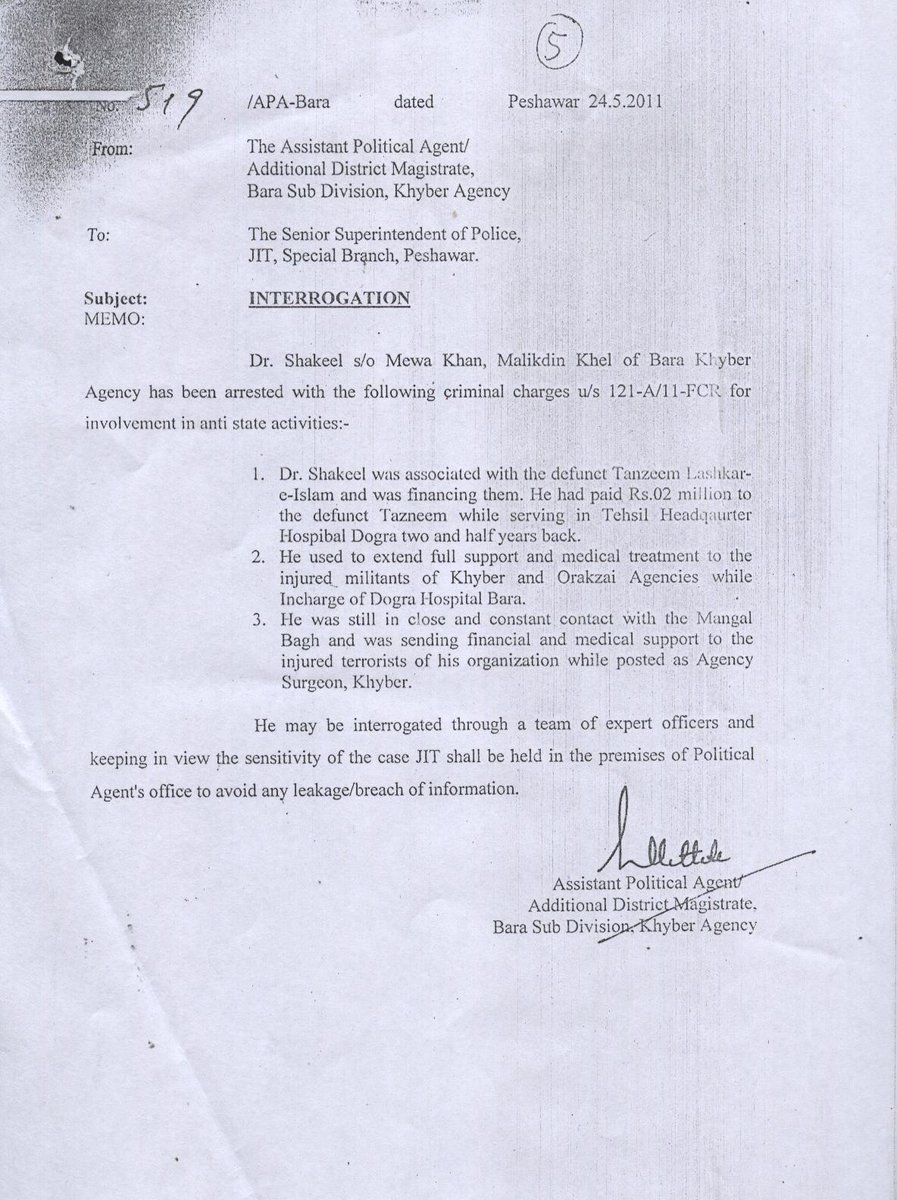
A few days after US special forces raided the bin Laden compound on May 2, 2011, and killed the Al-Qaeda leader, Afridi was arrested. A year later he was sentenced to 33 years in prison for colluding with terrorists.
The conviction was overturned on a technicality, and a retrial ordered, but in November 2013 Afridi was charged with murder over the death of a patient eight years before, and he has been prison ever since. The next hearing in his case will be on September 28.
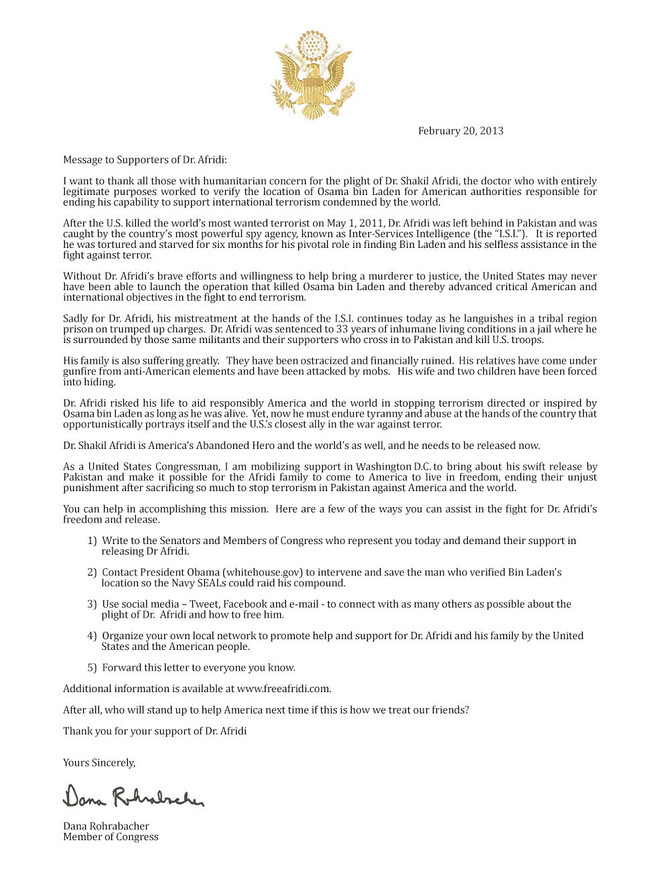
The Afridi affair has contributed to a souring in relations between Washington and Islamabad, dating back to the presidency of Barack Obama. Legislation was introduced into the US Congress to award Afridi a Congressional Gold Medal and make him a naturalised US citizen, and in 2014 a Senate panel cut aid to Pakistan by $33 million – $1m for each year of the doctor’s sentence.
Last year, Donald Trump said he could have Afridi released “in two minutes.” Pakistan’s interior minister at the time, Chaudhry Nisar Ali Khan, replied that the US president “should learn to treat sovereign states with respect.”
Afridi, he said, “is a Pakistani citizen, and nobody else has the right to dictate to us his future. Trump’s perception and his comments about Pakistan are highly misplaced and unwarranted.”
And this week the US Embassy in Islamabad told Arab News: “We believe Dr Afridi has been unjustly imprisoned and we have clearly communicated our position to Pakistan on Dr Afridi’s case, both in public and in private. We continue to raise this issue at the highest levels during discussions with Pakistan’s leadership. Pakistan has assured us that Dr Afridi is being treated humanely and is in good health.”
*   *   *
Afridi was detained by Pakistani security officials 20 days after the bin Laden raid, when his phone number was discovered on a cell phone at the Al-Qaeda leader’s compound. He was interrogated first in Peshawar, then in Islamabad for nearly a year.


The revelations about the fake hepatitis B vaccinations had unintended consequences. Militants denounced a crucial and life-saving polio inoculation campaign as “American poison,” and killed health workers administering the medication. In September 2012, while in prison, Afridi asked that a press release be distributed saying that his vaccination campaign was not fake, and was unconnected with polio, in hopes of reassuring the public.
There is considerable doubt about whether his collection of DNA samples actually identified bin Laden, but CIA spies were alerted when one of Afridi’s nurses used the doctor’s phone to contact bin Laden’s courier, Abu Ahmad Alkuwaiti. The courier’s “voice was well known” to the US intelligence community, and the contact reinforced the CIA’s view that the compound held a “high priority individual.”
After the raid, Afridi’s female CIA handlers urged him several times to leave Pakistan. He held a valid US visa, but was reluctant to travel with his wife and three children through hostile tribal territory where he had been abducted by militants in 2008. In the end, he decided to stay because there was a problem with his wife’s visa. It was to prove his undoing. 
On May 23, 2012, after 12 months in detention, Afridi was taken from Islamabad to Peshawar, sentenced to 33 years in prison and denied the legal right to a defense. 
His lawyer, Qamar Nadeem, and Afridi’s brother were allowed to meet him in prison under tight monitoring, until an interview he gave to two reporters from Fox News was published on September 10, 2012. A few days later, everyone, including Afridi’s family and lawyers, were barred from meeting him. Reports emerged that he was on hunger strike.
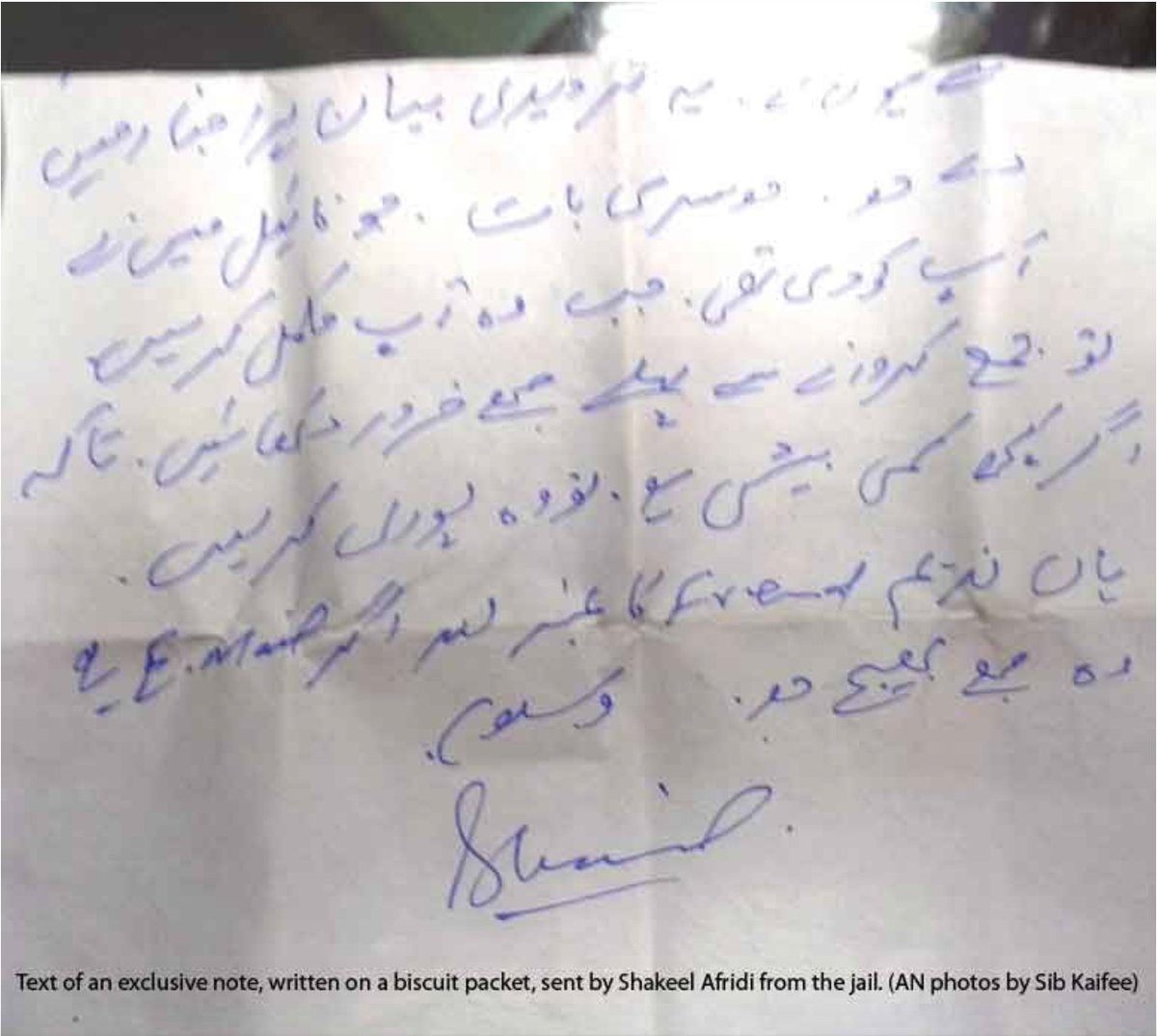
 

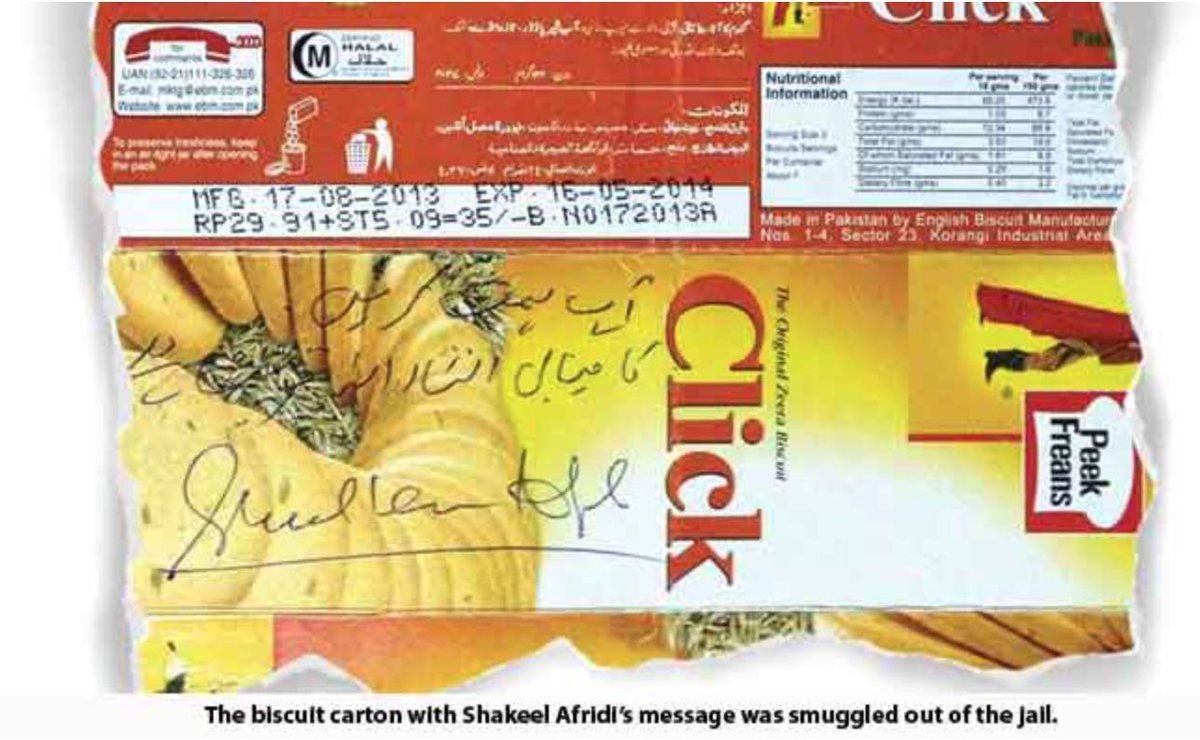
On November 20, 2013, a letter from Afridi written on a torn biscuit carton was smuggled out of prison. “My legal right to consult with my lawyers is being denied,” Afridi wrote. He decried his isolated confinement, and asked: “What sort of court and justice is this?” It is the last known correspondence from the doctor..
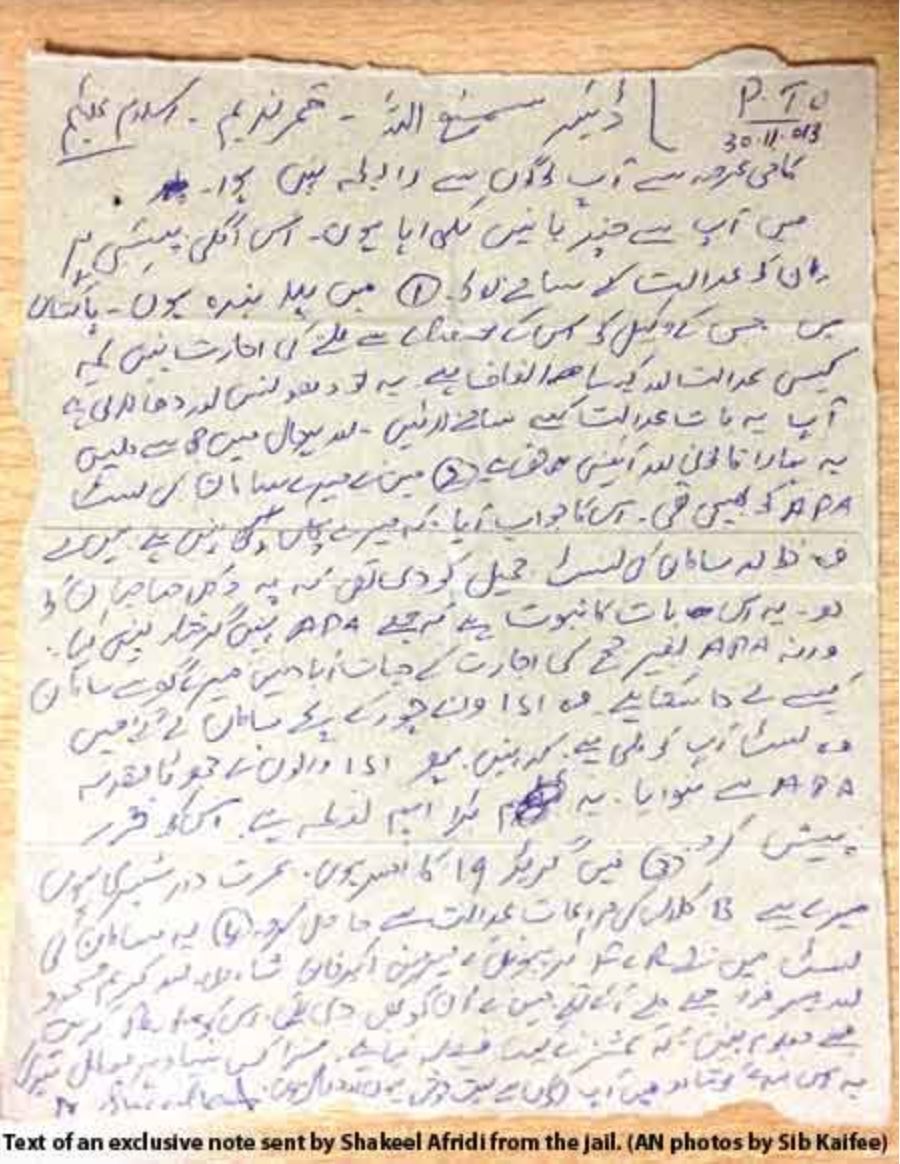


Afridi’s lawyer, Nadeem, last met his client in August 2012.  “Since then we haven’t been able to meet him,” he said, despite a high court order reinstating access. “The State wanted to stop Afridi from speaking out. therefore a ban to meet him was put in effect. But things have become more relaxed, and his family are allowed to meet him every month or so.”
*   *   *
A year after Afridi was sentenced, there were reports of an agreement to exchange him for Dr Afia Siddiqui, a Pakistani-born, US-educated neurosurgeon serving 86 years in a maximum-security medical detention center in Fort Worth, Texas. 
Siddiqui, 45, known in the US as “Lady Al-Qaeda,” was arrested in Afghanistan by American forces in July 2008, and convicted in 2010 on seven counts of attempted murder and assault of US military personnel.
Both the US and Pakistan denied the exchange reports. “Whether there was a deal previously, I don’t know,” said the State Department official. The Pakistani intelligence officer said a swap was “out of the question. She clearly was an Al-Qaeda associate. We won’t negotiate a terrorist for a traitor.”
Afridi’s lawyer, Nadeem, said Siddiqui’s representative contacted him to discuss a possible exchange. “I told her I needed to consult Afridi’s family members and my team before giving any response. We couldn’t move forward on it and the representative abandoned further efforts.”
Meanwhile Nadeem is working pro bono in the hope that someone will foot the mounting legal costs. The lawyer’s legal fees are not the only potential loss. Involvement in the Afridi case can be fatal. Nadeem’s colleague was murdered by the Taliban for defending Afridi, and the commissioner who ordered a retrial died in a gas explosion. 
The only support Afridi’s case has received is from beyond Pakistan’s borders because “there is a lot of popular antipathy towards him, and the state and pro-state voices in the public space have painted him as a traitor,” said Mustafa Qadri, a human rights expert and founder of Equidem Research and Consulting. “This all makes it very difficult for civil society to actively support his case and his family,” who are in hiding, living in fear of public reprisal.
Nevertheless, Nadeem remains undeterred, despite four dozen inconclusive court hearings, and frustration at what he says are deliberate attempts by the state prosecutor to prolong the case by failing to appear for hearings.
The only remaining option that legal experts and officials in the Pakistani government point to is a full pardon from the Governor of Khyber Pakhtunkhwa Province or the President of Pakistan, both of which seem highly unlikely. Nadeem also wants the abolition of the tribal law under which Afridi was charged, and has not given up hope of a deal between the US and Pakistan. “If both the countries come to an agreement, Afridi will be released.”
The lawyer is also offering the media rights to Afridi’s life story, if Hollywood or foreign publishers are interested. “But nothing so far has happened.”
US and Ukraine reach consensus on key issues aimed at ending the war but territorial disputes remain

Updated 5 sec ago
Follow

US and Ukraine reach consensus on key issues aimed at ending the war but territorial disputes remain

KYIV: The United States and Ukraine have reached a consensus on several critical issues aimed at bringing an end to the nearly four-year conflict, but sensitive issues around territorial control in Ukraine’s eastern industrial heartland, along with the management of the Zaporizhzhia nuclear power plant, remain unresolved, Ukraine’s president said.
Volodymyr Zelensky spoke as the US showed the 20-point plan, hammered out after marathon talks in Florida in recent days, to Russian negotiators. A response is expected from Moscow on Wednesday, Zelensky said.
The Ukrainian president briefed journalists on each point of the plan on Tuesday. His comments were embargoed until Wednesday morning. The draft proposal, which reflects Ukraine’s wishes, intertwines political and commercial interests to safeguard security while boosting economic potential.
At the heart of the negotiations lies the contentious territorial dispute concerning the Donetsk and Luhansk regions, known as the Donbas. This is “the most difficult point,” Zelensky said. He said these matters will be discussed at the leaders level.
Russia continues to assert maximalist demands, insisting that Ukraine relinquish the remaining territory in Donbas that it has not captured — an ultimatum that Ukraine has rejected. Russia has captured most of Luhansk and about 70 percent of Donetsk.
In a bid to facilitate compromise, the United States has proposed transforming these areas into free economic zones. Ukraine insists that any arrangement must be contingent upon a referendum, allowing the Ukrainian people to determine their own fate. Ukraine is demanding the demilitarization of the area and the presence of an international force to ensure stability, Zelensky said.
How the Zaporizhzhia nuclear power plant, the largest plant in Europe which is under Russian occupation, will be managed is another contentious issue. The US is proposing a consortium with Ukraine and Russia, with each party having an equal stake in the enterprise.
But Zelensky countered with a joint venture proposal between the US and Ukraine, in which the Americans are able to decide how to distribute their share, presuming it would go to Russia.
“We did not reach a consensus with the American side on the territory of the Donetsk region and on the ZNPP,” Zelensky said, referring to the power plant in Zaporizhzhia. “But we have significantly brought most of the positions closer together. In principle, all other consensus in this agreement has been found between us and them.”
A free economic zone compromise
Point 14, which covers territories that cut across the eastern front line, and Point 12, which discusses management of the Zaporizhzhia plant, will likely be major sticking points in the talks.
Zelensky said: “We are in a situation where the Russians want us to leave the Donetsk region, and the Americans are trying to find a way so that it is ‘not a way out’ — because we are against leaving — they want to find a demilitarized zone or a free economic zone in this, that is, a format that can provide for the views of both sides.”
The draft states that the contact line, which cuts across five Ukrainian regions, be frozen once the agreement is signed.
Ukraine’s stance is that any attempt to create a free economic zone must be ratified by a referendum, affirming that the Ukrainian people ultimately hold the decision-making power, Zelensky said. This process will require 60 days, he added, during which time hostilities should stop to allow the process to happen.
More difficult discussions would require hammering out how far troops would be required to move back, per Ukraine’s proposal, and where international forces would be s tationed. Zelensky said ultimately “people can choose: this ending suits us or not,” he said.
The draft also proposes that Russian forces withdraw from Dnipropetrovsk, Mykolaiv, Sumy, Kharkiv regions, and that international forces be located along the contact line to monitor the implementation of the agreement.
“Since there is no faith in the Russians, and they have repeatedly broken their promises, today’s contact line is turning into a line of a de facto free economic zone, and international forces should be there to guarantee that no one will enter there under any guise — neither ‘little green men’ nor Russian military disguised as civilians,” Zelensky said.
Managing Zaporizhzhia power plant
Ukraine is also proposing that the occupied city of Enerhodar, which is connected to the Zaporizhzhia power plant, be a demilitarized free economic zone, Zelensky said. This point required 15 hours of discussions with the US, he said.
For now, the US proposes that the plant be jointly operated by Ukraine, the US and Russia, with each side receiving dividends from the enterprise.
“The USA is offering 33 percent for 33 percent for 33 percent, and the Americans are the main manager of this joint venture,” he said. “It is clear that for Ukraine this sounds very unsuccessful and not entirely realistic. How can you have joint commerce with the Russians after everything?”
Ukraine offered an alternative proposal, that the plant be operated by a joint venture with the US in which the Americans can determine independently how to distribute their 50 percent share.
Zelensky said billions in investments are needed to make the plant run again, including restoring the adjacent dam.
“There were about 15 hours of conversations about the plant. These are all very complex things.”
A separate annex for security guarantees
The document ensures that Ukraine will be provided with “strong” security guarantees that mirror NATO’s Article 5, which would obligate Ukraine’s partners to act in the event of renewed Russian aggression.
Zelensky said that a separate bilateral document with the US will outline these guarantees. This agreement will detail the conditions under which security will be provided, particularly in the event of a renewed Russian assault, and will establish a mechanism to monitor the ceasefire.
This mechanism will utilize satellite technology and early warning systems to ensure effective oversight and rapid response capabilities.
“The mood of the United States of America is that this is an unprecedented step toward Ukraine on their part. They believe that they are giving strong security guarantees,” he said.
The draft contains other elements including keeping Ukraine’s army at 800,000 during peace time, and by nailing down a specific date for ascension to the European Union.
Elections and boosting the economy
The document proposes accelerating a free trade agreement between Ukraine and the US once the agreement is signed. The US wants the same deal with Russia, said Zelensky.
Ukraine would like to receive short-term privileged access to the European market and a robust global development package, that will cover a wide-range of economic interests, including a development fund to invest in industries including technology, data centers and artificial intelligence, as well as gas.
Also included are funds for the reconstruction of territories destroyed in the war.
“Ukraine will have the opportunity to determine the priorities for distributing its share of funds in the territories under the control of Ukraine. And this is a very important point, on which we spent a lot of time,” Zelensky said.
The goal will be to attract $800 billion through equity, grants, loans and private sector contributions.
The draft proposal also requires Ukraine to hold elections after the signing of the agreement. “This is the partners’ vision,” Zelensky said.
Ukraine is also asking that all prisoners since 2014 be released at once, and that civilian detainees, political prisoners and children be returned to Ukraine.