NEW YORK: It is a typical late summer weekend in New York’s Times Square, and tourists from around the world are snapping pictures beneath the commercial hub’s iconic neon billboards — watched closely by a heavy contingent of police.
Four cruisers are parked in the middle of the busy intersection, and pedestrian zones have been surrounded by barriers to stop cars from ramming the crowd, a mode of attack favored by violent extremists in recent years.
“I don’t like to come to places like this,” says Sue Garcia, a massage therapist from Brooklyn. “Or anywhere where incidents have happened repeatedly — the fear comes to mind.”
Fear of an attack. Fear of another 9/11, the deadliest terrorist assault in history, when almost 3,000 lives were extinguished, many in the rubble of the World Trade Center (WTC).
For New Yorkers who lost loved ones, narrowly survived or just witnessed the event, memories remain fresh and old wounds are re-opened on its anniversary. And a perpetual state of high alert is the new normal.
Garcia, now 33, was a high schooler when the planes slammed into the Twin Towers. She saw them burn then collapse, and walked all the way home like hundreds of thousands of New Yorkers that day after metro services were suspended.
“I was there, I saw it over and over again, I don’t need to think about it,” she says.
But her mind always drifts toward the horrors of that day, whenever it is mentioned on TV, or even “when I hear an airplane: It is like the trigger to the thought. It has subsided over the years but it is still there” she adds.
Or while waiting to meet her sister in Times Square, “The Crossroads of the World,” that symbolizes the spirit of New York.
Twice in recent years, catastrophe loomed. In May 2010, police discovered a car packed with explosives and primed for carnage.
In May, a mentally ill ex-soldier deliberately drove his sedan into 23 pedestrians, killed a young American tourist.
The episodes of anxiety described by Garcia are a burden borne by many New Yorkers.
For those directly affected, the anniversary of the attacks are the “most dreaded date” of the year and post-traumatic stress can remain for an individual’s entire life, says Charles Strozier, a psychoanalyst and author of a book that documents the experiences of survivors and witnesses.
“There was a collective trauma, the sense of having been proven to be not invulnerable,” he says.
“To say that New Yorkers are still traumatized is an exaggeration. But they think about it, they are aware of it, they do have active fears just below the surface of consciousness about things like bombs in the subways,” adds the professor, who watched the destruction of the WTC from his office just off Union Square.
Many are also convinced that, even though recent terror attacks have focused on Europe, it is New York, the beating heart of the Western world that remains the prime target.
“What better target, unfortunately, than NYC?” asks Tim Lambert, an IT consultant.
Then, as now, he worked on the southern tip of Manhattan near the WTC site. The city, he says, is a “magnet for people from all over the world... It symbolizes the freedoms that we have, the money that we have. What better way to make a statement?”
The 52-year-old says a heavier police presence is now a fact of life that people have come to expect.
“I am not comfortable with it, but it is the new norm. The world is changing and the terrorist threat is part of that change,” he adds.
They are apprehensions shared by the city’s leaders.
“Thank God this is not an act of terrorism. It is an isolated incident,” Mayor Bill de Blasio said in June when a doctor went on a shooting rampage in a hospital where he used to work in Bronx, killing one and injuring six.
When the car-ramming incident happened in May, police chief James O’Neill admitted, “The worst went through my mind.”
To protect its 8.5 million inhabitants, New York has to remain fully prepared.
A 38,000 strong police force that keeps watch over the city’s public spaces, a massive network of cameras providing round-the-clock surveillance and a ubiquitous campaign to remind denizens “If you see something, say something,” are all reminders of the cost of security.
Since 2001, the city has had its own anti-terrorist unit, which today has about 2,000 personnel and representatives in several foreign capitals, according to Robert Strang, president of the New York-based Investigative Management Group.
The agency has at times courted controversy, notably for its program that monitored citizens frequenting the city’s mosques which was criticized for being discriminatory.
But the intelligence network is essential and overall and has been successful in preventing major new attacks, said Strang.
The US financial capital also wants to set an example when it comes to honoring the victims of terror abroad.
After recent attacks in Europe, authorities were quick to offer their condolences and assistance, and turned off the lights at the Empire State Building in a mark of solidarity.
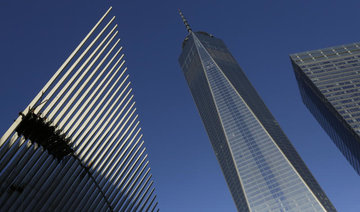
And the Sept. 11 Memorial, with its two immense black granite craters, built on the site of the Twin Towers, has become a site of meditation and mourning not just for New York but for the entire world.
It is “a memorial to all the terror victims in a way,” said Monique Mol, a 52-year-old Dutch tourist.
“It is like these people will live forever — like the pyramids and the mummified pharaohs in Egypt.”


![]()

16 years after 9/11, ever-vigilant New Yorkers on edge
16 years after 9/11, ever-vigilant New Yorkers on edge


Latest updates


© 2026 SAUDI RESEARCH & PUBLISHING COMPANY, All Rights Reserved And subject to Terms of Use Agreement.