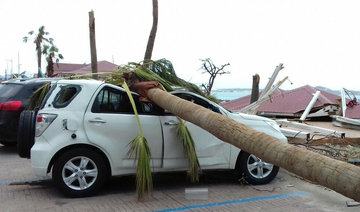
MIAMI: Three people in Florida, including a sheriff’s deputy, have been killed in car crashes as Hurricane Irma closed in with high winds and lashing rain, officials said.
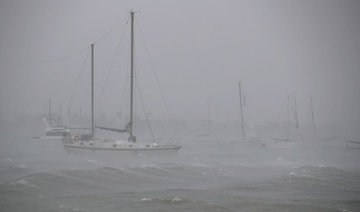
The hurricane bore down on southern Florida on Sunday with 130 mile-per-hour winds, flooding Miami streets and knocking out power to more than 1.6 million homes and businesses.
The storm was one of the most powerful ever seen in the Atlantic and has already killed two dozen people in the Caribbean and pummeled Cuba with 36-foot waves. Its core was located about 50 miles south of Naples by midday.
Some 6.5 million people, about a third of the state’s population, had been ordered to evacuate southern Florida.
Officials warned that Irma’s heavy storm surge — seawater driven on land by high winds — could bring floods of up to 15 feet along the state’s western Gulf Coast. It submerged the highway that connects the isolated Florida Keys archipelago with the mainland and small whitecapped waves could be seen in flooded streets between Miami office towers.
“There is a serious threat of significant storm surge flooding along the entire west coast of Florida,” Gov. Rick Scott told a press conference. “This is a life-threatening situation.”
Irma is expected to cause billions of dollars in damage to the third-most-populous US state, a major tourism hub with an economy comprising about 5 percent of US gross domestic product (GDP).
At least 1.6 million Florida homes and businesses had lost power, according to Florida Power & Light and other utilities.
The National Hurricane Center forecast that its center eye will move near or over the state’s west coast later.
The storm winds downed a construction crane and shook tall buildings in Miami, which was about 95 miles from Irma’s core.
Deme Lomas, who owns Miami restaurant Niu Kitchen, said he saw a crane torn apart by winds and dangling from the top of the building.
“We couldn’t hear it come down because of the loud wind, but when we just took a look it was pulled apart into a mess,” Lomas said in a phone interview from his 35th-floor apartment. “We feel the building swaying all the time ... It’s like being on a ship.”
Miami streets were flooded as the water crept up on and around Brickell Avenue, which runs around 550 feet from the waterfront through the city’s financial district and newly built high rises.
“There’s water everywhere,” said Chaim Lipskar, rabbi at the Rok Family Shul that is sheltering a few families through the storm. “It’s up and down Brickell and all over the side streets.”
South Florida’s large population of elderly residents posed a severe test for the emergency shelters, many of which were not equipped for people with elaborate medical needs.
Irma is now a Category 4 storm, the second-highest designation on the Saffir-Simpson scale.
One woman in Miami’s Little Haiti neighborhood delivered her own baby, with medical personnel coaching her on the phone because emergency responders were not able to reach her, the city of Miami said on Twitter. The two are now at the hospital, it said.
Irma comes just days after Hurricane Harvey dumped record-setting rain in Texas, causing unprecedented flooding, killing at least 60 people and leaving an estimated $180 billion in property damage in its wake. Almost three months remain in the Atlantic hurricane season, which runs through November.
US President Donald Trump spoke to the governors of Alabama, Georgia, South Carolina and Tennessee on Sunday and issued a disaster declaration for Puerto Rico, which was hit by the storm last week, the White House said.


3 dead as Hurricane Irma batters Florida with high winds, heavy rain

3 dead as Hurricane Irma batters Florida with high winds, heavy rain

Indonesia to send record number of women officers to assist Hajj pilgrims
- Women comprise 33% of Indonesian Hajj officers in 2026
- They will assist the world’s largest contingent of Hajj pilgrims
JAKARTA: Indonesia’s Ministry of Hajj and Umrah on Friday concluded a training program for Hajj officers, a group that this year includes a record number of female guides to help Indonesian pilgrims perform the spiritual journey.
The world’s biggest Muslim-majority nation, Indonesia sends the largest contingent of Hajj pilgrims every year, comprising 221,000 people in 2026.
They will be assisted by more than 1,600 Indonesian officers who came from different parts of the country to participate in a 20-day training program in East Jakarta to prepare them for the roles, ahead of the pilgrimage season in May.
“Education and training for Indonesian Hajj officers … are carried out as part of the operational preparations for the 2026 Hajj pilgrimage,” said Puji Raharjo, director general of Hajj management at the ministry, during the closing ceremony on Friday.
“This program is aimed at ensuring the physical, mental, technical and organizational readiness of the officers in order to guide, serve and protect Indonesian Hajj pilgrims.”
Indonesia is sending more than 500 female Hajj officers in 2026 — its largest group of women guides yet.
“This year, women officers comprise about 33 percent, the highest in the history of Hajj management in Indonesia,” Arifatul Choiri Fauzi, the minister of women’s empowerment and child protection, told reporters.
As over 55 percent of Indonesian Hajj pilgrims are women and most of them are elderly, female officers can help ensure that they are treated with more care and empathy, she added.
Fauzi said: “There are many issues that are more suitable to be handled by female officers, things related to women’s issues, assistance inside the room, or emergencies that concern the privacy of the (women) pilgrims.”
The training program, which ran from Jan. 10-30, was aimed at preparing the officers physically and educating them on existing Hajj policies and mechanisms, while also covering operational case studies and lessons on effective communication and Arabic, as well as simulations of real-life situations related to the pilgrimage.
Indonesian Hajj officers will undergo a round of training online in February, before another session is held with reference to their departure locations in Indonesia.
“Every year, Indonesia sends the largest number of pilgrims in the world. This fact demands us to be truly ready and organized with officers who are dependable. Hajj officers fill a strategic role, you represent the state for the pilgrims, (and) you represent the state in front of the world,” Minister of Hajj and Umrah Mochamad Irfan Yusuf said while addressing this year’s batch of Hajj officers.
“This training and guidance program is therefore very important, as this is where you all prepare in order to understand the extent of your duties, strengthen coordination and come together in unity and discipline for the mission ahead.”


