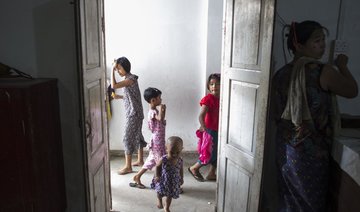
COX’S BAZAR, Bangladesh: The United Nations has appealed for aid to deal with a humanitarian crisis unfolding in southern Bangladesh after the number of Muslim Rohingya fleeing Myanmar neared 300,000, just two weeks after violence erupted there.
The wave of hungry and traumatized refugees is “showing no signs of stopping,” overwhelming agencies in the Cox’s Bazar region already helping hundreds of thousands displaced by previous spasms of conflict in Myanmar’s Rakhine state, the UN said.
“It is vital that aid agencies working in Cox’s Bazar have the resources they need to provide emergency assistance to incredibly vulnerable people who have been forced to flee their homes and have arrived in Bangladesh with nothing,” the UN Resident Coordinator in Bangladesh Robert Watkins said.
He said in a statement late on Saturday that agencies urgently needed $77 million to cope with an emergency that was triggered when Rohingya insurgents attacked police posts and an army base on Aug. 25, prompting a military counter-offensive.
The Arakan Rohingya Salvation Army (ARSA) insurgent group declared a month-long unilateral cease-fire, starting on Sunday, to enable aid groups bring humanitarian aid to those still in the northwestern state of Buddhist-majority Myanmar.
The impact of ARSA’s move is unclear, but it does not appear to have been able to put up significant resistance against the military force unleashed in Rakhine state, where thousands of homes have been burned down and dozens of villages destroyed.
Thousands of displaced people in Rakhine have been stranded or left without food for weeks. Many are still trying to cross mountains, dense bush and rice fields to reach Bangladesh.
Red Cross organizations are scaling up their operations in Rakhine after the UN had to suspend activities there following government suggestions that its agency had supported the insurgents. The UN has evacuated non-critical staff from the area over the past two weeks.
VILLAGES BURNT DOWN
In its cease-fire statement, ARSA called on the military to lay down arms and allow humanitarian aid to all affected people.
Myanmar says its security forces are carrying out clearance operations to defend against ARSA, which the government has declared a terrorist organization.
Rights monitors and fleeing Rohingya say the army and Rakhine Buddhist vigilantes have mounted a campaign of arson aimed at driving out the Muslim population.
About a dozen Muslim villages were burned down on Friday and Saturday in the ethnically mixed Rathedaung region of Rakhine, two sources monitoring the situation said.
“Slowly, one after another, villages are being burnt down — I believe that Rohingyas are already wiped out completely from Rathedaung,” said one of the sources, Chris Lewa of the Rohingya monitoring group the Arakan Project.
It was unclear who set fire to the villages, located in a part of northwest Myanmar far from where the insurgents launched their attacks last month. Independent journalists are not allowed into the area.
Three Rohingya were killed by land mines on Saturday as they tried to cross from Myanmar, a Bangladeshi border guard said, and an official with a non-government organization said two more were injured on Sunday.
In Cox’s Bazar, a Reuters reporter saw about 40 Rohingya, mainly women and children, arriving early on Sunday after a four-day trek and then a border crossing by fishing boat.
“The sea was very rough but we made it here somehow,” said 25-year-old Rashidullah, one of the group that was looking for temporary shelter on the beach in an area where there is no room left in refugee camps.
The International Crisis Group said in a report that the strife in Rakhine is causing more than a humanitarian crisis.
“It is also driving up the risks that the country’s five-year-old transition from military rule will stumble, that Rohingya communities will be radicalized, and that regional stability will be weakened,” it said.
Myanmar leader Aung San Suu Kyi has come under international pressure to halt the violence. Critics complain that Suu Kyi, who won a Nobel peace prize in 1991 for championing democracy, has failed to speak out for a minority of her country that has long complained of persecution.

UN appeals for aid as Myanmar refugee exodus nears 300,000

Judge bars federal prosecutors from seeking the death penalty against Luigi Mangione
- Judge Margaret Garnett’s Friday ruling foiled the Trump administration’s bid to see Mangione executed
- Garnett dismissed a federal murder charge against Mangione, finding it technically flawed. She left in place stalking charges that could carry a life sentence
NEW YORK: Federal prosecutors can’t seek the death penalty against Luigi Mangione in the killing of UnitedHealthcare CEO Brian Thompson, a federal judge ruled Friday, foiling the Trump administration’s bid to see him executed for what it called a “premeditated, cold-blooded assassination that shocked America.”
Judge Margaret Garnett dismissed a federal murder charge that had enabled prosecutors to seek capital punishment, finding it technically flawed. She wrote that she did so to “foreclose the death penalty as an available punishment to be considered by the jury” as it weighs whether to convict Mangione.
Garnett also dismissed a gun charge but left in place stalking charges that carry a maximum punishment of life in prison. To seek the death penalty, prosecutors needed to show that Mangione killed Thompson while committing another “crime of violence.” Stalking doesn’t fit that definition, Garnett wrote in her opinion, citing case law and legal precedents.
In a win for prosecutors, Garnett ruled they can use evidence collected from his backpack during his arrest, including a 9mm handgun and a notebook in which authorities say Mangione described his intent to “wack” an insurance executive. Mangione’s lawyers had sought to exclude those items, arguing the search was illegal because police hadn’t yet obtained a warrant.
During a hearing Friday, Garnett gave prosecutors 30 days to update her on whether they’ll appeal her death penalty decision. A spokesperson for the US attorney’s office in Manhattan, which is prosecuting the federal case, declined to comment.
Garnett acknowledged that the decision “may strike the average person — and indeed many lawyers and judges — as tortured and strange, and the result may seem contrary to our intuitions about the criminal law.” But, she said, it reflected her “committed effort to faithfully apply the dictates of the Supreme Court to the charges in this case. The law must be the Court’s only concern.”
Mangione, 27, appeared relaxed as he sat with his lawyers during the scheduled hearing, which took place about an hour after Garnett issued her written ruling. Prosecutors retained their right to appeal but said they were ready to proceed to trial.
Outside court afterward, Mangione attorney Karen Friedman Agnifilo said her client and his defense team were relieved by the “incredible decision.”
Jury selection in the federal case is set for Sept. 8, followed by opening statements and testimony on Oct. 13. The state trial’s date hasn’t been set. On Wednesday, the Manhattan district attorney’s office urged the judge in that case to schedule a July 1 trial date.
“That case is none of my concern,” Garnett said, adding that she would proceed as if the federal case is the only case unless she hears formally from parties involved in the state case. She also said the federal case will be paused if the government appeals her death penalty ruling.
Thompson, 50, was killed on Dec. 4, 2024, as he walked to a midtown Manhattan hotel for UnitedHealth Group’s annual investor conference. Surveillance video showed a masked gunman shooting him from behind. Police say “delay,” “deny” and “depose” were written on the ammunition, mimicking a phrase used by critics to describe how insurers avoid paying claims.
Mangione, an Ivy League graduate from a wealthy Maryland family, was arrested five days later at a McDonald’s in Altoona, Pennsylvania, about 230 miles (about 370 kilometers) west of Manhattan.
Following through on Trump’s campaign promise to vigorously pursue capital punishment, Attorney General Pam Bondi ordered Manhattan federal prosecutors last April to seek the death penalty against Mangione.
It was the first time the Justice Department sought the death penalty in President Donald Trump’s second term. He returned to office a year ago with a vow to resume federal executions after they were halted under his predecessor, President Joe Biden.
Garnett, a Biden appointee and former Manhattan federal prosecutor, ruled after hearing oral arguments earlier this month.
Besides seeking to have the death penalty rejected on the grounds Garnett cited, Mangione’s lawyers argued that Bondi’s announcement flouted long-established Justice Department protocols and was “based on politics, not merit.”
They said her remarks, followed by posts to her Instagram account and a TV appearance, “indelibly prejudiced” the grand jury process resulting in his indictment weeks later.
Prosecutors urged Garnett to keep the death penalty on the table, arguing that the charges were legally sound and Bondi’s remarks weren’t prejudicial, as “pretrial publicity, even when intense, is not itself a constitutional defect.”
Prosecutors argued that careful questioning of prospective jurors would alleviate the defense’s concerns about their knowledge of the case and ensure Mangione’s rights are respected at trial.
“What the defendant recasts as a constitutional crisis is merely a repackaging of arguments” rejected in previous cases, prosecutors said. “None warrants dismissal of the indictment or categorical preclusion of a congressionally authorized punishment.”