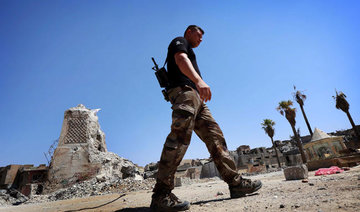
BAGHDAD: Mosul, wrested from the Daesh jihadist group on July 10, is Iraq’s second city and one of its cultural jewels.
The jihadists seized it in a lightning June 2014 offensive that humiliated Iraq’s security forces, who launched their massive operation to retake it in October last year.
Here are some facts about Mosul:
The Mosul area is rich in oil and the city straddles the Tigris River about 350 kilometers (220 miles) north of Baghdad and 50 kilometers (30 miles) south of Iraq’s biggest dam.
It has long been a trading hub between Iraq, Syria and Turkey, and its population before used to be a mosaic of Arabs, Kurds, Turkmen, Christians and other minorities.
Muslin, the fine cotton fabric that is one of the city’s best-known products, derives its name from “Mosul.”
The city controls key supply routes in northern Iraq, notably a highway to the border with Syria and its second city of Aleppo.
Mosul’s population, which has fallen from a peak of around two million, now comprises mostly Sunni Arabs, and after Saddam Hussein was defeated in 2003, the jihadist group Al-Qaeda took root there.
On June 10, 2014, fighters from Daesh seized the city. On June 29, the group proclaimed an Islamic “caliphate” that included Mosul, the Syrian city of Raqqa and large areas of Iraq and neighboring Syria.
The group labelled its project the Daesh, and leader Abu Bakr Al-Baghdadi made his first public appearance on July 5 at Mosul’s famed Great Mosque of Al-Nuri.
Daesh militants turned the city into an urban model for their state, setting school programs, shop opening hours and dress codes. The sale of alcohol and cigarettes was forbidden.
The city’s historic center was dotted with church spires, and it was home to an estimated 35,000 Christians when Daesh arrived. Christians were ordered to convert, pay a special tax, or leave. Almost all fled.
Starting in July 2014, Daesh began to destroy Shiite mosques and sanctuaries, some of which had been richly adorned and stood for centuries.
Militants burned thousands of rare books and manuscripts in the city’s vast museum and smashed priceless statues.
Daesh rigged the Nabi Yunus shrine — revered by both Muslims and Christians as the tomb of Prophet Jonah — with explosives and blew it up. It also destroyed the Prophet Seth shrine.
The Old City of Mosul, on the western side of the river, is also considered of major cultural value.
On June 21, as Iraqi forces advanced in the Old City, the jihadists blew up the Nuri mosque and Mosul’s iconic leaning minaret, known as the “Hadba” (Hunchback), which had been a symbol of the city for centuries.
Mosul was conquered by Arabs in 641 and reached its cultural peak in the 12th century before falling to Mongols in 1262, and then to Persians and Ottomans.
The city became part of Iraq when the country was created out of the ashes of the Ottoman Empire in the 1920s.
Britain annexed the oil-rich region in 1918, to the dismay of France which sought to attach the area to its mandate in Syria.
Nineveh has always been a border region, keenly contested by its rival communities and their powerful supporters in neighboring states.
In the early years of this century, Mosul proved a bastion of Saddam’s most dedicated supporters who became a foundation of Daesh.
Extortion and protection rackets in the city were a major source of jihadist funding in the years leading up to 2014.

Mosul: Iraq’s second city and cultural jewel
Netanyahu says Israel and Hamas will enter ceasefire’s second phase soon
- Says the second phase addresses the disarming of Hamas and withdrawal of Israeli troops from Gaza
- Second stage also includes the deployment of an international force to secure Gaza and forming a temporary Palestinian government
TEL AVIV, Israel: Israeli Prime Minister Benjamin Netanyahu said Sunday that Israel and Hamas are “very shortly expected to move into the second phase of the ceasefire,” after Hamas returns the remains of the last hostage held in Gaza.
Netanyahu spoke during a news conference with visiting German Chancellor Friedrich Merz and stressed that the second phase, which addresses the disarming of Hamas and the withdrawal of Israeli troops from Gaza, could begin as soon as the end of the month.
Hamas has yet to hand over the remains of Ran Gvili, a 24-year-old police officer who was killed in the Hamas-led Oct. 7, 2023, attack that sparked the war. His body was taken to Gaza.
The ceasefire’s second stage also includes the deployment of an international force to secure Gaza and forming a temporary Palestinian government to run day-to-day affairs under the supervision of an international board led by US President Donald Trump.
A senior Hamas official on Sunday told The Associated Press the group is ready to discuss “freezing or storing or laying down” its weapons as part of the ceasefire in a possible approach to one of the most difficult issues ahead.
Netanyahu says second phase will be challenging
Netanyahu said few people believed the ceasefire’s first stage could be achieved, and the second phase is just as challenging.
“As I mentioned to the chancellor, there’s a third phase, and that is to deradicalize Gaza, something that also people believed was impossible. But it was done in Germany, it was done in Japan, it was done in the Gulf States. It can be done in Gaza, too, but of course Hamas has to be dismantled,” he said.
The return of Gvili’s remains — and Israel’s return of 15 bodies of Palestinians in exchange — would complete the first phase of Trump’s 20-point ceasefire plan.
Hamas says it has not been able to reach all remains because they are buried under rubble left by Israel’s two-year offensive in Gaza. Israel has accused the militants of stalling and threatened to resume military operations or withhold humanitarian aid if all remains are not returned.
A group of families of hostages said in a statement that “we cannot advance to the next phase before Ran Gvili returns home.”
Meanwhile, Israeli military Chief of Staff Lt. Gen. Eyal Zamir on Sunday called the so-called Yellow Line that divides the Israeli-controlled majority of Gaza from the rest of the territory a “new border.”
“We have operational control over extensive parts of the Gaza Strip and we will remain on those defense lines,” Zamir said. “The Yellow Line is a new border line, serving as a forward defensive line for our communities and a line of operational activity.”
Germany says support for Israel is unchanged
Merz said Germany, one of Israel’s closest allies, is assisting with the implementation of the second phase by sending officers and diplomats to a US-led civilian and military coordination center in southern Israel, and by sending humanitarian aid to Gaza.
The chancellor also said Germany still believes that a two-state-solution is the best possible option but that “the German federal government remains of the opinion that recognition of a Palestinian state can only come at the end of such a process, not at the beginning.”
The US-drafted plan for Gaza leaves the door open to Palestinian independence. Netanyahu has long asserted that creating a Palestinian state would reward Hamas and eventually lead to an even larger Hamas-run state on Israel’s borders.
Netanyahu also said that while he would like to visit Germany, he hasn’t planned a diplomatic trip because he is concerned about an arrest warrant issued by the International Criminal Court, the UN’s top war crimes court, last year in connection with the war in Gaza.
Merz said there are currently no plans for a visit but he may invite Netanyahu in the future. He added that he is not aware of future sanctions against Israel from the European Union nor any plans to renew German bans on military exports to Israel.
Germany had a temporary ban on exporting military equipment to Israel, which was lifted after the ceasefire began on Oct. 10.
Israel kills militant in Gaza
The Israeli military said it killed a militant who approached its troops across the Yellow Line.
Gaza’s Health Ministry says Israeli forces have killed more than 370 Palestinians since the start of the ceasefire, and that the bodies of six people killed in attacks had been brought to local hospitals over the past 24 hours.
In the original Hamas-led attack in 2023, the militants killed around 1,200 people and took more than 250 others hostage. Almost all the hostages or their remains have been returned in ceasefires or other deals.
Israel’s offensive in Gaza has killed at least 70,360 Palestinians, according to Gaza’s Health Ministry, which operates under the Hamas-run government. The ministry does not differentiate between civilians and combatants, but says that nearly half the dead have been women and children. The ministry is part of Gaza’s Hamas government and its numbers are considered reliable by the UN and other international bodies.