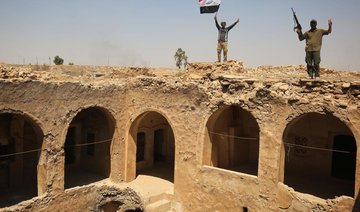
‘Gates of hell’ — Tal Afar fighting worse than Mosul: Iraqi Army

Smoke billows as Iraqi forces advance towards Al-Ayadieh village, the last remaining active front line near Tal Afar, during an operation to retake the city from Daesh group on Tuesday. (AFP)
Updated 31 August 2017
Follow

‘Gates of hell’ — Tal Afar fighting worse than Mosul: Iraqi Army

BAGHDAD: Iraqi forces battling to retake the small town of Al-Ayadiya, where militants fleeing Tal Afar have entrenched themselves, said on Tuesday the fighting is “multiple times worse” than the battle for Mosul’s Old City.
Hundreds of battle-hardened fighters were positioned inside most houses and high buildings inside the town, making it difficult for government forces to make any progress, army officers told Reuters.
Iraqi government troops captured the town of Mosul from Daesh in July, but only after nine months of grinding urban warfare.
But one Iraqi officer, Col. Kareem Al-Lami, described breaching the militants’ first line of defense in Al-Ayadiya as like opening “the gates of hell.”
Iraqi forces have in recent days recaptured almost all of the northwestern city of Tal Afar, long a stronghold of Daesh. They have been waiting to take Al-Ayadiya, just 11 km northwest of the city, before declaring complete victory.
Tough resistance from the militants in Al-Ayadiya has forced the Iraqi forces to increase the number of airstrikes, as well as bring in reinforcements from the federal police to boost units from the army, air force, the elite US-trained Counter-Terrorism Service (CTS) and some units from the Shiite Popular Mobilization Forces (PMF).
Up to 2,000 battle-hardened militants were believed to be defending Tal Afar against around 50,000 government troops last week.
Military intelligence indicated that many militants fled Tal Afar to mount a staunch defense in Al-Ayadiya. Many motorcycles carrying the Daesh insignia were seen abandoned at the side of the road outside Al-Ayadiya.
Though the exact numbers of militants on the ground in Al-Ayadiya were still unclear, Al-Lami, the Iraqi Army colonel, estimated they were in their “hundreds.”
“Daesh fighters in their hundreds are taking positions inside almost every single house in the town,” he said.
Sniper shots, mortars, heavy machine guns and anti-armored projectiles were fired from every single house, he added.
“We thought the battle for Mosul’s Old City was tough, but this one proved to be multiple times worse,” Al-Lami said. “We are facing tough fighters who have nothing to lose and are ready to die.”
Two army officers told Reuters that no significant advances had yet been made in Al-Ayadiya. They said they were waiting for artillery and airstrikes to undermine the militants’ power.
The extra federal police troops who were called in said late on Tuesday controlled 50 percent of the town, deploying snipers on the high buildings and intensifying shelling of the militants’ headquarters with rockets.
Tal Afar became the next target of the US-backed war on the terrorist group following the recapture of Mosul, where it had declared its “caliphate” over parts of Iraq and Syria in 2014.


Washington presses Syria to shift from Chinese telecom systems

Updated 26 February 2026
Follow

Washington presses Syria to shift from Chinese telecom systems

  • Syria is exploring the possibility of procuring Chinese technology
  • It was unclear whether the United States ⁠pledged financial or logistical support to Syria to do so

DAMASCUS: The United States has warned Syria against relying on Chinese technology in its telecommunications sector, arguing it conflicts with US interests and threatens US national security, according to three sources familiar with the matter.
The message was conveyed during an unreported meeting between a US State Department team and Syrian Communications Minister Abdulsalam Haykal in San Francisco on Tuesday. Washington has been coordinating closely with Damascus since 2024, when Syria’s now President Ahmed Al-Sharaa ousted longtime leader Bashar Assad, who had a strategic partnership with China.
Syria is exploring the possibility of procuring Chinese technology to support its telecommunications towers and the infrastructure of local Internet service providers, according to a Syrian businessman involved in the procurement talks.
“The US side asked for clarity on the ministry’s plans regarding Chinese telecom equipment,” said ⁠another source briefed on ⁠the talks.
But Syrian officials said infrastructure development projects were time-critical and that Damascus was seeking greater vendor diversity, the source added.
SYRIAN OFFICIALS CITE US EXPORT CONTROLS AS TELECOMS BARRIER
Syria is open to partnering with US firms but the matter was urgent and export controls and “over-compliance” remained an issue, according to person familiar with the meeting in San Francisco.
A US diplomat familiar with the discussions told Reuters that the US State Department “clearly urged Syrians to use American technology or technology from allied countries in the telecoms sector.”
It was unclear whether the United States ⁠pledged financial or logistical support to Syria to do so.
Responding to Reuters questions, a US State Department spokesperson said: “We urge countries to prioritize national security and privacy over lower-priced equipment and services in all critical infrastructure procurement. If it seems too good to be true, it probably is.”
The spokesperson added that Chinese intelligence and security services “can legally compel Chinese citizens and companies to share sensitive data or grant unauthorized access to their customers’ systems” and promises by Chinese companies to protect customers’ privacy were “entirely inconsistent with China’s own laws and well-established practices.”
China has repeatedly rejected allegations of it using technology for spying purposes.
The Syrian Ministry of telecommunications told Reuters any decisions related to equipment and infrastructure are made “in accordance with national technical and security standards, ensuring data protection and service continuity.”
The ministry said it is also prioritizing the diversification of partnerships and technology sources to ⁠serve the national interest.
Syria’s telecom ⁠infrastructure has relied heavily on Chinese technology due to US sanctions imposed on successive Assad governments over the civil war that grew from a crackdown on anti-government protests in 2011.
Huawei technology accounts for more than 50 percent of the infrastructure of Syriatel and MTN, the country’s only telecom operators, according to a senior source at one of the companies and documents reviewed by Reuters. Huawei did not immediately respond to a request for comment.
Syria is seeking to develop its private telecommunications sector, devastated by 14 years of war, by attracting foreign investment.
In early February, Saudi Arabia’s largest telecom operator, STC, announced it would invest $800 million to “strengthen telecommunications infrastructure and connect Syria regionally and internationally through a fiber-optic network extending over 4,500 kilometers.”
The ministry of telecommunications says that US restrictions “hinder the availability of many American technologies and services in the Syrian market,” emphasizing that it welcomes expanding cooperation with US companies when these restrictions are lifted.
Syria has inadequate telecommunications infrastructure, with network coverage weak outside city centers and connection speeds in many areas barely exceeding a few kilobits per second.