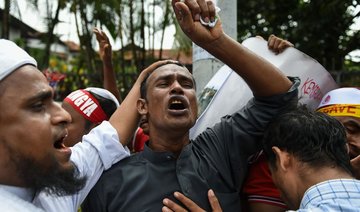
270,000 Rohingya refugees in Bangladesh: UNHCR

Persecuted in Myanmar, Rohingya refugees continue to pour into Bangladesh. (AN photo)
Updated 09 September 2017
Follow

270,000 Rohingya refugees in Bangladesh: UNHCR

COX’S BAZAR, Bangladesh: Nearly 270,000 Rohingya have fled Myanmar’s Rakhine state for Bangladesh over the past two weeks, the UN High Commissioner for Refugees (UNHCR) said Friday. Unofficial sources put the figure at more than 300,000.
“The two refugee camps in Cox’s Bazar in southeast Bangladesh — home to nearly 34,000 Rohingya refugees before this influx — are now bursting at the seams,” the UNHCR said.
“The population has more than doubled in two weeks, totaling more than 70,000. There is an urgent need for more land and shelters.” The UN has so far allocated $8 million in humanitarian aid for the refugees.
Despite local and international agencies operating in Cox’s Bazar, there is not enough humanitarian aid to meet the needs of so many refugees, most of whom are women and children.
“They’re in acute crisis regarding basic food, medicine and sanitation,” a local Red Cross volunteer told Arab News on condition of anonymity.
The International Organization for Migration (IOM) and other aid agencies are providing more mobile medical units, in addition to their regular health care services, to cope with the recent refugee influx.
Many Rohingya have entered Bangladesh in recent days by crossing the River Naf on small fishing boats, 11 of which have capsized. Bangladeshi authorities recovered 88 bodies in the last 10 days.
“It has been raining all day, and my fellow Rohingya are facing this hardship under the open sky,” Abul Hashem, who is in charge of one of the refugee camps, told Arab News.
“Today we received a huge number of Rohingya from Rakhine. All of them walked for 13 or 14 days to reach here to save their lives,” he said.
“We’d only received Rohingya from Mogdu Thana, but now we’re receiving refugees from Buchidang Thana as well. Since it’s a little further from Bangladesh, they need to walk longer.”
Among the crowd at the Teknaf border crossing, Sofuda Begum was looking for her husband along with her 11-year-old daughter Monowara while holding her 14-day-old baby.
She fled the village of Sofurdia Bari in Rakhine just after giving birth. She believes that her husband Solaiman is somewhere in Bangladesh, but she does not know exactly where.
“Here I don’t know anyone. How will I find Solaiman? How can I manage to get food for the three of us?” Begum told Arab News.
“I managed to escape from Myanmar with the help of my neighbors, but how long will they look after me? Everyone is struggling to survive.”


New US military-led group aided Mexico’s hunt for ‘El Mencho’ cartel boss

Updated 3 sec ago
Follow

New US military-led group aided Mexico’s hunt for ‘El Mencho’ cartel boss

  • Ex-official ‌says US gave Mexico detailed target package
  • Mexico planned, executed raid, Mexican official says
WASHINGTON: A new US-military-led task force specializing in intelligence collection on drug cartels played a role in the Mexican military raid on Sunday that killed the Mexican drug lord known as ‘El Mencho,’ ​a US defense official told Reuters. The Joint Interagency Task Force-Counter Cartel, which involves multiple US government agencies, was formally launched last month with the goal of mapping out networks of drug cartel members on both sides of the US-Mexico border, US officials said.
The US official, who spoke to Reuters on condition of anonymity, did not offer further details on any information that the US-military-led task force may have offered Mexican authorities. The official stressed the raid itself was a Mexican military operation.
A former US official, speaking on condition of anonymity without referring specifically to the task force, said the US compiled a detailed target package for El Mencho and provided it to the Mexican government for its operation.
This detailed dossier included information provided by US law enforcement, US intelligence, the former ‌official said.
The former official ‌added El Mencho was very high, if not at the top, of a ​list ‌of US ⁠targets in ​Mexico.
Mexican ⁠authorities killed drug lord Nemesio Oseguera, commonly known as ‘El Mencho,’ during an operation designed to capture him in the western state of Jalisco. The operation set off a wave of violence, with torched cars and gunmen blocking highways in more than half a dozen states.
Mexico’s defense ministry said US authorities had provided “complementary information,” but offered no details. A Mexican government source familiar with the operation said the Mexican government designed and executed it, and that no US military personnel were physically involved.
An ex-police officer, Oseguera, 60, was the shadowy leader of the powerful Jalisco New Generation Cartel (CJNG), an international criminal enterprise widely viewed as one of Mexico’s most powerful. He managed to evade arrest for ⁠years despite a $15 million bounty from the US for information leading to his arrest or capture.
The kingpin’s ‌killing notches a major victory for Mexico’s war on drug cartels that are ‌responsible for smuggling billions of dollars in cocaine and fentanyl into the US
President ​Donald Trump’s administration has waged a pressure campaign on Mexican President ‌Claudia Sheinbaum’s government to ramp up its crackdown on drug trafficking, including US threats to intervene directly in Mexico.

US MAPPING OUT ‌CARTELS
There is little information publicly available about the US Joint Interagency Task Force-Counter Cartel, or JITF-CC. Its website says its goal is to “identify, disrupt, and dismantle cartel operations posing a threat to the United States along the US-Mexico border.”
US Brig. Gen. Maurizio Calabrese, who leads the task force, spoke to Reuters this month about how the US military is channeling its experience battling groups like Al-Qaeda and Islamic State to map out cartel ‌networks.
“The cartels operate differently than Al-Qaeda or Daesh, different motivations, which makes it even more important for us to identify entire networks so that we can disrupt and dismantle (them),” ⁠Calabrese told Reuters, using an ⁠acronym for Islamic State.
Calabrese noted that estimates vary widely but said there were possibly a few hundred core cartel members “at the top.”
“But then you have anywhere from 200,000 to 250,000 independent contractors that will help you move these drugs,” Calabrese said.
Jack Riley, a former senior official at the Drug Enforcement Administration, said Trump’s designation of Mexican cartels as terrorist organizations last year
unlocked new kinds of US military assistance.
He said that could be helpful when it comes to US military intelligence, surveillance and reconnaissance resources.
“Our surveillance capabilities are going to be probably unlimited, and that will really help with real-time stuff,” Riley told Reuters.
“But these guys are extremely astute at being able to cover their tracks, cover who’s in charge and where those people are.”
A second US defense official, speaking to Reuters ahead of the Mexican operation, said the new task force fit into a broader US strategy to combat drug trafficking that has seen the US military take increasing operational control of the border with Mexico.
It also includes now-regular US strikes on suspected drug boats in ​Caribbean and Pacific waters, the legality of which has been ​challenged by Democratic lawmakers and legal experts.
“The whole idea of creating an interagency effort is to not have stray voltage, is to bring it all together, synchronize it,” the second official said of the task force.