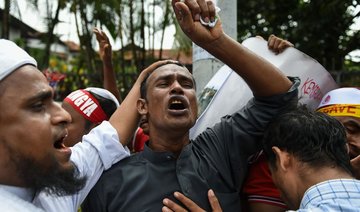
COX’S BAZAR, Bangladesh: Nearly 270,000 Rohingya have fled Myanmar’s Rakhine state for Bangladesh over the past two weeks, the UN High Commissioner for Refugees (UNHCR) said Friday. Unofficial sources put the figure at more than 300,000.
“The two refugee camps in Cox’s Bazar in southeast Bangladesh — home to nearly 34,000 Rohingya refugees before this influx — are now bursting at the seams,” the UNHCR said.
“The population has more than doubled in two weeks, totaling more than 70,000. There is an urgent need for more land and shelters.” The UN has so far allocated $8 million in humanitarian aid for the refugees.
Despite local and international agencies operating in Cox’s Bazar, there is not enough humanitarian aid to meet the needs of so many refugees, most of whom are women and children.
“They’re in acute crisis regarding basic food, medicine and sanitation,” a local Red Cross volunteer told Arab News on condition of anonymity.
The International Organization for Migration (IOM) and other aid agencies are providing more mobile medical units, in addition to their regular health care services, to cope with the recent refugee influx.
Many Rohingya have entered Bangladesh in recent days by crossing the River Naf on small fishing boats, 11 of which have capsized. Bangladeshi authorities recovered 88 bodies in the last 10 days.
“It has been raining all day, and my fellow Rohingya are facing this hardship under the open sky,” Abul Hashem, who is in charge of one of the refugee camps, told Arab News.
“Today we received a huge number of Rohingya from Rakhine. All of them walked for 13 or 14 days to reach here to save their lives,” he said.
“We’d only received Rohingya from Mogdu Thana, but now we’re receiving refugees from Buchidang Thana as well. Since it’s a little further from Bangladesh, they need to walk longer.”
Among the crowd at the Teknaf border crossing, Sofuda Begum was looking for her husband along with her 11-year-old daughter Monowara while holding her 14-day-old baby.
She fled the village of Sofurdia Bari in Rakhine just after giving birth. She believes that her husband Solaiman is somewhere in Bangladesh, but she does not know exactly where.
“Here I don’t know anyone. How will I find Solaiman? How can I manage to get food for the three of us?” Begum told Arab News.
“I managed to escape from Myanmar with the help of my neighbors, but how long will they look after me? Everyone is struggling to survive.”


![]()

270,000 Rohingya refugees in Bangladesh: UNHCR
270,000 Rohingya refugees in Bangladesh: UNHCR

Latest updates


Recommended


© 2026 SAUDI RESEARCH & PUBLISHING COMPANY, All Rights Reserved And subject to Terms of Use Agreement.