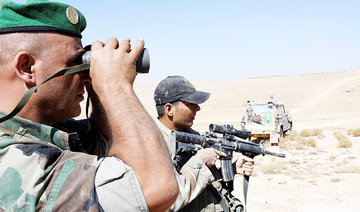
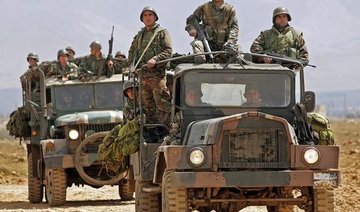
BEIRUT: Lebanon held a day of national mourning on Friday in tribute to nine soldiers killed by Daesh terrorists three years ago. A tenth solider, recently killed in an ambush near the Lebanese-Syrian border, was also remembered at the ceremony.
The 10 soldiers honored on Friday were: Ibrahim Mgheit, Ali Masri, Mustafa Wehbe, Seif Zabyan, Mohammed Youssef, Khaled Hassan, Hussein Ammar, Ali Hajj Hassan, Abbas Medlej and Yehya Ali Khoder.
The ceremony was held at the Defense Ministry in Beirut. In tribute to the martyrs, serving soldiers repeated three times, “We will never forget you.”
The soldiers were awarded Lebanon’s highest posthumous medals by Lebanese President Michel Aoun. Their families were handed the Lebanese flag by Army Commander Gen. Joseph Aoun.
The farewell ceremony was attended by President Michel Aoun; Speaker of the Parliament Nabih Berri; Prime Minister Saad Hariri; a large number of valiant serving soldiers, representatives of the heads of communities, diplomats and families of the martyrs.
Interior Minister Nohad Al-Mashnouq was not present at the ceremony because the families of the deceased soldiers had accused him of “being behind their sons’ executions, when he stormed Roumieh prison, a year after the abduction of the soldiers, which provoked Daesh militants at the time.”
Addressing the soldiers’ families, President Michel Aoun said: “The blood of your sons was not shed in vain and the goals they died for will be attained and the truth will be unveiled.” He stressed the necessity of “national unity.”
“We will surely triumph over terrorism, and we are aware of the sleeping terrorist cells that will try to retaliate after their defeat; we will remain vigilant,” said Gen. Joseph Aoun in his speech.
“We are fully committed to all provisions of Resolution 1701 and we will cooperate with the UNIFIL to maintain the stability of the southern borders,” he added.
The convoy transporting the coffins of the Lebanese soldiers passed by the families’ tent in Riad Al-Solh Square where relatives of the soldiers have held a sit-in for the past three years. They had demanded to know the fate of their loved ones. Mourners threw rice and flowers at the procession as it passed on its way to the North, to Bekaa and Shouf regions.
“It is a moment of dignity,” said Hussein Youssef, father of soldier Mohammed, and unofficial spokesman for the soldiers’ families.
President Aoun later chaired the Higher Defense Council’s meeting at Baabda Presidential Palace where measures to be taken by the army to deploy troops on the eastern borders were discussed. The meeting also discussed proposals to improve logistics and military supplies as soon as possible.
The Council issued a statement urging “all security forces to remain vigilant in case of retaliatory operations which might destabilize the country.”
The Council delegated Foreign Minister Gebran Bassil to submit to the UN Security Council a list of Israeli violations, including the use of Lebanese airspace for direct strikes on Syria.

Lebanon holds day of national mourning for fallen soldiers
Israel agrees to reopen Rafah crossing only for Gaza pedestrians
- The announcement came after visiting US envoys reportedly pressed Israeli officials to reopen the crossing, a vital entry point for aid into Gaza
JERUSALEM: Israel said Monday it would only allow pedestrians to travel through the Rafah crossing between Gaza and Egypt as part of its “limited reopening” once it has recovered the remains of the last hostage in the Palestinian territory.
Reopening Rafah, a vital entry point for aid into Gaza, forms part of a truce framework announced by US President Donald Trump in October, but the crossing has remained closed since Israeli forces took control of it during the war in the Palestinian territory.
Visiting US envoys had reportedly pressed Israeli officials to reopen the crossing during talks in Jerusalem over the weekend.
World leaders and aid agencies have repeatedly pushed for more humanitarian convoys to be able to access Gaza, which has been left devastated by more than two years of war and depends on the inflow of essential medical equipment, food and other supplies.
Prime Minister Benjamin Netanyahu’s office said on Monday that Israel had agreed to a reopening “for pedestrian passage only, subject to a full Israeli inspection mechanism.”
The move would depend on “the return of all living hostages and a 100 percent effort by Hamas to locate and return all deceased hostages,” it said on X.
It remained unclear whether the reopening would allow medical patients to leave Gaza for treatment in Egypt or other countries.
The Israeli military said it was searching a cemetery in the Gaza Strip on Sunday for the remains of the last hostage, Ran Gvili.
“Upon completion of this operation, and in accordance with what has been agreed upon with the US, Israel will open the Rafah Crossing,” said Netanyahu’s office.
The announcement came after Gaza’s newly appointed administrator, Ali Shaath, said the crossing would open “in both directions” this week.
“For Palestinians in Gaza, Rafah is more than a gate, it is a lifeline and a symbol of opportunity,” Shaath said at the World Economic Forum in Davos on Thursday.
Israeli media had also reported that US envoys Steve Witkoff and Jared Kushner had urged Netanyahu to reopen Rafah during their Jerusalem talks.
Before the war erupted in October 2023, Rafah had been the only gateway connecting Gazans to the outside world and enabling international humanitarian aid to enter the territory, home to 2.2 million people living under Israeli blockade.
Last hostage
A spokesman for Hamas’s Ezzedine Al-Qassam Brigades, Abu Obeida, said on Sunday that the group had “provided mediators with all the details and information in our possession regarding the location of the captive’s body,” referring to Gvili.
Obeida added that “the enemy (Israel) is currently searching one of the sites based on information transmitted by the Al-Qassam Brigades.”
Except for Gvili, all of the 251 people taken hostage during Hamas’s October 7, 2023 attack on Israel have since been returned, whether living or dead.
A non-commissioned officer in the Israeli police’s elite Yassam unit, Gvili was killed in action on the day of the attack and his body was taken to Gaza.
The first phase of the US-backed ceasefire deal had stipulated that Hamas hand over all the hostages in Gaza.
Gvili’s family has expressed strong opposition to launching the second phase of the plan, which includes reopening Rafah, before they have received his remains.
“First and foremost, Ran must be brought home,” his family said in a statement on Sunday.
The Gaza war was sparked by Hamas’s October 7, 2023 attack on Israel, which resulted in the deaths of 1,221 people, according to an AFP tally based on official Israeli figures.
The Israeli retaliation flattened much of Gaza, a territory that was already suffering severely from previous rounds of fighting and from an Israeli blockade imposed since 2007.
The two-year war between Israel and Hamas has left at least 71,657 people dead in Gaza, according to the territory’s health ministry, figures considered reliable by the United Nations.