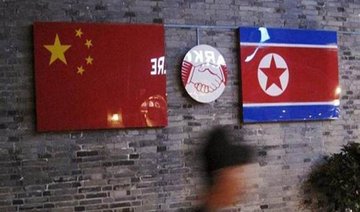
BEIJING/VLADIVOSTOK: China said on Thursday it agreed the UN should take more action against North Korea after its latest nuclear test, while pushing for more dialogue to resolve the crisis on the Korean peninsula.
North Korea said it would respond to any UN sanctions and US pressure with “powerful counter measures,” accusing the US of aiming to start a war.
The United States wants the UN Security Council to impose an oil embargo on North Korea, ban its exports of textiles and the hiring of North Korean laborers abroad, and to subject leader Kim Jong Un to an asset freeze and travel ban, according to a draft resolution seen by Reuters on Wednesday.
Pressure from Washington has ratcheted up since North Korea conducted its sixth and largest nuclear test on Sunday. That test, along with a series of missile launches, showed it was close to achieving its goal of developing a powerful nuclear weapon that could reach the US.
“We will respond to the barbaric plotting around sanctions and pressure by the United States with powerful counter measures of our own,” North Korea said in a statement by its delegation to an economic forum in Vladivostok, in Russia’s Far East.
US President Donald Trump has urged China to do more to rein in its neighbor, which has pursued its weapons programs in defiance of UN sanctions and international condemnation.
“Given the new developments on the Korean peninsula, China agrees that the UN Security Council should make a further response and take necessary measures,” Chinese Foreign Minister Wang Yi told reporters on Thursday, without elaborating.
“Any new actions taken by the international community against the DPRK should serve the purpose of curbing the DPRK’s nuclear and missile programs, while at the same time be conducive to restarting dialogue and consultation,” he said, referring to North Korea by the initials of its official name, the Democratic People’s Republic of Korea.
China is by far North Korea’s biggest trading partner, accounting for 92 percent of two-way trade last year. It also provides hundreds of thousands of tons of oil and fuel to the impoverished regime.
US Treasury Secretary Steve Mnuchin said he had an executive order ready for Trump to sign that would impose sanctions on any country that trades with North Korea, if the UN does not put impose new sanctions on it.
Amid the rising tension, South Korea installed the four remaining launchers of a US anti-missile Terminal High Altitude Area Defense (THAAD) system on a former golf course south of its capital, Seoul, early on Thursday. Two launchers had already been deployed.
More than 30 people were hurt when about 8,000 police broke up a blockade near the site by about 300 villagers and members of civic groups opposed to the THAAD deployment, fire officials said.
The decision to deploy it has drawn strong objections from China, which believes the system’s radar could be used to look deeply into its territory and will upset the regional security balance.
China lodged another stern protest over the THAAD deployment on Thursday.
“We again urge South Korea and the United States to take seriously China’s and regional nations’ security interests and concerns, stop the relevant deployment progress, and remove the relevant equipment,” Foreign Ministry spokesman Geng Shuang told a regular media briefing.
Japanese Prime Minister Shinzo Abe and South Korean President Moon Jae-in spoke at the regional meeting in Vladivostok and agreed to try to persuade China and Russia to cut off oil to North Korea as much as possible, according to South Korean officials.
North Korea accused South Korea and Japan of “dirty politics” for what it said was the highjacking a meeting meant to be about economic development.
Russian President Vladimir Putin said at the meeting he thought the North Korea crisis would not escalate into nuclear war, predicting that common sense would prevail.
But he said he believed North Korea’s leadership feared that any freeze of its nuclear program would be followed by what amounted to “an invitation to the cemetery.”
North Korea says it needs its weapons to protect itself from US aggression.
South Korea and the US are technically still at war with North Korea after the 1950-53 Korean conflict ended with a truce, not a peace treaty.
China and Russia have advocated a “freeze for freeze” plan, under which the US and South Korea would stop major military exercises in exchange for North Korea halting its weapons programs.
But neither side appears willing to budge.
South Korean Marines wrapped up a three-day firing drill aimed at protecting its islands just south of the border with North Korea, while the air force will finish up a week-long drill on Friday.


![]()

China agrees more UN actions needed against North Korea after nuclear test
China agrees more UN actions needed against North Korea after nuclear test

Latest updates






© 2026 SAUDI RESEARCH & PUBLISHING COMPANY, All Rights Reserved And subject to Terms of Use Agreement.