YANGON, Myanmar: Rohingya Muslims are once more fleeing in droves into Bangladesh, trying to escape the latest surge in violence in Rakhine state between a shadowy militant group and Myanmar’s military.
It is the newest chapter in the grim recent history of the Rohingya, a people of about one million reviled in Myanmar as illegal immigrants and denied citizenship.
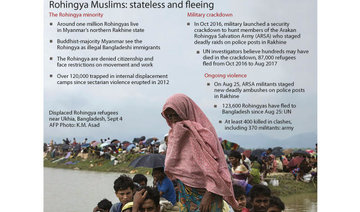
This is a fact box on them:
The Rohingya are the world’s largest stateless community and of one of its most persecuted minorities.
Using a dialect similar to that spoken in Chittagong in southeast Bangladesh, the Sunni Muslims are loathed by many in majority-Buddhist Myanmar who see them as illegal immigrants and call them “Bengali” — even though many have lived in Myanmar for generations.
They are not officially recognized as an ethnic group, partly due to a 1982 law stipulating that minorities must prove they lived in Myanmar prior to 1823 — before the first Anglo-Burmese war — to obtain nationality.
Most live in the impoverished western state of Rakhine but are denied citizenship and harassed by restrictions on movement and work.
More than half a million also live in Bangladeshi camps, although Dhaka only recognizes a small portion as refugees.
Sectarian violence between the Rohingya and local Buddhist communities broke out in 2012, leaving more than 100 dead and the state segregated along religious lines.
More than 120,000 Rohingya fled over the following five years to Bangladesh and Southeast Asia, often braving perilous sea journeys controlled by brutal trafficking gangs.
Then last October things got much worse.
Despite decades of persecution, the Rohingya largely eschewed violence.
But in October a small and previously unknown militant group — the Arakan Rohingya Salvation Army (ARSA) — staged a series of well coordinated and deadly attacks on security forces.
Myanmar’s military responded with a massive security crackdown that UN investigators said unleashed “devastating cruelty” on the Rohingya that may amount to ethnic cleansing.
More than 250,000 new refugees have since flooded into Bangladesh bringing with them harrowing stories of murder, rape and burned villages.
A majority of those arrivals — 164,000 — have come in the past 12 days in the aftermath of a new series of ARSA ambushes and a subsequent Myanmar army crackdown.
Some 27,000 ethnic Rakhine Buddhists have also fled in the opposite direction saying Rohingya militants have murdered members of their community.
De facto leader Aung San Suu Kyi has faced widespread criticism for her stance on the Rohingya.
Her administration has dismissed concerns about rights abuses and refused to grant visas to UN officials tasked with investigating such allegations.
On Wednesday she said sympathy for the Rohingya was being generated by a “huge iceberg of misinformation.”
Analysts say Suu Kyi is hampered by the politically incendiary nature of the issue in Myanmar and the fact she has little control over the military.
Hatred toward the Rohingya is profound, particularly among Myanmar’s Bamar majority, making speaking up for them a potentially politically suicidal move.
But detractors say Suu Kyi is one of the few people with the mass appeal and moral authority in Myanmar to swim against the tide on the issue.
In the short term aid agencies say they need a major international drive to provide for the huge influx of arrivals in Bangladesh’s already overstretched camps.
They have also been unable to distribute food aid in northern Rakhine since the fighting began.
Longer term solutions are even more problematic.
Suu Kyi’s government commissioned former UN chief Kofi Annan to lead a year-long review on how peace can be brought back to Rakhine.
It published its findings last month.
Among its recommendations was an end to the state-sanctioned persecution of the Rohingya and a path to citizenship for them, as well as an investment drive to alleviate poverty among both Muslims and Buddhists in Rakhine.
The report was widely welcomed internationally with calls for Myanmar’s government to swiftly implement its findings, which they have previously vowed to do.
But within hours of the report’s release, renewed fighting broke out sparking the latest exodus.


![]()

Myanmar’s Rohingya: stateless, persecuted and fleeing
Myanmar’s Rohingya: stateless, persecuted and fleeing


Latest updates


© 2026 SAUDI RESEARCH & PUBLISHING COMPANY, All Rights Reserved And subject to Terms of Use Agreement.