Philippine president’s son denies links to $125 million drug shipment

Davao City Vice Mayor Paolo Duterte (C), son of Philippine President Rodrigo Duterte, attends a senate hearing in Manila on September 7, 2017. (AFP)
Updated 07 September 2017
Follow

Philippine president’s son denies links to $125 million drug shipment

MANILA: Philippine President Rodrigo Duterte’s son on Thursday told a Senate inquiry he had no links to a seized shipment of $125 million worth of narcotics from China, dismissing as “baseless” the allegations of his involvement in the drugs trade.
Opponents of the president, who has instigated a fierce crackdown on a trade he says is destroying the country, say they believe his son Paolo may have helped ease the entry of the drug shipment at the port in Manila, the capital.
On Tuesday Duterte said he had told Paolo to attend the senate investigation if he had nothing to hide, besides advising him not to answer questions and invoke his right to keep silent.
“I cannot answer allegations based on hearsay,” Paolo Duterte, the vice mayor of the southern city of Davao, told the Senate.
“My presence here is for the Filipino people and for my fellow Davaoeños whom I serve,” he added, referring to the people of Davao, where his father served as mayor for more than two decades before being elected president in 2016.
The Philippine leader has repeatedly said he would resign if critics could prove any members of his family were involved in corruption.
Senator Antonio Trillanes, a staunch critic of the president, displayed to the Senate panel photographs of Paolo Duterte beside a businessman who was behind the shipment in which the alleged drugs were found.
The president’s son-in-law, Manases Carpio, who has also been accused of links to the May drug shipment from China, told the hearing he had no involvement.
Duterte unleashed his bloody campaign the day he took office on June 30 last year, after promising Filipinos he would use deadly force to wipe out crime and drugs.
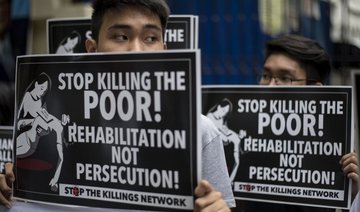
Police records show more than 3,800 people have died in police operations since July last year, and more than 2,100 other reported murders are linked to drugs.
Police reject activists’ allegations that they are executing suspected drug users and dealers and say officers shoot only in self-defense.
Trillanes said he had intelligence information from an undisclosed foreign country that Paolo Duterte was a member of a criminal syndicate, citing as proof a “dragon-like” tattoo with secret digits on his back.
Asked about the tattoo, Duterte said he had one, but declined to describe it, invoking his right to privacy.
Asked by Trillanes if he would allow a photograph to be taken of the tattoo and sent to the USDrug Enforcement Agency to decode secret digits, Duterte said: “No way.”
He refused to respond to questions about his bank accounts, calling them “irrelevant.”
Presidential spokesman Ernesto Abella said the attendance of Duterte and Carpio “demonstrates that both gentlemen are willing and ready to face malicious allegations intended to impugn their character and credibility.”


Trump says Australia will grant asylum to Iran women footballers

Team Iran listens to the national anthem before the AFC Women’s Asian Cup Australia 2026 football match.
Updated 57 min 43 sec ago
Follow

Trump says Australia will grant asylum to Iran women footballers

  • Presenter on Iranian state TV had branded the players “wartime traitors” after they stood motionless during the anthem

MIAMI: US President Donald Trump said Monday that Australia had agreed to grant asylum to some of Iran’s visiting women’s football team, amid fears they could face retaliation back home for not singing the national anthem before a match.
The gesture ahead of the team’s Asian Cup match against South Korea last week was seen by many as an act of defiance against the Islamic republic just two days after the United States and Israel attacked it.
“I just spoke to Prime Minister Anthony Albanese, of Australia, concerning the Iranian National Women’s Soccer Team. He’s on it! Five have already been taken care of,” Trump said Monday on his Truth Social network, less than two hours after an initial post urging Australia to take them in.
Trump added that “some, however, feel they must go back because they are worried about the safety of their families, including threats to those family members if they don’t return.”
There was no immediate comment from the Australian government, which has so far declined to say whether it could offer the players asylum.
Asked about their case on Sunday, Foreign Minister Penny Wong said Australia “stands in solidarity” with the people of Iran.
The son of Iran’s late shah, US-based Reza Pahlavi, warned on Monday that the refusal to sing the anthem could have “dire consequences,” and urged Australia to offer the team protection.
Trump then weighed in, pressing Albanese to “give ASYLUM” to the team and adding: “The US will take them if you won’t.”
“Australia is making a terrible humanitarian mistake by allowing the Iran National Woman’s Soccer team to be forced back to Iran, where they will most likely be killed,” the US leader said on Truth Social.
Pahlavi, who has not returned to Iran since before the 1979 Islamic revolution that ousted the monarchy, has billed himself as the man to lead a democratic transition to a secular Iran as the theocratic regime fights to survive.
Politicians, human rights activists and even “Harry Potter” author J.K. Rowling have also called for the team to be offered official protection.
“Please, protect these young women,” Rowling said in a post on social media.

‘Save our girls’ 

A presenter on Iranian state TV had branded the players “wartime traitors” after they stood motionless during the anthem before their match against South Korea.
In subsequent games, the players saluted and sang.
Crowds gathered outside the Gold Coast stadium where the side played their last match over the weekend, banging drums and shouting “regime change for Iran.”
They then surrounded the Iranian team bus, chanting “let them go” and “save our girls.”
On Monday, an AFP journalist saw members of the team speaking on phones from their balcony of their hotel.
Asked about the possibility of granted asylum, a spokesperson for Australia’s Home Affairs department told AFP earlier it “cannot comment on the circumstances of individuals.”
Amnesty International campaigner Zaki Haidari said they faced persecution, or worse, if they were sent home.
“Some of these team members probably have had their families already threatened,” Haidari told AFP.
“Them going back... who knows what sort of punishment they will receive?“
Despite being heavily monitored, the side would have a “small window of opportunity” to seek asylum at the airport, he said.
Iran’s embassy in Australia did not respond to a request for comment.