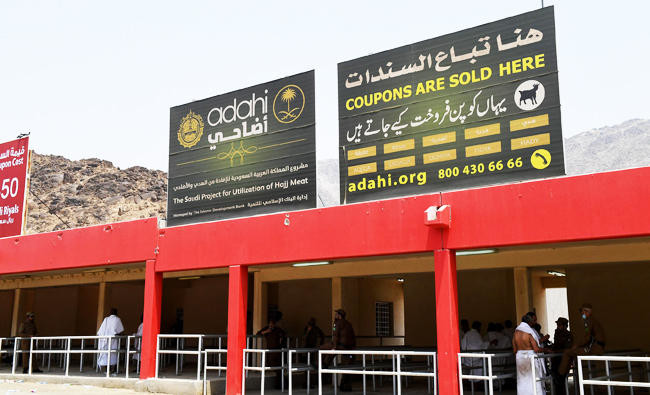
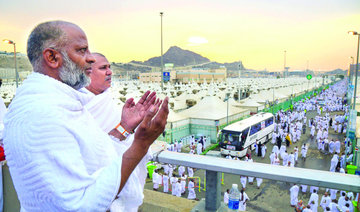
MAKKAH: Adahi is a Saudi Arabian project to distribute Hajj meat to over 30 million people in 27 different countries in Asia and Africa.
During previous Hajj seasons, people used to freeze and ship the excess meat from lamb sacrifices to their countries.
The abundance of meat during Hajj became a problem over the years. Pilgrims could not eat all the sacrificed meat and it was left on the streets, causing a sanitation crisis, bad smells and disease. The authorities then would bury the meat.
Saudi scholar Saeed Al-Amoudi told Al-Hayat that the increase of pollution caused by the lamb sacrifices led the Kingdom to take the first initiative in 1983 to avoid such waste and to help the poor. The Kingdom assigned the Islamic Development Bank (IDB) to manage the project along with Saudi government authorities.
In 2000, the Adahi project was developed, with over 40,000 employees working in different fields such as management, supervision, slaughtering, shipping and distribution. Every year, 30,000 lambs, cows and camels are slaughtered to be distributed to 30 million poor people and refugees in 27 different countries in Asia and Africa.
A center for treating the excess meat was also established. The center is capable of processing 500 tons of waste per day and turning it into natural fertilizers, separated from the extracted fat that can be used in factories. Thus, the center is able to get rid of the excess meat in an eight-day period following the Hajj.
This unique project emphasizes the creative ideology of turning problems into innovative solutions, and stresses the efforts of the Kingdom to provide a better life for the less fortunate.

Saudi’s Adahi project delivers sacrificial meat to 30m needy people in 27 countries
Outdoor festival brings new energy to Ithra
- Inaugural Food Festival offers workshops and diverse cuisine with a relaxed vibe
DHAHRAN: The King Abdulaziz Center for World Culture, or Ithra, launched its inaugural outdoor Food Festival on Monday, turning part of its grounds into a lively culinary space in view of the iconic building.
Music, laughter and the smell of cooking fill the area, guiding visitors toward the festival site.
The festival program includes four specialized cooking workshops — taco, pizza, steak and sushi — each running for three days and powered by Filmmaster. While registration is required to participate, visitors can watch the chefs prepare dishes in the open-air kitchen.
Beyond the workshops, visitors can explore 10 food stations offering a range of cuisines, including Saudi, Indian, Egyptian, Mexican, Japanese and Lebanese.
HIGHLIGHTS
• The Food Festival program includes four specialized cooking workshops — taco, pizza, steak and sushi — each running for three days and powered by Filmmaster.
• While registration is required to participate, visitors can watch the chefs prepare dishes in the open-air kitchen
One such booth is Whoa Tea & Desserts, which was bubbling with excitement on opening night. Its founder, Liu Yang, who also goes by the name of Edwin, told Arab News why his business chose to participate.
“I found the Saudi market is very good and they have so many young people here, so me and my two friends we decided to resign and we started a business here targeting the young people,” he told Arab News.
The Chinese entrepreneur has now lived in Saudi Arabia for more than four years, spending the first half of that time working for a Chinese company before deciding to branch out.
The company brought their own brand of Chinese milk tea, fruity and matcha drinks as well as an assortment of snacks, and even board games, to their shop.
“Now we, in two years, have more than 10 branches in Riyadh and we decided to come to Alkhobar, so soon we will have three shops here which will open in the Eastern Province; one at the end of January and two in February,” he added.
Since they are opening locally next month, the festival was the perfect way to introduce their products for customers to sample.
Ekin, who moved to Saudi Arabia last year from the US, told Arab News why she chose to bring her family, which included two young children under 10, to the festival.
“We are members at Ithra, we love Ithra. So that is why we trusted that this event was going to be a success,” she told Arab News.
“This is the perfect weather — I love the outdoors eating option. It’s also spacious; there are picnic tables. I think the variety makes it even better because you don’t have to wait in the line for a long time to just grab food,” she said.
The festival is set to end on Jan. 3.