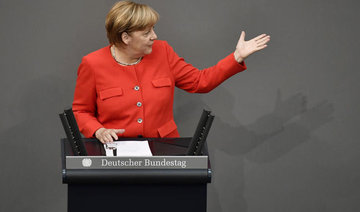
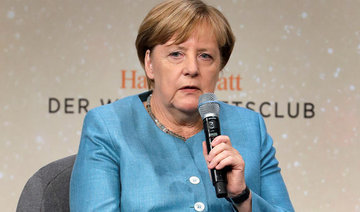
BERLIN: Chancellor Angela Merkel warned German voters on Wednesday not to risk allowing an untested left-wing alliance to take power after this month’s national election, urging them to stick with her in “turbulent times.”
Less than three weeks before the Sept. 24 vote, politicians and media in Germany are turning their attention to the possible coalitions that could form after the election, from which no single party is expected to emerge with a clear majority.
Merkel, 63, leads a “grand coalition” of her conservatives and the left-leaning Social Democrats (SPD) — a tie-up neither wants to repeat after the vote. Seeking a fourth term, Merkel is stressing her credentials as a global stateswoman.
“Our country can’t afford experiments — especially in these turbulent times,” she told a rally in Torgau, some 70 miles (120 km) south of Berlin in the state of Saxony.
Merkel spoke above a cacophony of jeers and whistles from some protesters — a feature at many of her rallies as resentment persists at her decision in 2015 to open Germany’s borders to hundreds of thousands of refugees fleeing war in Syria and Iraq.
That decision helped the rise of the anti-immigrant Alternative for Germany (AfD) party, which punished her conservatives in regional votes last year.
She has since bounced back, but the national election is likely to return a more fractured parliament due to the rise of the AfD — set to enter the Bundestag for the first time — and the expected return of the pro-business Free Democrats (FDP).
This could make coalitions harder to form.
Merkel wants to avoid being outflanked by a coalition of the SPD, the far-left Linke and the environmentalist Greens, who have held exploratory talks about the possibility of joining forces in a so-called ‘Red-Red-Green’, or ‘R2G’, coalition.
“I say Red-Red-Green would be bad for our country,” she told the rally. “In the future too, we will need stability and security.”
In a televised debate with SPD leader Martin Schulz on Sunday, Merkel challenged him to rule out a coalition with the Linke party, which he refused to do.
A Red-Red-Green combination is untested at federal level, though the three parties have teamed up to take control of Berlin’s city government.
An opinion poll released on Wednesday put support for Merkel’s conservatives at 38.5 percent, ahead of the SPD on 24 percent. The Greens were on 7.5 percent, the Free Democrats on 10 percent and the Linke and the AfD each on 8 percent.
Resentment at Merkel’s open-door policy runs particularly high in eastern Germany, but she has also been booed at rallies in the west — such as in Ludwigshafen, 45 miles (70 km) south of Frankfurt, last week.
“We are Germans. She needs to be taking care of us,” Vincent Raap, an 18-year-old starting an apprenticeship as a machine operator, said at the Ludwigshafen rally.
“Three times, an apprenticeship for which I had applied was given to foreigners instead,” he said, holding a sign saying “Merkel must go.”


![]()

Germany’s Merkel tells voters: ‘Don’t experiment’ with the left
Germany’s Merkel tells voters: ‘Don’t experiment’ with the left
Latest updates


© 2026 SAUDI RESEARCH & PUBLISHING COMPANY, All Rights Reserved And subject to Terms of Use Agreement.