Germany is at a crossroads now, says Merkel

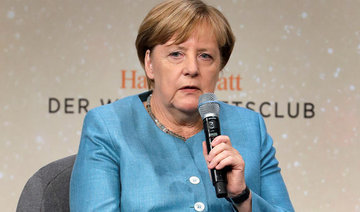
German Chancellor Angela Merkel delivers a speech in Berlin on Wednesday. (AFP)
Updated 05 September 2017
Follow

Germany is at a crossroads now, says Merkel

BERLIN: German Chancellor Angela Merkel highlighted her government’s economic achievements in a speech to Parliament Tuesday, positioning herself as the leader who can cope with rapidly changing technology as she seeks election to a fourth term later this month.
Merkel, whose conservative Christian Democratic Party (CDP) is currently leading in polls ahead of the national election on Sept. 24, listed a strong economy, low unemployment, and the introduction of a mandatory minimum wage as some of her administration’s achievements.
But she stressed that Germany is “at a crossroads now” especially in digital development and technological progress.
“We don’t want Germany to end in the museum of technology,” she told lawmakers , referring to the Berlin museum housing historical artifacts. The rest of the world “doesn’t sleep” when it comes to digitalization, she warned.
Pitching herself as the one who can deal with future challenges, she promised that if re-elected as chancellor, she would invest more money into research so that Germany would not fall behind on technological development.
Turning her attention to international affairs, Merkel condemned North Korea’s latest nuclear test as a “flagrant violation” of international conventions, but also said there can only be a “diplomatic and peaceful solution” of the crisis.
Merkel spoke by telephone Monday night with US President Donald Trump and South Korean President Moon Jae-in, expressing Germany’s support for tougher sanctions on North Korea, according to her office.
Turning to the issue of migration, Merkel said a summit between Europe and several African nations will be held later in the year, aimed at finding solutions to stem the flow of refugees by better addressing the causes that force people to flee.
Her speech came two days after the only televised live debate between Merkel and main challenger Martin Schulz of the center-left Social Democrats.
Merkel has been governing Germany in a coalition with the Social Democrats for the last four years. Both candidates have run lackluster campaigns, and Sunday’s debate was widely criticized because the two were seen as not being aggressive enough.
During the debate, both candidates refused to rule out continuing their current coalition at the national level after the election.


Canada PM Carney says can’t rule out military participation in Iran war

Updated 55 min 12 sec ago
Follow

Canada PM Carney says can’t rule out military participation in Iran war

  • Carney had said the US-Israeli strikes on Iran were “inconsistent with international law”
  • However, he supports the efforts to stop Iran from obtaining a nuclear weapon

CANBERRA, Australia: Canadian Prime Minister Mark Carney said Thursday that he couldn’t rule out his country’s military participation in the escalating war in the Middle East.
Carney’s visit to Australia this week has been overshadowed by expanding war in the Middle East, sparked by a massive US-Israeli strike on Iran that killed its supreme leader, Ayatollah Ali Khamenei.
Speaking alongside local counterpart Anthony Albanese in Canberra, Carney was asked whether there was a situation in which Canada would get involved.
“One can never categorically rule out participation,” he said, while stressing the question was a “hypothetical” one.
“We will stand by our allies,” said Carney, adding that “we will always defend Canadians.”
Carney had said the US-Israeli strikes on Iran were “inconsistent with international law.”
However, he supports the efforts to stop Iran from obtaining a nuclear weapon — a position that Canada takes “with regret” as it represented “another example of the failure of the international order.”
The Canadian leader reiterated on Thursday his call for a “de-escalation” of the conflict.
Carney’s trip is part of a multi-country tour of the Asia-Pacific aimed at reducing reliance on the United States — a hedge against what he has described as a fading US-led global order.
The Australia leg of the tour is aimed at bringing in investment and deepening ties with a like-minded “middle power” partner.

‘Middle power’ rallying cry

On Thursday morning he issued a rallying cry in Australia’s parliament to “middle powers,” urging them to work together in an increasingly hegemonic world order.
Nations like Australia and Canada faced a stark choice — work together to help write the “new rules” of the global order or have great powers do it for them, he said.
“In this brave new world, middle powers cannot simply build higher walls and retreat behind them. We must work together,” he said.
“Great powers can compel, but compulsion comes with costs, both reputational and financial,” the former central banker added.
“Middle powers like Australia and Canada hold this rare convening power because others know we mean what we say and we will match our values with our actions.”
The Canadian leader also said the two countries would together as “strategic collaborators” to pool their vast combined rare earth mineral resources.
And he detailed renewed cooperation in areas from defense to artificial intelligence.
“We know we must work with others who share our values to build solid capabilities,” he told parliament.
Otherwise, he warned, they risked being “caught between the hyperscalers and the hegemons.”
The Canadian leader has frequently clashed with US President Donald Trump, who has repeatedly threatened to annex Canada and slapped swingeing tariffs on the country.
In a speech to political and financial elites at the World Economic Forum in January, Carney warned the US?led global system of governance was enduring “a rupture.”