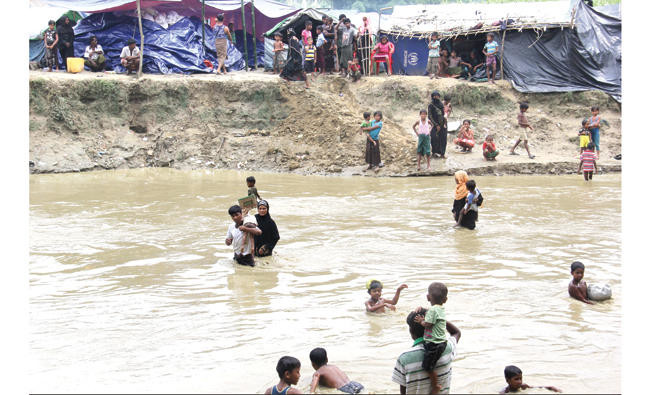
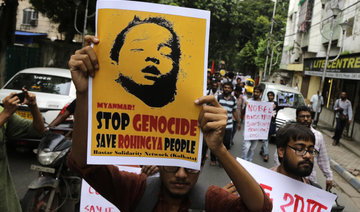
BANDARBAN, BANGLADESH: In front of them, border guards block entry to Bangladesh. Behind them, the Myanmar Army plants deadly land mines to prevent their return.
Bandarban is the exotic jewel in Bangladesh’s tourist crown. Today, it is a nightmare no-man’s land for 20,000 Rohingya desperate for food, water and medical help.
Shab-e-Meraj, 26, crossed the shallow Tombru river holding her two-month-old daughter Noor Kaida, who was suffering from fever. She sought help from the Medecins Sans Frontieres medical aid agency.
About 300 men and women, all thin and starving, waited in queues to see the MSF doctors.
Meraj used to live in the village of Raimmyakhali in Rakhine state in Myanmar. She said soldiers torched their homes with the help of Buddhist villagers. It took her three hours to walk to the border.
Her husband Mohammed Noor, a day laborer, fled here with nine members of his family when the bloodshed in Racine began. Now they survive mostly on dry food offered by villagers and local volunteers.
Meraj said: “There is no way I can return to that hell.”
For kilometers, as far as the eye can see, there are makeshift houses on the hilltops of this border area, where 20,000 Rohingya have been trapped for more than a week. “We are trying our level best to provide them with food and drinking water,” said local government official Jahangir Aziz. “This morning I have distributed 2kg of rice, lentils, onion etc for each family that took shelter in my district.”
However, food supplies in the village market had been exhausted because of the refugees, he said. “I am afraid of deterioration in the law and order situation. All the educational institutions are closed for Eid Al-Adha but classes will resume from tomorrow. I don’t know how the students will attend the classes. My whole area has turned into a dustbin.”
The local authorities have set up four tube wells to provide clean drinking water for the refugees, and several more are planned. A local philanthropist started work on providing 10 lavatories.
Small trucks carrying relief goods move through the narrow roads. Aid agency volunteers are trying to provide basic support, and Red Cross workers distribute drinking water in plastic bags, but they cannot cope with the demand.
The trapped Rohingya are among 150,000 who have fled Myanmar, according to AFP. Many are sleeping in the open air and are in dire need of food and water after walking for days to reach safety. “There is an urgent need for emergency shelters and for land to build these shelters on,” said Vivian Tan, spokeswoman for the UN refugee agency.
“These people have walked for days. Some of them haven't eaten for days since they left. They survived on rain water and groundwater.”
Bangladeshi rights campaigner Nur Khan Liton said a “massive humanitarian crisis” was unfolding. “People are staying in refugee camps, on the roads, school yards and under open sky. They are clearing forest to create new settlements. There is an acute crisis of water and food,” he said.

20,000 Rohingya in no-man’s land battle hunger, disease
Uganda partially restores internet after president wins 7th term
- “The internet shutdown implemented two days before the elections limited access to information, freedom of association, curtailed economic activities ... it also created suspicion and mistrust on the electoral process,” the team said in their report
KAMPALA: Ugandan authorities have partially restored internet services late after 81-year-old President Yoweri Museveni won a seventh term to extend his rule into a fifth decade with a landslide victory rejected by
the opposition.
Users reported being able to reconnect to the internet and some internet service providers sent out a message to customers saying the regulator had ordered them to restore services excluding social media.
“We have restored internet so that businesses that rely on internet can resume work,” David Birungi, spokesperson for Airtel Uganda, one of the country’s biggest telecom companies said. He added that the state communications regulator had ordered that social media remain shut down.
The state-run Uganda Communications Commission said it had cut off internet to curb “misinformation, disinformation, electoral fraud and related risks.” The opposition, however, criticized the move saying it was to cement control over the electoral process and guarantee a win for the incumbent.
The electoral body in the East African country on Saturday declared Museveni the winner of Thursday’s poll with 71.6 percent of the vote, while his rival pop star-turned-politician Bobi Wine was credited with 24 percent
of the vote.
A joint report from an election observer team from the African Union and other regional blocs criticized the involvement of the military in the election and the authorities’ decision to cut
off internet.
“The internet shutdown implemented two days before the elections limited access to information, freedom of association, curtailed economic activities ... it also created suspicion and mistrust on the electoral process,” the team said in their report.
In power since 1986 and currently Africa’s third longest-ruling head of state, Museveni’s latest win means he will have been in power for nearly half a century when his new term ends in 2031.
He is widely thought to be preparing his son, Muhoozi Kainerugaba, to take over from him. Kainerugaba is currently head of the military and has expressed presidential ambitions.
Wine, who was taking on Museveni for a second time, has rejected the results of the latest vote and alleged mass fraud during the election.
Scattered opposition protests broke out late on Saturday after results were announced, according to a witness and police.
In Magere, a suburb in Kampala’s north where Wine lives, a group of youths burned tires and erected barricades in the road prompting police to respond with tear gas.
Police spokesperson Racheal Kawala said the protests had been quashed and that arrests were made but said the number of those detained would be released later.
Wine’s whereabouts were unknown early on Sunday after he said in a post on X he had escaped a raid by the military on his home. People close to him said he remained at an undisclosed location in Uganda. Wine was briefly held under house arrest following the previous election in 2021.
Wine has said hundreds of his supporters were detained during the months leading up to the vote and that others have been tortured.
Government officials have denied those allegations and say those who have been detained have violated the law and will be put through due process.