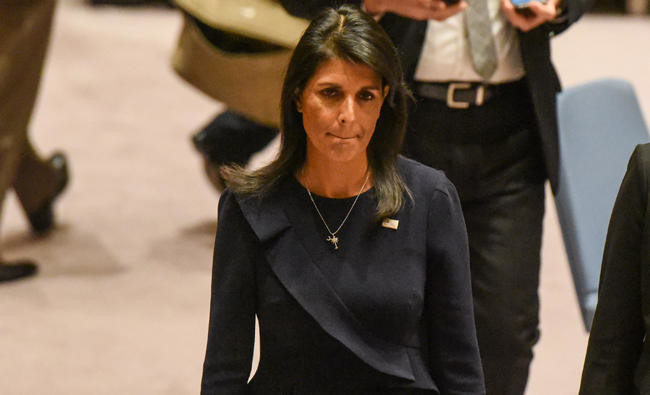
US envoy lays out argument to say Iran not abiding nuclear deal

Nikki Haley, US ambassador to the UN, leaves after a United Nations Security Council meeting on North Korea on September 4, 2017 in New York City. (Stephanie Keith/Getty Images/AFP)
Updated 05 September 2017
Follow

US envoy lays out argument to say Iran not abiding nuclear deal

WASHINGTON: President Donald Trump’s envoy to the United Nations is laying out the argument for the US potentially declaring Iran in formal violation of the nuclear deal.
US Ambassador to the UN Nikki Haley says she doesn’t know what decision Trump will make on the Iran deal. She says it’s his decision alone.
But Haley is detailing a litany of US grievances against Iran and its Revolutionary Guard. Many of the accusations took place before the nuclear deal was negotiated.
Decertification would be a first step toward the Trump administration fulfilling its threat to pull out of the deal.
But notably, Haley says if Trump does declare Iran in violation, that doesn’t necessarily mean the US will withdraw from the deal. She’s leaving open the possibility that sanctions relief could remain.


South Korea will boost medical school admissions to tackle physician shortage

Updated 9 sec ago
Follow

South Korea will boost medical school admissions to tackle physician shortage

  • Jeong said all of the additional students will be trained through regional physician programs

SEOUL: South Korea plans to increase medical school admissions by more than 3,340 students from 2027 to 2031 to address concerns about physician shortages in one of the fastest-aging countries in the world, the government said Tuesday.

The decision was announced months after officials defused a prolonged doctors’ strike by backing away from a more ambitious increase pursued by Seoul’s former conservative government. Even the scaled-down plan drew criticism from the country’s doctors’ lobby, which said the move was “devoid of rational judgment.”

Kwak Soon-hun, a senior Health Ministry official, said that the president of the Korean Medical Association attended the healthcare policy meeting but left early to boycott the vote confirming the size of the admission increases.

The KMA president, Kim Taek-woo, later said the increases would overwhelm medical schools when combined with students returning from strikes or mandatory military service, and warned that the government would be “fully responsible for all confusion that emerges in the medical sector going forward.” The group didn’t immediately signal plans for further walkouts.

Health Minister Jeong Eun Kyeong said the annual medical school admissions cap will increase from the current 3,058 to 3,548 in 2027, with further hikes planned in subsequent years to reach 3,871 by 2031. This represents an average increase of 668 students per year over the five-year period, far smaller than the 2,000-per-year hike initially proposed by the government of former President Yoon Suk Yeol, which sparked the months long strike by thousands of doctors.

Jeong said all of the additional students will be trained through regional physician programs, which aim to increase the number of doctors in small towns and rural areas that have been hit hardest by demographic pressures. The specific admissions quota for each medical school will be finalized in April.