LONDON: The Ras Al-Khaimah Investment Authority (Rakia) has been drawn into a legal tug of war over a hotel in Georgia that is at the center of a $1.5 billion international fraud probe.
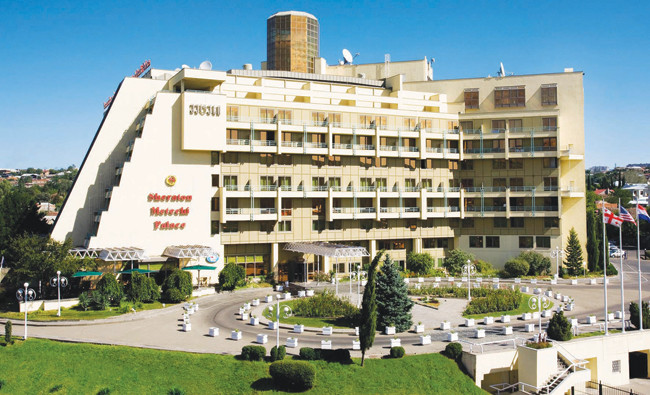
The Sheraton Metechi Palace Hotel in Tbilisi is part of a complex web of legal cases connected to Khater Massaad, the former chief executive of Rakia who is currently in Saudi Arabia.
Now the authority has been hit with a claim in the Georgian courts from an Austrian group called VI2 Partners, seeking the return of millions of dollars it claims it is owed following the aborted sale of the hotel five years ago. A VI2 Partners spokesman declined to comment.
The Austrian company won an initial judgment against Rakia in a Georgia court in July which Rakia is now appealing.
“We would expect to prevail on appeal,” said Jamie Buchanan, a spokesman for the RAK Government, in an exclusive interview in London.
Buchanan said there was a contractual clause in the original deal that determined in the event of a dispute, that the argument would be referred to arbitration.
“Further, there was a non-assignment clause, preventing assignment to any third party, such as VI2,” he said.
“Three individuals together with a number of companies paid us $20 million back in 2012 in part payment to buy the hotel and they would like their money back. The problem is who is “they?”
The latest row to emerge from the labyrinthine legal proceedings emanating from the UAE’s northernmost emirate relates to a failed deal to sell the Sheraton Metechi Palace Hotel in Tbilisi in 2011.
In a case launched last year, Rakia claimed more than $2.6 million in damages from Farhad Azima, an Iranian-American businessman who features in the Panama Papers.
The claim focused on his alleged role in brokering an aborted attempt to sell the hotel for $62.5 million to a company called Eurasia Hotel Holdings.
Rakia alleges in its claim dated Sept. 30, 2016 that Massaad agreed with Azima to receive a commission in return for referring potential third-party purchasers for the Tbilisi hotel.
It was agreed he would get 5 percent of the sale price, Rakia claimed.
It also claimed that Azima had without its prior knowledge agreed a side deal with the planned purchaser to receive a separate 10 percent interest in the hotel on completion of the sale — a stake that would be worth $6.25 million based on its intended sale price.
That complaint was met with a counter-claim from Azima alleging he had been unfairly blamed for the collapse of the deal and more significantly that his computers had been hacked.
This case and others arise from the legal pursuit by Rakia of its former chief executive Khater Massaad who for many years was the face of both the investment authority of the emirate and its largest publicly traded company — the tile maker RAK Ceramics.
Rakia accuses the dual Swiss-Lebanese national of being the central character in a series of fraudulent transactions bankrolled by funds from the investment agency. Massaad denies the claims.
It has spent millions of dollars in legal fees chasing individuals connected to the businessman, who it claimed were implicated in a series of fraudulent transactions.
Massaad was detained at Jeddah airport last September on an arrest warrant issued from the UAE that related to his conviction, in his absence, in Ras Al-Khaimah on charges linked to a wider fraud probe. So far authorities in the UAE have been unable to extradite him to the country.


UAE fund in tug of war over Georgia hotel at center of fraud probe
UAE fund in tug of war over Georgia hotel at center of fraud probe


Closing Bell: Saudi stocks slip as Tadawul falls 1% amid broad market weakness
RIYADH: Saudi stocks fell sharply on Tuesday, with the Tadawul All Share Index closing down 108.14 points, or 1.03 percent, at 10,381.51.
The broader decline was reflected across major indices. The MSCI Tadawul 30 Index slipped 0.78 percent to 1,378.00, while Nomu, the parallel market index, fell 1 percent to 23,040.79.
Market breadth was strongly negative on the main board, with 237 stocks falling compared to just 24 gainers. Trading activity remained robust, with 164.7 million shares changing hands and a total traded value of SR3.19 billion ($850.6 million).
Among the gainers, SEDCO Capital REIT Fund led, rising 2.73 percent to SR6.77, followed by Chubb Arabia Cooperative Insurance Co., which gained 2.69 percent to SR20.20.
National Medical Care Co. added 1.72 percent to close at SR141.60, while Alyamamah Steel Industries Co. and Thimar Advertising, Public Relations and Marketing Co. advanced 1.57 percent and 1.13 percent, respectively.
Losses were led by Al Masar Al Shamil Education Co., which tumbled 8.36 percent to SR24.65. Raoom Trading Co.fell 6.75 percent to SR64.20, while Alkhaleej Training and Education Co. dropped 6.60 percent to SR18.12 and Naqi Water Co. declined 5.51 percent to SR54.00. Gulf General Cooperative Insurance Co. closed 5.44 percent lower at SR3.65.
On the announcement front, Chubb Arabia Cooperative Insurance Co. signed a multiyear insurance agreement with Saudi Electricity Co. to provide various coverages, expected to positively impact its financial results over the 2025–2026 period. The deal will run for three years and two months and is within the company’s normal course of business.
Meanwhile, Bupa Arabia for Cooperative Insurance Co. announced a one-year health insurance contract with Saudi National Bank, valued at SR330.2 million, covering the bank’s employees and their families from January 2026. Despite the sizable contract, Bupa Arabia shares fell 0.8 percent to close at SR137, weighed down by the broader market weakness.
In contrast, United Cooperative Assurance Co. revealed an extension of its engineering insurance agreement with Saudi Binladin Group for the Grand Mosque expansion in Makkah. The contract value exceeds 20 percent of the company’s gross written premiums based on its latest audited financials and is expected to support results through 2026. However, the stock came under selling pressure, ending the session down 4.51 percent at SR3.39.


