GANDHINAGAR, India: Air pollution is diminishing India’s capacity to harness power from the sun, experts say, undermining billions being invested in renewables as the energy-hungry giant emerges as a solar superpower.
New research has found the smog and dust that sickens millions across India every year is also sapping solar power generation by more than 25 percent, far beyond levels previously thought.
In the first study of its kind, US and Indian scientists measured how man-made particles floating in the air and deposited as grime on solar panels combined to seriously impair sunlight from converting to energy.
This interference causes steep drops in power generation, they found.
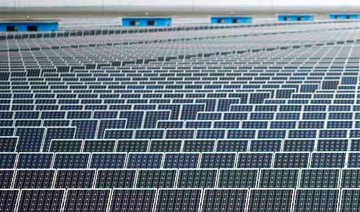
At present levels in India, it could amount to roughly 3,900 megawatts of lost energy — six times the capacity of its largest solar farm, a gigantic field of 2.5 million panels.
“A simple calculation shows that this is a big amount of energy we are going to lose,” Professor Chinmay Ghoroi, who co-authored the paper, said at the Indian Institute of Technology in Gandhinagar.
These huge losses will only compound as India realizes its grand solar ambitions, experts say.
India, the world’s third-largest polluter, is banking on solar to electrify homes for hundreds of millions of its poorest citizens without adding to its sizeable carbon footprint.
At the Paris climate summit in 2015, India pledged cuts to its future emissions and vowed to source at least 40 percent of its energy from renewables by 2030 — a target it is well on track to exceed.
New panels are being installed so fast that India is expected to more than double capacity this year, overtaking Japan as the world’s third-largest solar market.
But with this spectacular growth comes “an exponential rise in the total amount of money lost” because of air pollution, said Mike Bergin, a professor from Duke University in North Carolina, who lead the research published in June.
“We’re talking billions of dollars here, easy,” he said.
Dust has long been a menace for solar projects in desert states like Rajasthan and Gujarat, where robotic wipers are deployed to ensure panels are cleaned after sandstorms.
But the new research confirmed what solar installers had long suspected — that choking smog from cars, coal plants, crop burning and trash fires was particularly adept at bleeding energy.
The grimy coating that man-made pollutants deposit on solar panels is far more effective at blocking light than dust, and trickier to remove by washing, Bergin and Ghoroi found.
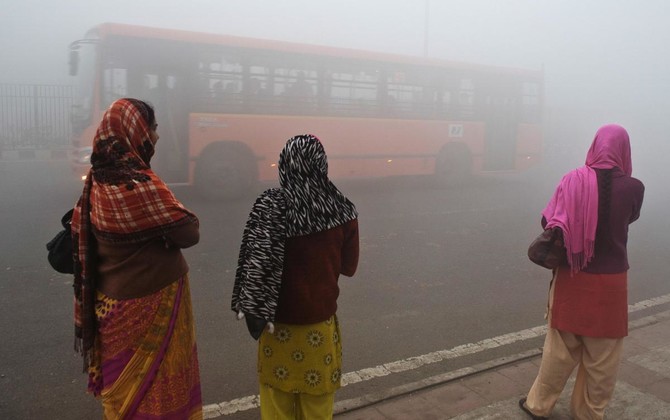
This is especially troublesome in northern India, where fine airborne particles from human activity contribute far more than dust to the dire air quality.
Vinay Rutagi, director of solar consultancy Bridge to India, said rooftop panels in Delhi, one of the world’s most polluted cities, produced up to 30 percent less power than the same project just 40 kilometers away.
“The reason for that is the constant haze, the pollution and high dust levels,” Rutagi said.
“There is a huge amount of practical evidence on the ground available in this regard.”
This bodes ill as the government seeks 40 percent of its solar energy from rooftop panels atop industrial zones and urban centers by 2022.
But there is little appetite for gloomy projections as India’s solar sector undergoes an unprecedented boom.
Amid this optimism, new milestones are being surpassed at a dizzying speed.
A behemoth solar park nearing completion in India’s southeastern Andhra Pradesh state will rival the world’s largest.
In May, wholesale solar prices plunged to record lows, cheaper than the coal-powered electricity that overwhelmingly dominates the power grid.
Dr. Andre Noble, an expert on the effect of haze on solar generation, found little interest when he presented his findings at a solar summit in Delhi last month.
“People didn’t pay much attention,” said Noble, who is head of operations and maintenance at Singapore-based Cleantech Solar, which invests heavily in India.
“They might have a gut feeling, but they might think the impact is negligible.”

Air pollution throws shade on India’s solar ambitions
AI will never replace human creativity, says SRMG CEO
- Speaking to Maya Hojeij, senior business anchor at Asharq with Bloomberg, Jomana R. Alrashid expressed pride in SRMG platforms that had absorbed and adopted AI
RIYADH: Jomana R. Alrashid, CEO of Saudi Research and Media Group, highlighted how AI cannot replace human creativity during a session at The Family Office’s “Investing Is a Sea” summit at Shura Island on Friday.
“You can never replace human creativity. Journalism at the end of the day, and content creation, is all about storytelling, and that’s a creative role that AI does not have the power to do just yet,” Alrashid told the investment summit.
“We will never eliminate that human role which comes in to actually tell that story, do the actual investigative reporting around it, make sure to be able to also tell you what’s news or what’s factual from what’s wrong ... what’s a misinformation from bias, and that’s the bigger role that the editorial player does in the newsroom.”
Speaking on the topic of AI, moderated by Maya Hojeij, senior business anchor at Asharq with Bloomberg, the CEO expressed her pride in SRMG platforms that had absorbed and adopted AI in a way that was “transformative.”
“We are now translating all of our content leveraging AI. We are also now being able to create documentaries leveraging AI. We now have AI-facilitated fact-checking, AI facilities clipping, transcribing. This is what we believe is the future.”
Alrashid was asked what the journalist of the future would look like. “He’s a journalist and an engineer. He’s someone who needs to understand data. And I think this is another topic that is extremely important, understanding the data that you’re working with,” she said.
“This is something that AI has facilitated as well. I must say that over the past 20 years in the region, especially when it comes to media companies, we did not understand the importance of data.”
The CEO highlighted that previously, media would rely on polling, surveys or viewership numbers, but now more detailed information about what viewers wanted was available.
During the fireside session, Alrashid was asked how the international community viewed the Middle Eastern media. Alrashid said that over the past decades it had played a critical role in informing wider audiences about issues that were extremely complex — politically, culturally and economically — and continued to play that role.
“Right now it has a bigger role to play, given the role again of social media, citizen journalists, content creators. But I also do believe that it has been facilitated by the power that AI has. Now immediately, you can ensure that that kind of content that is being created by credible, tier-A journalists, world-class journalists, can travel beyond its borders, can travel instantly to target different geographies, different people, different countries, in different languages, in different formats.”
She said that there was a big opportunity for Arab media not to be limited to simply Arab consumption, but to finally transcend borders and be available in different languages and to cater to their audiences.
The CEO expressed optimism about the future, emphasizing the importance of having a clear vision, a strong strategy, and full team alignment.
Traditional advertising models, once centered on television and print, were rapidly changing, with social media platforms now dominating advertising revenue.
“It’s drastically changing. Ultimately in the past, we used to compete with one another over viewership. But now we’re also competing with the likes of social media platforms; 80 percent of the advertising revenue in the Middle East goes to the social media platforms, but that means that there’s 80 percent interest opportunities.”
She said that the challenge was to create the right content on these platforms that engaged the target audiences and enabled commercial partnerships. “I don’t think this is a secret, but brands do not like to advertise with news channels. Ultimately, it’s always related with either conflict or war, which is a deterrent to advertisers.
“And that’s why we’ve entered new verticals such as sports. And that’s why we also double down on our lifestyle vertical. Ultimately, we have the largest market share when it comes to lifestyle ... And we’ve launched new platforms such as Billboard Arabia that gives us an entry into music.”
Alrashid said this was why the group was in a strong position to counter the decline in advertising revenues across different platforms, and by introducing new products.
“Another very important IP that we’ve created is events attached to the brands that have been operating in the region for 30-plus years. Any IP or any title right now that doesn’t have an event attached to it is missing out on a very big commercial opportunity that allows us to sit in a room, exchange ideas, talk to one another, get to know one another behind the screen.”
The CEO said that disruption was now constant and often self-driving, adding that the future of the industry was often in storytelling and the ability to innovate by creating persuasive content that connected directly with the audience.
“But the next disruption is going to continue to come from AI. And how quickly this tool and this very powerful technology evolves. And whether we are in a position to cope with it, adapt to it, and absorb it fully or not.”