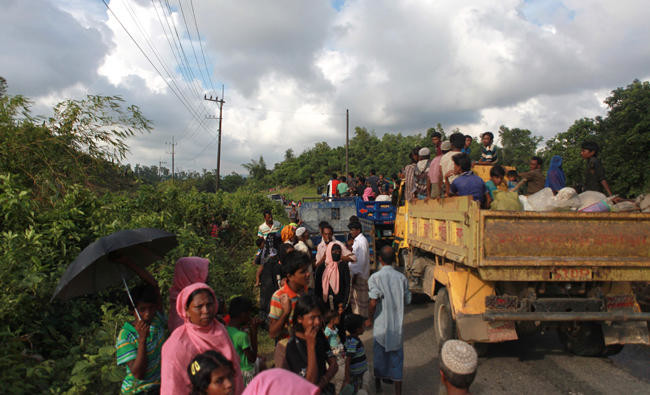
DHAKA: "For last two days I did not get anything to eat. This one-month-old baby is not even getting proper breastfeeding," said Saleha Khatun, a 26-year-old woman who narrowly escaped with her life from the atrocities of the Myanmar Army and law enforcing agencies in the Rakhine province of Myanmar, and has now taken shelter in a Rohingya camp at Teknaf under Cox's Bazar district of Bangladesh.
In the past week, more than 20,000 Rohingyas took shelter in different camps and areas of Cox's Bazar District. Most of them are facing an acute crisis of food and shelter, sitting under the open sky. Bangladesh is facing extreme trouble in coping with this refugee crisis
Nearly half a million Rohingya refugees are already living in the bordering areas of Bangladesh for many years. International Organization for Migration (IOM) is working with the Bangladesh government to provide food and other basic necessities for the refugees, but the efforts still fall short to meet the need.
"Although Bangladesh is a small country … and a developing nation with limited resources, it is putting its best effort to maintain the Rohingyas,” said former ambassador Mohammad Zamir, who is one of the senior foreign policy makers of the ruling party Bangladesh Awami League.
“Despite few odd incidents of pushing back the Rohingyas to Myanmar,” he said, “the Bangladeshi government as well as our people are always very kind and sympathetic to the Rohingya Muslims. But the world community should play a more active role to resolve the crisis and implement the UN (Kofi) Annan Commission's report on the issue. Moreover, the UN General Assembly session is scheduled to be held in September that should raise a strong voice to ensure equal rights and opportunities for all the people living within the land of Myanmar since their birth."
"This refugee crisis is no more a bilateral issue between Bangladesh and Myanmar," said Barrister Rumin Farhana, political affairs secretary for the Bangladesh Nationalist Party. She urged the prime minister to build diplomatic pressure on the international community to stop the atrocities by the Myanmar government so that the Rohingyas can live peacefully in their country.
Rohingyas received international attention after the 2012 Rakhine State riots which resulted in the Rohingya refugee crisis of 2015 and a subsequent military crackdown between 2016 and 2017. A large number of Rohingya fled to the bordering areas with Thailand, Bangladesh, and Pakistan's port city of Karachi. Nearly 100,000 Rohingyas are estimated to live in camps established for internally displaced persons inside Myanmar. The Rohingyas are not recognized by Myanmar as native ethnic minority and are often denied citizenship and basic rights.
"It is a systematic genocide committed by the Myanmar law enforcing agencies," said Ameena Mohsin, who is a professor of international relations at Dhaka University. Expressing her frustration over the situation she said: "The Organization of Islamic Cooperation (OIC) should play an effective role to save the Rohingya Muslims."

Bangladeshi PM urged to put pressure on world community to stop Myanmar atrocities on Rohingyas
Only 4% women on ballot as Bangladesh prepares for post-Hasina vote
- Women PMs have ruled Bangladesh for over half of its independent history
- For 2026 vote, only 20 out of 51 political parties nominated female candidates
DHAKA: As Bangladesh prepares for the first election since the ouster of its long-serving ex-prime minister Sheikh Hasina, only 4 percent of the registered candidates are women, as more than half of the political parties did not field female candidates.
The vote on Feb. 12 will bring in new leadership after an 18-month rule of the caretaker administration that took control following the student-led uprising that ended 15 years in power of Hasina’s Awami League party.
Nearly 128 million Bangladeshis will head to the polls, but while more than 62 million of them are women, the percentage of female candidates in the race is incomparably lower, despite last year’s consensus reached by political parties to have at least 5 percent women on their lists.
According to the Election Commission, among 1,981 candidates only 81 are women, in a country that in its 54 years of independence had for 32 years been led by women prime ministers — Hasina and her late rival Khaleda Zia.
According to Dr. Rasheda Rawnak Khan from the Department of Anthropology at Dhaka University, women’s political participation was neither reflected by the rule of Hasina nor Zia.
“Bangladesh has had women rulers, not women’s rule,” Khan told Arab News. “The structure of party politics in Bangladesh is deeply patriarchal.”
Only 20 out of 51 political parties nominated female candidates for the 2026 vote. Percentage-wise, the Bangladesh Socialist Party was leading with nine women, or 34 percent of its candidates.
The election’s main contender, the Bangladesh Nationalist Party, whose former leader Zia in 1991 became the second woman prime minister of a predominantly Muslim nation — after Pakistan’s Benazir Bhutto — was the party that last year put forward the 5 percent quota for women.
For the upcoming vote, however, it ended up nominating only 10 women, or 3.5 percent of its 288 candidates.
The second-largest party, Jamaat-e-Islami, has not nominated a single woman.
The 4 percent participation is lower than in the previous election in 2024, when it was slightly above 5 percent, but there was no decreasing trend. In 2019, the rate was 5.9 percent, and 4 percent in 2014.
“We have not seen any independent women’s political movement or institutional activities earlier, from where women could now participate in the election independently,” Khan said.
“Real political participation is different and difficult as well in this patriarchal society, where we need to establish internal party democracy, protection from political violence, ensure direct election, and cultural shifts around female leadership.”
While the 2024 student-led uprising featured a prominent presence of women activists, Election Commission data shows that this has not translated into their political participation, with very few women contesting the upcoming polls.
“In the student movement, women were recruited because they were useful, presentable for rallies and protests both on campus and in the field of political legitimacy. Women were kept at the forefront for exhibiting some sort of ‘inclusive’ images to the media and the people,” Khan said.
“To become a candidate in the general election, one needs to have a powerful mentor, money, muscle power, control over party people, activists, and locals. Within the male-dominated networks, it’s very difficult for women to get all these things.”