

Philippine military gets protective masks for counterterrorism operations

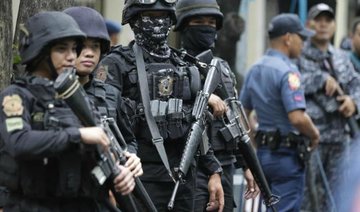
Members of the Joint US Military Assistance Group demonstrate the wear and use of M40 field protective masks at Philippine Marine headquarters in Taguig, Philippines. (US Embassy photos)
Updated 03 September 2017
Follow

Philippine military gets protective masks for counterterrorism operations

MANILA: Amid the prolonged crisis in Marawi City, the United States has turned over 1,000 gas masks and C2 filter canisters to the Philippine military.

“Officials from the Joint United States Military Assistance Group (JUSMAG) delivered 1,000 M40 field protective masks and C2 filter canisters to the Philippine Navy (PN) through the Mutual Logistics Support Agreement (MLSA),” the US Embassy Manila said in a statement on Saturday, Sept. 2.

The transfers were made August 30 and 31 at the Marine Barracks Rudiardo Brown, Taguig City.

The M-40 field protective mask has been used for years by US Armed Forces. The facepiece can protect the user from field concentrations of chemical and biological agents, along with radiological fallout particles

The Philippine Navy requested these gas masks to better prepare their sailors and marines to respond to chemical threats as the fighting continues in Mindanao, according to the US embassy.

“This transfer is part of a series of ongoing transfers from the US military to multiple branches of the Armed Forces of the Philippines (AFP) through both MLSA and the security assistance program,” read the statement.

Through the MLSA, the AFP is able to receive select munitions and equipment from US military stock in an accelerated process reserved for allies and close partners of the United States.

“The United States is proud to work closely with the Republic of the Philippines and will continue to support capacity-building counterterrorism efforts and the AFP’s long-term modernization goals,” the embassy further said.

This aid is one of many recent deliveries from the US as part of Washington’s commitment to help enhance the AFP’s counterterrorism capabilities.

On August 23 to 24, the Commander of the United States Pacific Command, Adm. Harry B. Harris Jr., visited the Philippines to meet with Philippine military and government leadership.

During his visit, Harris met with President Rodrigo Duterte to discuss US support to the Philippine government for ongoing efforts to end the conflict in Marawi, as well as military interoperability and regional threats.

Harris’ visit comes as the crisis in Marawi drags on, significantly increasing concerns about terrorist activity in the southern Philippines and broadly, in Southeast Asia.

Duterte in May placed the whole southern island of Mindanao under martial law following the Maute attack in Marawi, which is the biggest Muslim-majority city in the country.

On Friday, Duterte said he has considered lifting the martial law, but a possible spillover of the terror crisis to other parts of the Autonomous Region in Muslim Mindanao (ARMM) held him back.

“I was thinking that we could, you know, lift it earlier. But the way it looks, parang may spillover na sa ARMM (it seems there is a spillover in ARMM),” Duterte said in a speech before troops during the 11th founding anniversary of the Eastern Mindanao Command (Eastmincom) in Davao City.

“Let us see, if it’s to the interest of the country that I will lift it, I will lift it. But if not then, we’ll just have to continue with the martial law,” he added.

Also, last week, Duterte announced that he is giving the military the option to decide on whether or not to bomb mosques where Mautes were are still holed up. And that is even if there are hostages still inside.

“The option is already yours because we cannot have a stalemate for over one year,” he said, as he admitted that he was the reason why the crisis in Marawi has been prolonged.

He said the option to bomb the mosques to capture or kill the leaders of the Maute group has always been on deck, but he refused as “this will just create more animosity and outright hostility in the government.”

This time, however, Duterte is giving the military the free hand to decide on the matter to finally liberate the city from the Daesh-inspired local terror group.


Texas stunner: Democrat flips Republican state Senate district Trump won by 17 points

Updated 3 sec ago
Follow

Texas stunner: Democrat flips Republican state Senate district Trump won by 17 points

  • Trump immediately distanced himself from the loss, saying he was not involved in the "local Texas race”
Democrat Taylor Rehmet flipped a reliably Republican state Senate district in Texas in Saturday’s special election, continuing a string of surprise victories for Democrats across the US in the year since Donald Trump returned to the White House.
The Republican president immediately distanced himself from the loss in a district he’d won by 17 points in 2024.
“I’m not involved in that. That’s a local Texas race,” Trump told reporters Sunday at his Mar-a-Lago estate in Florida.
Yet just a day before the race, Trump had heaped praise on Republican contender Leigh Wambsganss, a conservative activist and entrepreneur, on his social media platform, declaring that she would be “a GREAT Candidate and has my Complete and Total Endorsement.” A longer post came later, in which he urged Texans to get out and vote, describing Wambsganss as a successful entrepreneur and “an incredible supporter” of his Make America Great Again movement.
Despite the plugs, Wambsganss was easily trounced in the Fort Worth-area district by Rehmet, a labor union leader and veteran, for a partial term ending in early January. With almost all votes counted, Rehmet was leading by more than 14 percentage points.
“This win goes to everyday working people,” Rehmet told supporters.
Republican Texas Lt. Gov. Dan Patrick called the outcome “a wake-up call for Republicans across Texas,” where the GOP controls every statewide office.
“Our voters cannot take anything for granted,” Patrick wrote on X, while noting low-turnout special elections are always unpredictable. “I know the energy and strength the Republican grassroots in Texas possess. We will come out fighting with a new resolve, and we will take this seat back in November.”
Rehmet’s victory added to the Democrats’ record of overperforming in special elections so far this cycle, beginning in March — when they prevailed in a Pennsylvania legislative district made up of suburbanites and farmers that Democrats hadn’t held in a century — and continuing through to November, when they dominated candidate and ballot contests from Maine to California.
And Zohran Mamdani, an unapologetic Democratic Socialist, was elected mayor of New York City, a Democratic stronghold that saw the highest voter turnout in a mayor’s race in 50 years.
The showings come as Trump’s approval ratings with the public hold steady at around 40 percent. A January AP-NORC poll found that a majority of US adults disapprove of the way he’s handling foreign policy, trade negotiations and immigration, as well as the economy.
Democrats said Saturday’s results in Texas were further evidence that voters under the second Trump administration are motivated to reject GOP candidates and their policies.
Texas Democratic Party Chair Kendall Scudder said Rehmet won by standing with working people and talking to Texans about the future.
“This win shows what is possible in Texas with strong organizing, great candidates and strategic investments,” he said in a statement. “People are noticing that Democrats have the workers’ backs and are delivering results.”
Democrats’ other state victories since 2025 included wins for governor in Virginia and New Jersey and in special elections in Kentucky and Iowa. And, while Republican Matt Van Epps won a Tennessee special election for a US House seat, the relatively slim margin of victory gave Democrats hope for this fall’s midterms.
With that backdrop in mind, Trump and Vice President JD Vance have pushed states to redraw their political maps to Republicans’ advantage headed into those contests, which will determine partisan control in Washington. Some Democratic states — most notably California — have pushed back with their own redistricting efforts.
The Texas Senate seat was open because the four-term GOP incumbent, Kelly Hancock, resigned to take a statewide office. Hancock easily won election each time he ran for the office, and Republicans have held the seat for decades.
The district is redder than its home, Tarrant County. Trump won the county by 5 points in 2024, but Democratic President Joe Biden carried it in 2020 by about 1,800 votes out of more than 834,000 cast.
But Rehmet had support from national organizations, including the DNC and VoteVets, a veterans group that said it spent $500,000 on ads. Rehmet, who served in the Air Force and works as a machinist, focused on lowering costs, supporting public education and protecting jobs.
Wambsganss called Saturday’s result “a wakeup call for Republicans in Tarrant County, Texas, and the nation” and warned her party not to be complacent.
“The Democrats were energized,” she said in a statement. “Too many Republicans stayed home.”
Rehmet’s victory allows him to serve only until early January. He will face Wambsganss again in the November general election to decide who occupies the seat for a full four-year term. The Texas Legislature is not set to reconvene until 2027, and the GOP still will have a comfortable majority.