VIENNA: The US is pushing UN nuclear inspectors to check military sites in Iran to verify it is not breaching its nuclear deal with world powers. But for this to happen, inspectors must believe such checks are necessary and so far they do not, officials say.
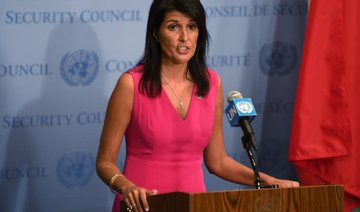
Last week, US Ambassador to the UN Nikki Haley visited the International Atomic Energy Agency (IAEA), which is scrutinizing compliance with the 2015 agreement, as part of a review of the pact by the administration of President Donald Trump. He has called it “the worst deal ever negotiated.”
After her talks with officials of the UN nuclear watchdog, Haley said: “There are ... numerous undeclared sites that have not been inspected. That is a problem.” Iran dismissed her demands as “merely a dream.”
The IAEA has the authority to request access to facilities in Iran, including military ones, if there are new and credible indications of banned nuclear activities there, according to officials from the agency and signatories to the deal.
But they said Washington has not provided such indications to back up its pressure on the IAEA to make such a request.
“We’re not going to visit a military site like Parchin just to send a political signal,” an IAEA official said, mentioning a military base often cited by opponents of the deal including Iran’s arch-adversary Israel and Trump’s Republican Party. The deal was hatched under his Democratic predecessor Barack Obama.
IAEA Director-General Yukiya Amano frequently describes his Vienna-based agency as a technical rather than a political one, underscoring the need for its work to be based on facts alone.
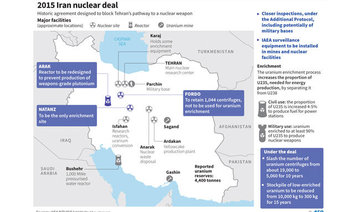
The accord restricts Iran’s atomic activities with a view to keeping the Islamic Republic a year’s work away from having enough enriched uranium for a nuclear bomb, should it pull out of the accord and sprint toward making a weapon.
The deal also allows the IAEA to request access to facilities other than the nuclear installations Iran has already declared if it has concerns about banned materials or activities there. But it must present a basis for those concerns.
Those terms are widely understood by officials from the IAEA and member states to mean there must be credible information that arouses suspicion, and IAEA officials have made clear they will not take it at face value.
“We have to be able to vet this information,” a second IAEA official said, asking not to be identified because inspections are sensitive and the agency rarely discusses them publicly.
No new intelligence
Despite Haley’s public comments, she neither asked the IAEA to visit specific sites nor offered new intelligence on any site, officials who attended her meetings said. A US State Department spokesman confirmed this.
“She conveyed that the IAEA will need to continue to robustly exercise its authorities to verify Iran’s declaration and monitor the Joint Comprehensive Plan of Action,” the spokesman added, using the deal’s official name.
Under US law, the State Department must notify Congress every 90 days of Iran’s compliance with the deal. The next deadline is October. Trump has said he thinks by then Washington will declare Iran to be non-compliant — a stance at odds with that of other five world powers including US allies in Europe.
An IAEA report published in 2015 as part of the deal formally drew a line under whether Iran pursued nuclear weapons in the past, which is why new information is needed to trigger a request for access.
The IAEA has not visited an Iranian military facility since the agreement was implemented because it has had “no reason to ask” for access, the second agency official said.
The deal’s “Access” section lays out a process that begins with an IAEA request and, if the UN watchdog’s concerns are not resolved, can lead to a vote by the eight members of the deal’s decision-making body — the United States, Iran, Russia, China, France, Britain, Germany and the European Union.
Five votes are needed for a majority, which could comprise the United States and its Western allies. Such a majority decision “would advise on the necessary means to resolve the IAEA’s concerns” and Iran “would implement the necessary means,” the deal’s Access section says.
That process and wording have yet to be put to the test.
But Iran has already made clear that its military sites are off limits, raising the risk of a stand-off if a request for access were put to a vote. That adds to the pressure to be clear on the grounds for an initial request.
“If they want to bring down the deal, they will,” the first IAEA official said, referring to the Trump administration. “We just don’t want to give them an excuse to.”
During its decade-long impasse with world powers over its nuclear program, Iran repeatedly refused IAEA visits to military sites, saying they had nothing to do with nuclear activity and so were beyond the IAEA’s purview.
Shortly after the 2015 deal, Iran allowed inspectors to check its Parchin military complex, where Western security services believe Tehran carried out tests relevant to nuclear bomb detonations more than a decade ago. Iran has denied this.
Iran has placed its military bases off limits also because of what it calls the risk that IAEA findings could find their way to US and Israeli intelligence services.


![]()

US demands Iran’s ‘undeclared nuclear sites’ to be inspected
US demands Iran’s ‘undeclared nuclear sites’ to be inspected
Latest updates


Recommended


© 2026 SAUDI RESEARCH & PUBLISHING COMPANY, All Rights Reserved And subject to Terms of Use Agreement.