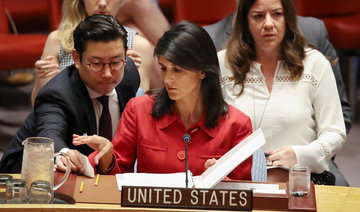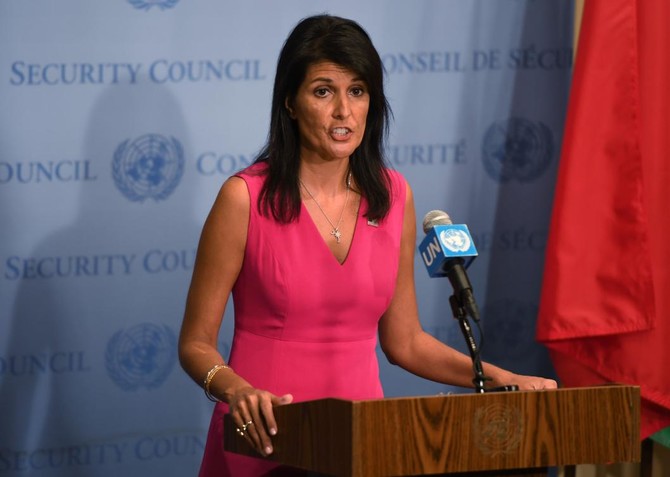
JEDDAH: US Ambassador to the UN Nikki Haley voiced concern on Friday that nuclear inspectors were not granted access to Iranian military bases.
“I have good confidence in the IAEA (International Atomic Energy Agency), but they’re dealing with a country that has a clear history of lying and pursuing covert nuclear programs,” Haley told a news conference after returning from a trip to Vienna, where the agency is based.
“We’re encouraging the IAEA to use all the authorities they have, and to pursue every angle possible,” to verify Tehran’s compliance with the 2015 nuclear deal.
Dr. Majid Rafizadeh, an Iranian-American political scientist, said there are several sites in Iran that are pursuing its nuclear program without notifying the IAEA.
“Iran conducts major nuclear research in its military bases, specifically the Parchin site,” he told Arab News on Friday.
“There’s a recently revealed site in Parchin called Pajouhesh Kadeh (Research Institute), which is operated by the Center for Explosives, Blast Research and Technologies. This center is believed to be the main player behind attempts to weaponize Iran’s nuclear program.”
Under the terms of the nuclear deal, Iran is prohibited from conducting advanced nuclear research and development, but it appears to still be doing so, he said.
“Iran has long been determined not to allow the IAEA to inspect its military sites. This issue raises significant suspicions,” Rafizadeh added.
“Without the inspection of Iran’s military sites, specifically Parchin, it would be impossible to ensure whether or not Tehran is complying with the nuclear deal.”
He said Tehran has a long history of defying the IAEA’s terms and deceiving the international community regarding its nuclear program and activities.
UN mission in Lebanon
Meanwhile, the US is wrestling with other UN Security Council members over renewing the UN peacekeeping mission mandate in Lebanon, which Washington is calling to strengthen against the wishes of Paris and Moscow.
Annual renewal of the mandate, which expires at the end of August, is normally uneventful, but the Trump administration this year is pushing to bolster the force’s authority against arms movements by the Shiite militia Hezbollah.
“The Security Council cannot adopt a business-as-usual approach when so much is at stake,” said Haley in a statement on Wednesday.
“We call on the members of the Security Council to join us in taking real action to make UNIFIL a stronger peacekeeping mission and to stand up against forces of terror in Lebanon and around the region.”
She said beefing up the force is necessary as “Hezbollah openly boasts about its illegal stockpile of weapons and publicly threatens” Israel, a key US ally.
But France on Wednesday said it wants the UN peacekeeping mission in Lebanon to stick to its current mandate.
Anne Gueguen, France’s deputy permanent representative to the UN, told reporters that Paris saw no need to change the 2006 Security Council resolution that sets the mission’s current mandate.
“We want to keep the mandate as such,” she said. Gueguen spoke before the talks on whether to extend the mandate for another year.
After the talks, Russian Ambassador Vassily Nebenzia said Moscow also saw no need to change the mandate, a position he said was shared by many at the session. “We think this mandate should be renewed in the present form,” he said.