Texas storm Harvey breaks historic rainfall record

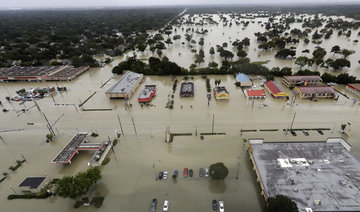
A SUV is seen submerged on the street after the area was inundated with flooding from Hurricane Harvey on Tuesday in Friendswood, Texas. (AFP)
Updated 30 August 2017
Follow

Texas storm Harvey breaks historic rainfall record

MIAMI: Hurricane Harvey has set what forecasters believe is a new rainfall record for the continental United States, officials said Tuesday.
Harvey, swirling for the past few days off Texas and Louisiana — at times as a hurricane and at times a tropical storm — has dumped 51.88 inches (132 centimeters) of rain in Cedar Bayou, a salt water channel on the Texas coast, the National Weather Service said.
“This reading is higher than the previous record of 48 inches set during tropical cyclone Amelia of 1978 at Medina, Texas,” it added.
It was the second record reported in just one day. The first was 49.32 inches measured at a rain gauge southeast of Houston.
NHC spokesman Dennis Feltgen said that record is being treated preliminarily as one for the entire continental United States.
He added that confirming the figure “will take a lot of research,” as experts review water gauges and past historical records — a process likely to take several weeks.
Harvey made landfall in Texas on Friday as a Category Four hurricane. It has since weakened to a tropical storm but is still unleashing massive amounts of rain over Texas and Louisiana.


Venezuela advances amnesty bill that could lead to mass release of political prisoners

Updated 06 February 2026
Follow

Venezuela advances amnesty bill that could lead to mass release of political prisoners

  • Such an amnesty is a central demand of the country’s opposition and human rights organizations with backing from the United States

CARACAS: Venezuela’s legislature on Thursday advanced an amnesty bill proposed by acting President Delcy Rodríguez that could lead to the release of hundreds of opposition leaders, journalists and human rights activists detained for political reasons.
Such an amnesty is a central demand of the country’s opposition and human rights organizations with backing from the United States. But the contents of the bill have not been released publicly, and rights groups have so far reacted with cautious optimism — and with demands for more information.
The bill, introduced just weeks after the US military captured then-President Nicolás Maduro, still requires a second debate that has yet to be scheduled. Once approved, it must be signed by Rodríguez before it can go into effect.
In announcing the bill late last month, Rodríguez told a gathering of justices, magistrates, ministers, military brass and other government leaders that the ruling party-controlled National Assembly would take up the legislation with urgency.
“May this law serve to heal the wounds left by the political confrontation fueled by violence and extremism,” she said in a pre-taped televised event. “May it serve to redirect justice in our country, and may it serve to redirect coexistence among Venezuelans.”
Rights groups, fearing some political detainees will be excluded, want more details about the requirements for amnesty before any final vote.
The Venezuelan Program for Education-Action in Human Rights, or PROVEA, issued a statement emphasizing that the bill must be made public urgently due to its potential impact on victims’ rights and broader Venezuelan society.
Based on what is known so far about the legislation, the amnesty would cover a broad timeline, spanning the administration of the late Hugo Chávez from 1999 to 2013 and that of his political heir, Maduro, until this year. It would exclude people convicted of murder, drug trafficking, and serious human rights violations, reports indicate.