

Social media users share fake photos of Hurricane Harvey in a bid to go viral

Social media users are flooding the Internet with fake images of the floods in a bid to go viral. (Photo courtesy: Twitter)
Updated 29 August 2017
Follow

Social media users share fake photos of Hurricane Harvey in a bid to go viral

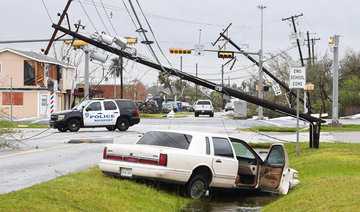
DUBAI: Social media users are flooding the Internet with fake images of Hurricane Harvey as it unleashes one of the heaviest downpours in US history over Texas.
One debunked photo shows a shark swimming on what is said to be a flooded road.

Another shows floodwater submerging airplanes.

Meanwhile, another photo shows a looted shop which the sharer claims was ransacked during the natural disaster.

All the snaps have been proven to be either digitally faked or from previous events.
Forecasters expect the system to stay over water with 45 mph (72 kph) winds for 36 hours and then head back inland east of Houston sometime Wednesday. The system will then head north and lose its tropical strength.
Before then, up to 20 more inches (51 centimeters) of rain could fall, National Weather Service Director Louis Uccellini said Monday.
— With AP

6 planets will parade across the night sky at the end of February

Updated 23 February 2026
Follow

6 planets will parade across the night sky at the end of February

NEW YORK: Six planets are linking up in the sky at the end of February, and most will be visible to the naked eye.
It’s what’s known as a planetary parade, which happens when multiple planets appear to line up in the sky at once. The planets aren’t in a straight line, but are close together on one side of the sun.
Skygazers can usually spot two or three planets after sunset, according to NASA. Hangouts of four or five that can be glimpsed with the naked eye are less common and occur every few years. Last year featured lineups of six and all seven planets.
When will they be visible?
On Saturday, Mercury, Venus, Jupiter and Saturn will be visible to the naked eye if clear skies allow. Uranus and Neptune can only be spotted with binoculars and telescopes.

What time is optimal for viewing?
Go outside about an hour after sunset and venture away from tall buildings and trees that will block the view. Look to the western sky and spot Mercury, Venus and Saturn close to the horizon. Jupiter will be higher up, along with Uranus and Neptune.
How to know if you’ve spied a member of the parade?
“If it’s twinkling, it’s a star. If it is not twinkling, it’s a planet,” said planetary scientist Sara Mazrouei with Humber Polytechnic in Canada.
The parade should be visible over the weekend and in the days after. Eventually, Mercury will bow out and dip below the horizon.
At least one bright planet is visible on most nights, according to NASA.
Glimpsing many in the sky at once is a fun way to connect with astronomers of centuries’ past, said planetary scientist Emily Elizondo with Michigan State University.
Ancient astronomers used to make sense of the universe “just by looking up at the stars and the planets,” Elizondo said, “which is something that we can do today.”