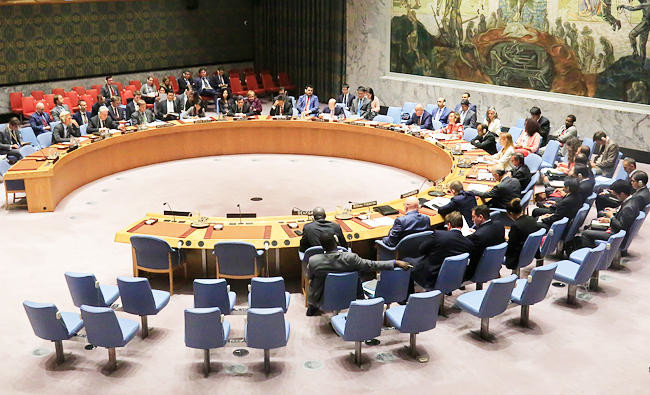
UNITED NATIONS, United States: The UN Security Council denounced North Korea’s latest missile test Tuesday, unanimously demanding that Pyongyang halt the program after a rocket was fired over Japan into the Pacific.
Following the emergency closed-door session called by the United States and Japan, Tokyo’s envoy at the UN suggested that a new sanctions declaration could be issued.
“Next step starting now. We can’t predict the outcome but I certainly hope it would be a strong resolution following this statement,” Koro Bessho said.
The 15-member body maintained its unity after Kim Jong-Un’s latest provocation, with China and Russia agreeing to sign up to a statement condemning his isolated regime’s action.
But the US-drafted statement, while noting that the test contravened several previous Security Council resolutions, will not immediately lead to new or tightened measures against Pyongyang.
Still, diplomatic sources told AFP that the speed with which the members had reacted underlined their determination to remain united.
“The Security Council stresses that these DPRK actions are not just a threat to the region, but to all UN member states,” said the statement, issued after closed-door talks at UN headquarters.
“The Security Council expresses its grave concern that the DPRK is, by conducting such a launch over Japan as well as its recent actions and public statements, deliberately undermining regional peace and stability.”
The Council demanded that North Korea — already the target of seven rounds of UN sanctions that have done little to quell Kim’s nuclear missile ambitions — obey all existing resolutions.
This would mean the North “abandon all nuclear weapons and existing nuclear programs in a complete, verifiable and irreversible manner, and immediately cease all related activities.”
Pyongyang must not “conduct any further nuclear tests or any further provocation; and abandon any other existing weapons of mass destruction in a complete, verifiable and irreversible manner.”
Finally, the body “welcomes efforts by Council members, as well as other states, to facilitate a peaceful and comprehensive solution through dialogue.”


UN Council unanimously condemns North Korea missile test
UN Council unanimously condemns North Korea missile test



In show of support, Canada, France open consulates in Greenland
- Decisions taken in a strong show of support for Greenland government amid threats by US President Trump to seize the island
COPENHAGEN, Denmark: Canada and France, which both adamantly oppose Donald Trump’s wish to control Greenland, will open consulates in the Danish autonomous territory’s capital on Friday, in a strong show of support for the local government.
Since returning to the White House last year, Trump has repeatedly insisted that Washington needs to control the strategic, mineral-rich Arctic island for security reasons.
The US president last month backed off his threats to seize Greenland after saying he had struck a “framework” deal with NATO chief Mark Rutte to ensure greater American influence.
A US-Denmark-Greenland working group has been established to discuss ways to meet Washington’s security concerns in the Arctic, but the details of the talks have not been made public.
While Denmark and Greenland have said they share Trump’s security concerns, they have insisted that sovereignty and territorial integrity are a “red line” in the discussions.
“In a sense, it’s a victory for Greenlanders to see two allies opening diplomatic representations in Nuuk,” said Jeppe Strandsbjerg, a political scientist at the University of Greenland.
“There is great appreciation for the support against what Trump has said.”
French President Emmanuel Macron announced Paris’s plans to open a consulate during a visit to Nuuk in June, where he expressed Europe’s “solidarity” with Greenland and criticized Trump’s ambitions.
The newly-appointed French consul, Jean-Noel Poirier, has previously served as ambassador to Vietnam.
Canada meanwhile announced in late 2024 that it would open a consulate in Greenland to boost cooperation.
The opening of the consulates is “a way of telling Donald Trump that his aggression against Greenland and Denmark is not a question for Greenland and Denmark alone, it’s also a question for European allies and also for Canada as an ally, as a friend of Greenland and the European allies also,” Ulrik Pram Gad, Arctic expert at the Danish Institute of International Studies, told AFP.
“It’s a small step, part of a strategy where we are making this problem European,” said Christine Nissen, security and defense analyst at the Europa think tank.
“The consequences are obviously not just Danish. It’s European and global.”
Recognition
According to Strandsbjerg, the two consulates — which will be attached to the French and Canadian embassies in Copenhagen — will give Greenland an opportunity to “practice” at being independent, as the island has long dreamt of cutting its ties to Denmark one day.
The decision to open diplomatic missions is also a recognition of Greenland’s growing autonomy, laid out in its 2009 Self-Government Act, Nissen said.
“In terms of their own quest for sovereignty, the Greenlandic people will think to have more direct contact with other European countries,” she said.
That would make it possible to reduce Denmark’s role “by diversifying Greenland’s dependence on the outside world, so that it is not solely dependent on Denmark and can have more ties for its economy, trade, investments, politics and so on,” echoed Pram Gad.
Greenland has had diplomatic ties with the European Union since 1992, with Washington since 2014 and with Iceland since 2017.
Iceland opened its consulate in Nuuk in 2013, while the United States, which had a consulate in the Greenlandic capital from 1940 to 1953, reopened its mission in 2020.
The European Commission opened its office in 2024.


