MINA: Agencies involved in Hajj preparations are ready to serve more than 2 million pilgrims, a senior Saudi official said.
Pilgrims have arrived in preparation for the “Day of Tarwiyah,” which falls today, said Interior Ministry Spokesman Maj. Gen. Mansour Al-Turki.
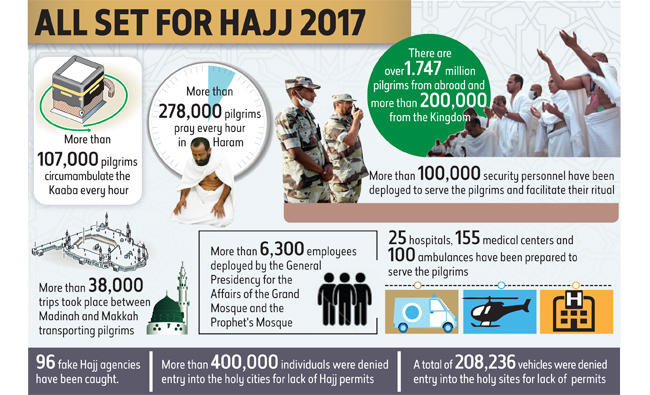
He said the Hajj plan would serve over 2 million pilgrims, including 1,747,440 who have already arrived from abroad and another 200,000 from inside Saudi Arabia, including citizens and residents.
Al-Turki stressed the efforts made at the entrance to the holy sites to detect any violations of Hajj regulations. He said more than 400,000 people have been turned away for lacking Hajj permits.
A total of 208,236 cars driven by those without the correct permits were turned away, while another 3,296 vehicles were seized at the entrances to Makkah, officials said.
Hatim bin Hassan Qadi, adviser to the minister of Hajj, announced the completion of the first phase of the pilgrim-receiving plan through the entry points in Makkah and Madinah.
He said 19,500 buses transported pilgrims from Madinah to Makkah while another 38,000 buses transported pilgrims from other areas. Pilgrims will later be transported to Mina by 9,000 buses.
Qadi affirmed the readiness of camps in Mina to receive pilgrims and said that both public and private sectors are working to serve the pilgrims.
The Hajj plan also includes myriad medical facilities for pilgrims.
Ahmad bin Rayan Barayan, general supervisor of public relations and media at the Saudi Red Crescent Authority (SRCA), said the facilities include 133 ambulance centers run by 78 physicians and specialists and 2,500 administrative employees and technicians.
He said there are 25 teams assigned for advanced response that will support field-ambulance teams, in addition to other ambulance teams.
There are four well-equipped air ambulances while 500 male and female volunteers will serve at the Grand Mosque and Arafat sites.
Health Ministry Spokesman Mishaal Al-Rabian announced the completion of the ministry’s preparations for the current Hajj season through the preparation of 25 hospitals and 155 medical centers at the holy sites. These are supported by 100 small ambulances working as mobile intensive-care units, which are capable of reaching crowded areas to attend to the injured.
Al-Rabian said 21 pilgrims who were earlier admitted to hospitals in Madinah were on Tuesday transferred to Arafat General Hospital to allow them perform the Arafat Day ritual.
He said the ministry prepared more than 285 special rooms to receive cases of heat stress and sunstroke, while medial teams carried out free-of-charge operations including open heart procedures, cardiac catheterization, dialysis and other medical services.
Civil Defense Spokesman Col. Abdullah Al-Harthi said the first phase of the emergency plan of the current Hajj season had been completed without any incident that could have adversely affected the safety of pilgrims.
He said the number of agencies involved in the emergency plan had increased from 19 to 32, with five mock incidents carried out to prepare them.


![]()
Saudi Arabia’s Hajj agencies ‘ready to serve over 2m pilgrims’
Saudi Arabia’s Hajj agencies ‘ready to serve over 2m pilgrims’


Latest updates


© 2026 SAUDI RESEARCH & PUBLISHING COMPANY, All Rights Reserved And subject to Terms of Use Agreement.