Egyptian actresses trolled over niqab, bikini photos

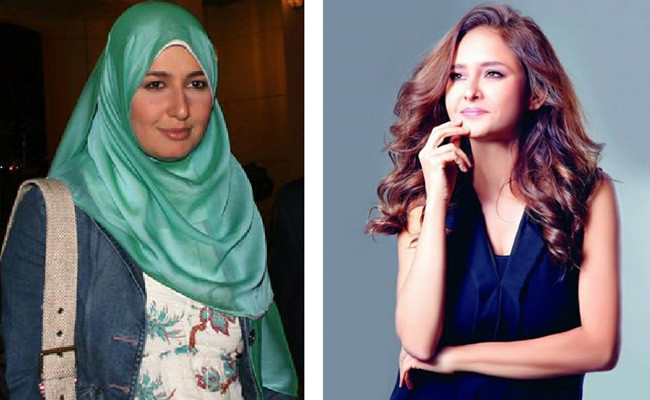
Egyptian actresses Nelly Karim (R) and Hala Shiha. (Photo courtesy: social media)
Updated 29 August 2017
Follow

Egyptian actresses trolled over niqab, bikini photos

CAIRO: Egyptian actresses Nelly Karim and Hala Shiha have been criticized over pictures they posted on social media, slamming them for what they were wearing.
Karim was recently shamed for posting a picture of herself wearing a bikini on the beach. While this week, former actress Shiha is said to have been criticized after sharing the first picture of her wearing an Islamic face veil or niqab. 
“When actors post pictures on their personal social media accounts, they understand that those platforms are public and thus, should be prepared that a backlash may follow,” Art critic Magda Khairallah said in comments to Arab News.  
Bikini backlash 
Trolls began posting comments aimed at Karim when she shared a photo of her holidaying at one of Egypt’s Red Sea resorts earlier this month. 
Despite a non-provocative pose and showing little of her body, some users said Karim should not have posted the image at all.


A post shared by Nelly Karim (@nellykarim_official) on

Comments included: “We did not expect that from a star like you,” while another said: “I used to respect you, why did you do this?” and: “why are you wearing a bikini?” 
But some also defended her, saying she was free to wear what she wanted, adding that she “looked beautiful,” and telling her to ignore the criticism. 
Niqab controversy  
Meanwhile Shiha, who quit acting several years ago to focus on religion, shared a photo on Facebook of her wearing the niqab. 
Shiha shared the photo after being out of the public eye for several years, sparking backlash among users who questioned her wearing it.  
Some users began attacking her, saying she looked like a “trash bag.” Others were skeptical about her identity, because her face was covered. 
In response Shiha asked users to avoid the hatred and negativity.
She had quit acting years ago while at the peak of her career. She first decided to wear the headscarf in her 2006 film “Kamil El Awsaf.” 
At the time, fans embraced her new appearance. Later Shiha left the acting scene and traveled to the United States where she preaches Islam.
Public trolling
Art critic Khairallah said actors should be ready to accept all kinds of reactions when sharing posts with the public. 
“Social media for actors would allow them to better promote themselves to reach a wider audience, if done right.” 
“I personally think that Karim’s picture was normal, given that she was wearing what people usually do on the beach,” Khairallah said. 
“But some people are not aware of the fine line between an actor’s lifestyle and beliefs in their private life, and try too hard to force their opinions on them.”   
And the critic said fans may have been surprised by Shiha’s decision to post a picture of her wearing a niqab in public. 
Khairallah said several actresses in Egypt who had quit their careers and were veiled, had since disappeared from the media appearances.  
“People may have reacted that way because they are suspicious towards the message she could be trying to convey through her photo, questioning the timing and the purpose.”
“But throwing impolite comments at her the way we saw is definitely unacceptable.” 

Second doctor in Matthew Perry overdose case sentenced to home confinement

Updated 17 December 2025
Follow

Second doctor in Matthew Perry overdose case sentenced to home confinement

  • Dr. Mark Chavez, 55, a onetime San Diego-based physician, pleaded guilty in federal court in October
  • Judge Sherilyn Peace Garnett also sentenced Chavez to 300 hours of community service

LOS ANGELES: A second California doctor was sentenced on Tuesday to eight months of home confinement for illegally supplying “Friends” star Matthew Perry with ketamine, the powerful sedative that caused the actor’s fatal drug overdose in a hot tub in 2023.
Dr. Mark Chavez, 55, a onetime San Diego-based physician, pleaded guilty in federal court in October to a single felony count of conspiracy to distribute the prescription anesthetic and surrendered his medical license in November.
Judge Sherilyn Peace Garnett also sentenced Chavez to 300 hours of community service. As part of his plea agreement, Chavez admitted to selling ketamine to another physician Dr. Salvador Plasencia, 44, who in turn supplied the drug to Perry, though not the dose that ultimately killed the performer. Plasencia, who pleaded guilty to four counts of unlawful drug distribution, was sentenced earlier this month to 2 1/2 years behind bars.
He and Chavez were the first two of five people convicted in connection with Perry’s ketamine-induced death to be sent off to prison.
The three others scheduled to be sentenced in the coming weeks — Jasveen Sangha, 42, a drug dealer known as the “Ketamine Queen;” a go-between dealer Erik Fleming, 56; and Perry’s former personal assistant, Iwamasa, 60.
Sangha admitted to supplying the ketamine dose that killed Perry, and Iwamasa acknowledged injecting Perry with it. It was Iwamasa who later found Perry, aged 54, face down and lifeless, in the jacuzzi of his Los Angeles home on October 28, 2023.
An autopsy report concluded the actor died from the acute effects of ketamine,” which combined with other factors in causing him to lose consciousness and drown.
Perry had publicly acknowledged decades of substance abuse, including the years he starred as Chandler Bing on the hit 1990s NBC television series “Friends.”
According to federal law enforcement officials, Perry had been receiving ketamine infusions for treatment of depression and anxiety at a clinic where he became addicted to the drug.
When doctors there refused to increase his dosage, he turned to unscrupulous providers elsewhere willing to exploit Perry’s drug dependency as a way to make quick money, authorities said. Ketamine is a short-acting anesthetic with hallucinogenic properties that is sometimes prescribed to treat depression and other psychiatric disorders. It also has seen widespread abuse as an illicit party drug.