LONDON: With Emirati Women’s Day being celebrated on Monday, it is the perfect time to celebrate one of the UAE’s most prominent artists, Sheikha Khawla Bint Ahmed Khalifa Al-Suwaidi.
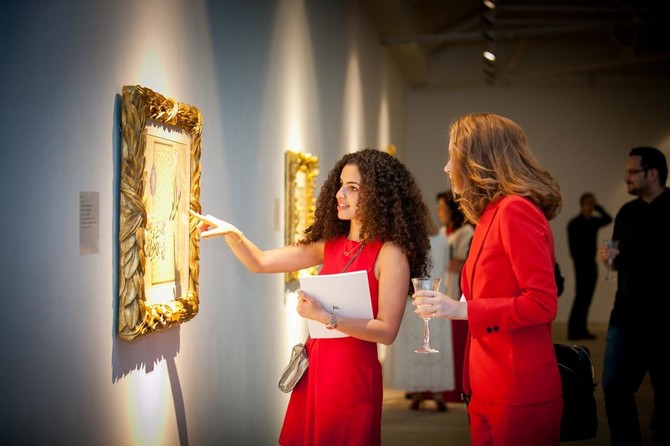
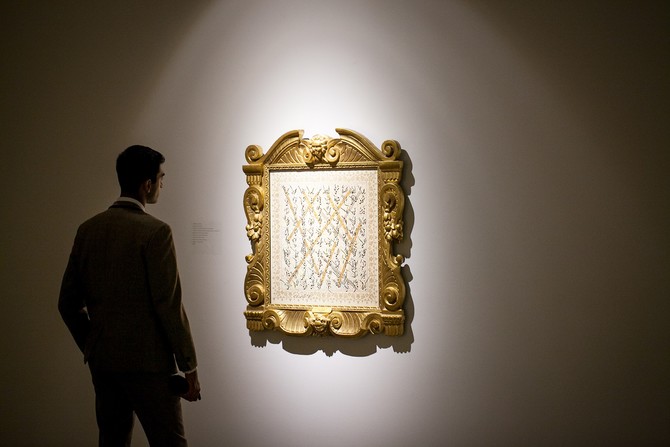
She just wrapped up her first solo art exhibition in the UK, which was on show at the ultra-chic Saatchi Gallery in London. The body of work is entitled “Letters of Love & Peace, Spoken with Ink and Paper.”
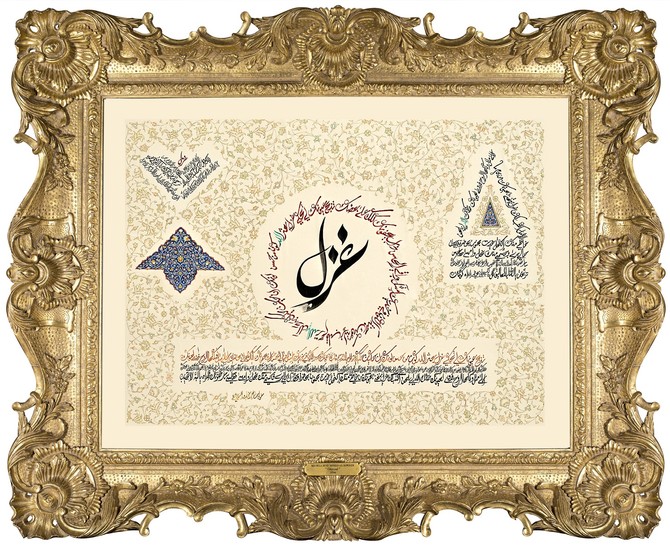
Her beautiful calligraphy, accompanied by her powerful poetry, lifts the spirits and invites the viewer to think about the meaning of love — in both its earthly and spiritual capacities.
There is a sensitive understanding of deep human feelings in her writing. She elucidates this particularly well in her piece titled “Ma El Hawa (People Wonder, What Is Love?).”
“I’ve been asked, what is love?/ I answered, it’s the /longing that/sweeps the hearts/ and melts them with/passion. It is lonely nights/flooding with tears/ the heart helpless/and powerless/weeps/ a love sick/ only with kisses/ can be revived/have mercy on your soul/young lad/and beware the love/that torments/that ruins.”
In “Ghazzal (Words of Love),” she writes:
“Your eyes kill with words/of love. God has scattered the/ cosmos to match your/ beauty. Your words only flirt. Lord have mercy on my/ Heart.”
In “Keys of Happiness,” she writes: “Keys of happiness/ giving/ love/ respect/ faith/ contentment/ appreciation/ forgiveness.”
Al-Suwaidi began studying calligraphy in 2005 under Emirati master Mohammed Mandi. She learnt about both calligraphy and the materials used for this highly-specialized art form from Mandi. She particularly likes to work with papyrus and specializes in Andalusian-Arab calligraphy.
She grew up in a family with a great love of culture and the arts. Her father, Ahmed Khalifa Al-Suwaidi served as the UAE’s first minister of foreign affairs. He founded the Abu Dhabi Cultural Foundation, home of the first National Library.
Her husband, Sheikh Tahnoun bin Mohammed Al-Nahyan, who was appointed a National Security Adviser in 2016, shares her love of the arts.
Though a gifted artist, her university studies were business orientated. She has a degree in business administration and subsequently studied interior design, fine arts and photography.
In an interview with Arab News, she described the creative inspiration behind her work.
“My poems belong to the specific moment of their inspiration. Such feelings come to me and overwhelm me unexpectedly at any time and place. Sometimes, I’m moved by another poem that I read, or by some incident that I witness or patriotic feelings that shake me. Each has a different atmosphere and effect on me which I portray in my work,” she said.
“My passion for reading led me to writing poetry and (practicing) Arabic calligraphy. I can convey my poems and ideas so they can reach the hearts of people as messages of love and peace,” she added.
Asked about the kind of atmosphere she likes to work in, she said: “These works are the outcome of my time in my own place, which has its own conditions and rituals. The table that I draw on, the right lighting and the music that takes listeners to a world of inspiring ideas where letters can be put together to create poems.”
Her love of reading and music is channelled into her work, she said.
“I have always had a passion for reading and music. I was very touched by the world of music and loved the arts, which made me seek a way through which I could convey my poems. I was able to do that with the clear Andalusian font — it has the capability of touching people’s hearts in a unique and new way,” she explained.
She is particularly moved by the reaction of young people to her work.
“I’m amazed by the young generation because they attach great importance to letters, words and poems. Young people from the audience stand in front of the paintings to read the poems. They care about the written word if you can find a way to convey it to them,” she said.
People seem to be able to connect with her art and poetry because her work deals with emotions and experiences in a very moving and humane way. It was notable that viewers in the gallery took their time to read the poetry alongside each painting.


![]()
![]()
![]()
![]()
This UAE Women’s Day, explore the work of a celebrated Emirati artist

This UAE Women’s Day, explore the work of a celebrated Emirati artist
Latest updates


© 2026 SAUDI RESEARCH & PUBLISHING COMPANY, All Rights Reserved And subject to Terms of Use Agreement.