Naked models become living art at S. Korea festival

1 / 2
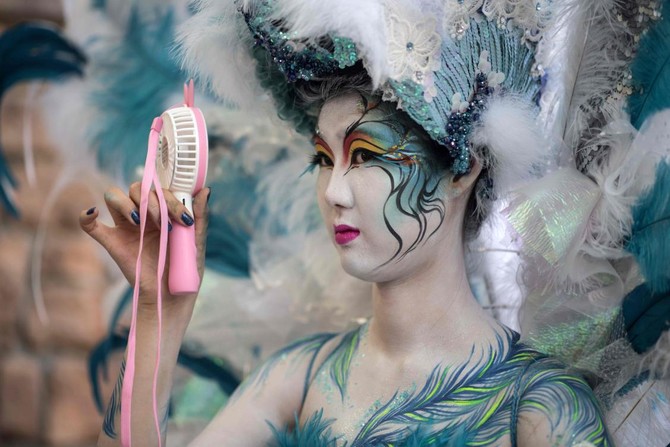
In this photo taken on August 26, 2017, a model uses a portable fan to keep cool backstage during the Daegu International Bodypainting Festival in Daegu. The bodies of dozens of female models turned into living canvases this weekend as they allowed delicate brush strokes and flamboyant illustrations to cover up their bare skin. They are part of the 2017 Daegu International Bodypainting Festival along with top artists from 10 countries that runs until August 27 in South Korea's southeastern city of Daegu. (AFP)
2 / 2
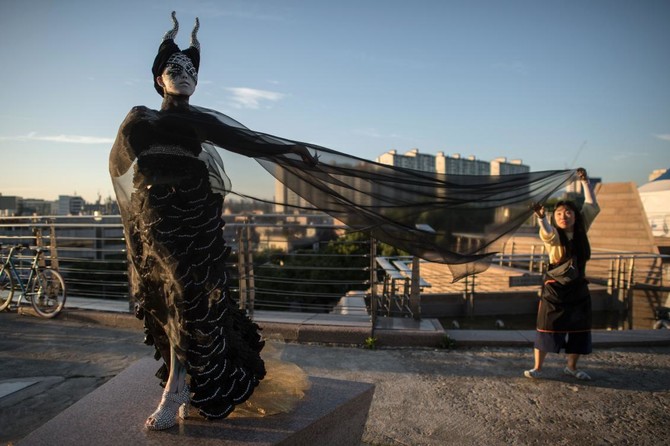
In this photo taken on August 26, 2017, a model poses for a photo during the Daegu International Bodypainting Festival in Daegu. The bodies of dozens of female models turned into living canvases this weekend as they allowed delicate brush strokes and flamboyant illustrations to cover up their bare skin. They are part of the 2017 Daegu International Bodypainting Festival along with top artists from 10 countries that runs until August 27 in South Korea's southeastern city of Daegu. (AFP)
Updated 27 August 2017
Follow

Naked models become living art at S. Korea festival

DAEGU, Korea: The bodies of dozens of female models were turned into living canvases at a festival in Seoul this weekend, as delicate brush strokes and flamboyant illustrations covered up their bare skin.
Near-naked women — wearing only panties and strategically placed pieces of tape on their breasts — packed the 2017 Daegu International Bodypainting Festival, surrounded by teams of artists and onlookers.
Top artists from across the world took part in the event South Korea’s southeastern city, as their female subjects strutted across the stage in high heeled shoes and exotic headdresses to display their dazzling body art before the cameras.
“I’ve never been naked anywhere but around my husband,” American participant Neome Mullenberg told AFP as artists, equipped with spray paint and brushes, diligently worked on her body.
“The weirdest part is that I feel like I’m fully clothed,” Mullenberg said, adding that the camera flashes and gazes from strangers did not bother her.
“It’s amazing how paint can make you feel like you’re clothed.”
In just six hours, the models were turned into walking works of art as they strutted down an open air stage in front of hundreds of spectators.
One model was transformed into an elegant blue and green peacock, while another looked as if she had just popped out of a fantasy novel, adorned with a pharaoh-like headpiece and with images of the Greek gods painted on her body.
Italian artist Anna Chapovalov said recommendations from her colleagues and photos from previous events were enough to get her to jump on a plane from Austin, Texas for this year’s festival.
“I loved how the event was organized. It’s worth it,” Chapovalov said.
The artists, who compete for cash prizes, are judged on a range of criteria including the use of color, painting techniques and originality.


Arts festival’s decision to exclude Palestinian author spurs boycott

Randa Abdel Fattah. (Photo/Wikipedia)
Updated 12 January 2026
Follow

Arts festival’s decision to exclude Palestinian author spurs boycott

  • A Macquarie University academic who researches Islamophobia and Palestine, Abdel-Fattah responded saying it was “a blatant and shameless act of anti-Palestinian racism and censorship,” with her lawyers issuing a letter to the festival

SYDENY: A top Australian arts festival has seen ​the withdrawal of dozens of writers in a backlash against its decision to bar an Australian Palestinian author after the Bondi Beach mass shooting, as moves to curb antisemitism spur free speech concerns.
The shooting which killed 15 people at a Jewish Hanukkah celebration at Sydney’s Bondi Beach on Dec. 14 sparked nationwide calls to tackle antisemitism. Police say the alleged gunmen were inspired by Daesh.
The Adelaide Festival board said last Thursday it would disinvite Randa ‌Abdel-Fattah from February’s ‌Writers Week in the state of South Australia because “it ‌would not ​be ‌culturally sensitive to continue to program her at this unprecedented time so soon after Bondi.”

FASTFACTS

• Abdel-Fattah responded, saying it was ‘a blatant and shameless act of anti-Palestinian racism and censorship.’

• Around 50 authors have since withdrawn from the festival in protest, leaving it in doubt, local media reported.

A Macquarie University academic who researches Islamophobia and Palestine, Abdel-Fattah responded saying it was “a blatant and shameless act of anti-Palestinian racism and censorship,” with her lawyers issuing a letter to the festival.
Around 50 authors have since withdrawn from the festival in protest, leaving it in doubt, local media reported.
Among the boycotting authors, Kathy Lette wrote on social media the decision to bar Abdel-Fattah “sends a divisive and plainly discriminatory message that platforming Australian Palestinians is ‘culturally insensitive.'”
The Adelaide Festival ‌said in a statement on Monday that three board ‍members and the chairperson had resigned. The ‍festival’s executive director, Julian Hobba, said the arts body was “navigating a complex moment.”

 a complex and ‍unprecedented moment” after the “significant community response” to the board decision.
In the days after the Bondi Beach attack, Jewish community groups and the Israeli government criticized Prime Minister Anthony Albanese for failing to act on a rise in antisemitic attacks and criticized protest marches against Israel’s war in ​Gaza held since 2023.
Albanese said last week a Royal Commission will consider the events of the shooting as well as antisemitism and ⁠social cohesion in Australia. Albanese said on Monday he would recall parliament next week to pass tougher hate speech laws.
On Monday, New South Wales state premier Chris Minns announced new rules that would allow local councils to cut off power and water to illegally operating prayer halls.
Minns said the new rules were prompted by the difficulty in closing a prayer hall in Sydney linked to a cleric found by a court to have made statements intimidating Jewish Australians.
The mayor of the western Sydney suburb of Fairfield said the rules were ill-considered and councils should not be responsible for determining hate speech.
“Freedom ‌of speech is something that should always be allowed, as long as it is done in a peaceful way,” Mayor Frank Carbone told Reuters.