Merkel backs Libyan coast guard but warns against abuses

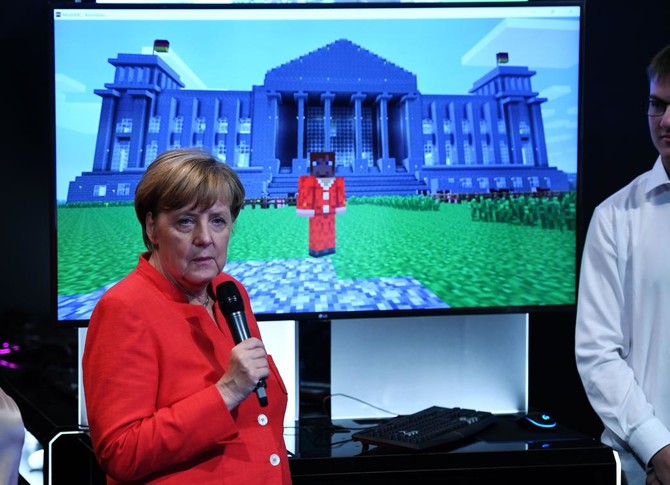
German Chancellor Angela Merkel follows a presentation of Microsoft´s Minecraft game at the stand of Microsoft during the gaming fair "gamescom" in Cologne on August 22, 2017. (AFP)
Updated 27 August 2017
Follow

Merkel backs Libyan coast guard but warns against abuses

BERLIN: German Chancellor Angela Merkel on Sunday said the Libyan coast guard should be supported in its efforts to stem the flow of migrants to Europe, but warned that rights abuses would not be tolerated.
A day before a Paris summit on the migrant crisis, Merkel said the Libyan coast guard had to become capable of patrolling its waters and should be given “the necessary equipment to do its job.”
“At the same time, of course we also consider it of the utmost importance that the Libyan coast guard adheres to international law, both in its dealings with refugees and migrants as well as non-governmental groups,” she told the Welt am Sonntag newspaper.
“Should any doubts be raised about this, then we will investigate the allegations,” she vowed.
The Libyan government sparked controversy this month when it barred foreign vessels from a stretch of water off its coast, claiming that charity boats active in the search and rescue zone were facilitating illegal migration.
The move was welcomed by Italy, the main port of arrival for migrants from north Africa, but several NGOs have since suspended their sea missions, accusing the Libyan coast guard of making threats and creating a hostile environment in the Mediterranean.
So far this year more than 100,000 people have made the perilous journey from Libya, according to the International Organization for Migration, and the European Union is eager for Libya to clamp down on the influx.
Over 2,300 have died attempting the crossing.
“We cannot allow the business of people smugglers who have the deaths of so many on their conscience,” said Merkel.
French President Emmanuel Macron is hosting talks on the crisis at the Elysee Palace on Monday, with Merkel and her Spanish and Italian counterparts in attendance.
Libya’s unity government chief Fayez Al-Sarraj and the leaders of Chad and Niger will also attend the gathering.
Merkel, who is campaigning for a fourth term in next month’s general election, told Die Welt am Sonntag that she had no regrets about her bold move to open Germany’s borders to refugees in 2015.
“I would make all the important decisions of 2015 again in the same way,” she said.
The arrival of hundreds of thousands of asylum seekers, mainly from Iraq, Syria and Afghanistan, deeply divided Germany and hurt Merkel’s approval ratings.
But as the influx has slowed in recent months, Merkel’s popularity has rebounded and her conservatives are comfortably leading in the polls ahead of the September 24 vote.


Taiwan says reached ‘general consensus’ with US on trade deal

Updated 6 sec ago
Follow

Taiwan says reached ‘general consensus’ with US on trade deal

  • Taiwan has reached a “general consensus” with the United Sates on a trade deal, the democratic island’s negotiators said Tuesday, after months of talks
TAIPEI: Taiwan has reached a “general consensus” with the United Sates on a trade deal, the democratic island’s negotiators said Tuesday, after months of talks.
Taiwan and the United States began negotiations in April to hash out a trade deal after US President Donald Trump slapped a 32 percent tariff on Taiwanese exports, which was later lowered to 20 percent, as part of his sweep of measures against dozens of trade partners.
Taiwanese President Lai Ching-te has pledged to boost investment in the United States and increase defense spending as his government tries to further reduce the levy on its shipments, as well as avoid a toll on its semiconductor chip exports.
“The goal of the US-Taiwan tariff negotiations has always been to seek reciprocal tariff reductions without stacking tariffs, and to obtain preferential treatment under Section 232 for semiconductors, semiconductor derivatives, and other items,” the Office of Trade Negotiations said in a statement, adding there was a “general consensus” on these issues.
Section 232 refers to part of the US Trade Expansion Act that allows tariffs to be imposed when national security is found to be at risk.
“Both sides are currently discussing the schedule for a concluding meeting, and an announcement will be made once it is confirmed,” the statement said.
Taiwan’s trade officials also vowed to provide “a complete explanation of the negotiations and the agreement” to the opposition-controlled parliament and the public.
American soil
Taiwan is a powerhouse in the manufacturing of semiconductor chips, which are the lifeblood of the global economy, as well as other electronics.
Trump has previously accused Taiwan of stealing the US chip industry and his administration had made clear it wants more of the critical technology made on American soil.
The US government launched investigations under Section 232 into semiconductors and chip-making equipment last year.
Taiwan’s trade surplus with the United States was the seventh highest of any country in 2024, reaching $73.9 billion.
More than half of its exports to the United States are information and communications technology products, including semiconductors.
Lai has been at pains to find favor with Trump, vowing to raise defense spending to more than three percent of GDP this year and five percent by 2030.
TSMC, which is the world’s largest contract chip maker, also has pledged to invest an additional $100 billion in the United States.
But Taiwanese Deputy Foreign Minister Francois Chih-chung Wu told AFP recently that Taiwan planned to keep making the “most advanced” chips on home soil.