


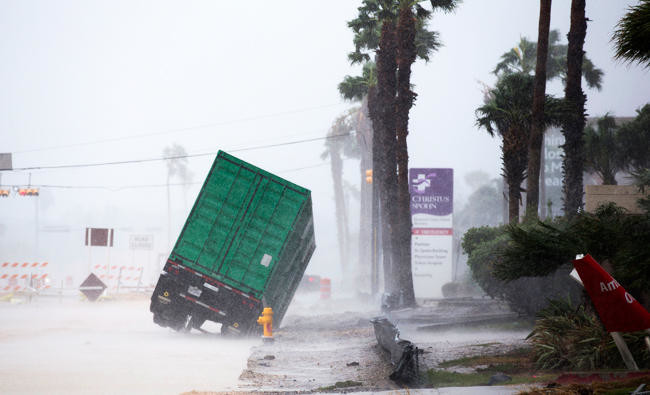
CORPUS CHRISTI, Texas: Hurricane Harvey was on the verge of reaching Texas on Friday, bringing fierce winds and torrential rain to a wide swath of the state’s Gulf Coast and prompting tens of thousands of residents fleeing inland in hopes of escaping its wrath.
The National Hurricane Center said the eyewall of the dangerous Category 4 storm reached the Texas coast Friday evening, suggesting that the eye of the storm would soon make landfall.
With time running out, residents fled Friday from the path of the increasingly menacing-looking hurricane as it took aim at an area of Texas that includes oil refineries, chemical plants and dangerously flood-prone Houston, the nation’s fourth-largest city.
Texas Gov. Greg Abbott warned that the monster system would be “a very major disaster,” and the forecasts drew fearful comparisons to Hurricane Katrina, one of the deadliest ever to strike the US
“We know that we’ve got millions of people who are going to feel the impact of this storm,” said Dennis Feltgen, a spokesman and meteorologist for the National Hurricane Center. “We really pray that people are listening to their emergency managers and get out of harm’s way.”
A view from Ocean Drive in Corpus Christi. #HurricaneHarvey Video: Gilbert H. pic.twitter.com/hPkhk4v2Ct
— KIII 3 News (@kiii3news) August 26, 2017
As night fell, punishing winds had already begun to cause damage in downtown Corpus Christi, the city closest to the center of the storm. A trash can lid skipped across a parking lot behind hotels on the seawall. In the city of 325,000 residents, a traffic light post was toppled but still lit, its wires unearthed.
Fueled by warm Gulf of Mexico waters, Harvey grew rapidly, accelerating from a Category 1 early in the morning to a Category 4 by evening. Its transformation from an unnamed storm to a life-threatening behemoth took only 56 hours, an incredibly fast intensification.
If it does not lose significant strength, the system will come ashore as the fiercest hurricane to hit the US in 13 years and the strongest to strike Texas since 1961’s Hurricane Carla, the most powerful Texas hurricane on record.
Aside from the winds of 130 mph (201 kph) and storm surges up to 12 feet (4 meters), Harvey was expected to drop prodigious amounts of rain — up to 3 feet. The resulting flooding, one expert said, could be “the depths of which we’ve never seen.”
Galveston-based storm surge expert Hal Needham said forecasts indicated that it was “becoming more and more likely that something really bad is going to happen.”
At least one researcher predicted heavy damage that would linger for months or longer.
“In terms of economic impact, Harvey will probably be on par with Hurricane Katrina,” said University of Miami senior hurricane researcher Brian McNoldy. “The Houston area and Corpus Christi are going to be a mess for a long time.”
Before the storm arrived, home and business owners raced to nail plywood over windows and fill sandbags. Steady traffic filled the highways leaving Corpus Christi, but there were no apparent jams. In Houston, where mass evacuations can include changing major highways to a one-way vehicle flow, authorities left traffic patterns unchanged.
#HurricaneHarvey now a category 4 hurricane (wind to 130mph) as of 7pm EDT according to @NWSNHC. View from 30-second update imagery #GOES16 pic.twitter.com/lEYTxM2iHA
— NWS Buffalo (@NWSBUFFALO) August 25, 2017
Federal health officials called in more than 400 doctors, nurses and other medical professionals from around the nation and planned to move two 250-bed medical units to Baton Rouge, Louisiana. Other federal medical units are available in Dallas.
Just hours before the projected landfall, the governor and Houston leaders issued conflicting statements on evacuation.
After Abbott urged more people to flee, Houston authorities told people to remain in their homes and recommended no widespread evacuations.
In a Friday press conference that addressed Houston officials’ decision to not have a voluntary or mandatory evacuation, Houston Mayor Sylvester Turner said there might be a “greater danger” in having people who don’t need to be evacuated on roads that could flood.
“We are not having a hurricane,” Harris County Judge Ed Emmett said. “We are having a rain event.”
At a convenience store in Houston’s Meyerland neighborhood, at least 12 cars lined up for fuel. Brent Borgstedte said this was the fourth gas station he had visited to try to fill up his son’s car. The 55-year-old insurance agent shrugged off Harvey’s risks.
“I don’t think anybody is really that worried about it. I’ve lived here my whole life,” he said. “I’ve been through several hurricanes.”
Scientists warned that Harvey could swamp counties more than 100 miles (161 kilometers) inland and stir up dangerous surf as far away as Alabama and the Florida Panhandle, 700 miles (1,126 kilometers) from the projected landfall.
It may also spawn tornadoes. Even after weakening, the system might spin out into the Gulf and regain strength before hitting Houston a second time Wednesday as a tropical storm, forecasters said.
By late afternoon, the storm was centered about 60 miles (96 kilometers) southeast of Corpus Christi, moving 10 mph (17 kph) to the northwest.
All seven Texas counties on the coast from Corpus Christi to the western end of Galveston Island ordered mandatory evacuations from low-lying areas. Four counties ordered full evacuations and warned there was no guarantee of rescue for people staying behind.
Voluntary evacuations have been urged for Corpus Christi and for the Bolivar Peninsula, a sand spit near Galveston where many homes were washed away by the storm surge of Hurricane Ike in 2008.
People in the town of Port Lavaca, population 12,200, appeared to heed the danger. The community northeast of Corpus Christi was a ghost town Friday, with every business boarded up. But at a bayside RV park that looked vulnerable, John Bellah drove up in his pickup to have a look at an RV he had been told was for sale. He and his wife planned to ride out Harvey.
“This is just going to blow through,” said Bellah, 72, who said he had been through Hurricane Rita in 2005 and Carla in 1961. He described those storms as “much worse.”
State officials said they had no count on how many people actually left their homes.
The storm posed the first major emergency management test of President Donald Trump’s administration.
The White House said Trump was closely monitoring the hurricane and planned to travel to Texas early next week to view recovery efforts. The president was expected to receive briefings during the weekend at Camp David.
Trump’s homeland security and counterterrorism adviser, Tom Bossert, said the administration was “bringing together the firepower of the federal government to assist the state and local governments, but the state and local governments are in the lead here.”
The last Category 4 storm to hit the US was Hurricane Charley in August 2004 in Florida. Superstorm Sandy, which pummeled New York and New Jersey in 2012, never had the high winds and had lost tropical status by the time it struck. But it was devastating without formally being called a major hurricane.
The heavy rain from Harvey threatened to turn many communities into “essentially islands” and leave them isolated for days, said Melissa Munguia, deputy emergency management coordinator for Nueces County.
The rain and the storm surge could collide like a car and a train, particularly in the Galveston and Houston areas, said Needham, who works for private firm Marine Weather and Climate.
“There’s absolutely nowhere for the water to go,” he said. Galveston Bay, where normal rain runs off to, will already be elevated.
Rain was expected to extend into Louisiana, driven by counter-clockwise winds that could carry water from the Gulf of Mexico far inland. Forecasts called for as much as 15 inches in southwest Louisiana over the next week, and up to 6 inches in the New Orleans area.
Harvey would be the first significant hurricane to hit Texas since Ike in September 2008 brought winds of 110 mph (177 kph) to the Galveston and Houston areas, inflicting $22 billion in damage.
It’s taking aim at the same vicinity as Carla, which had wind gusts estimated at 175 mph and inflicted more than $300 million in damage. The storm killed 34 people and forced about 250,000 people to evacuate.


