

Samsung heir found guilty of bribery, sentenced to five years in prison

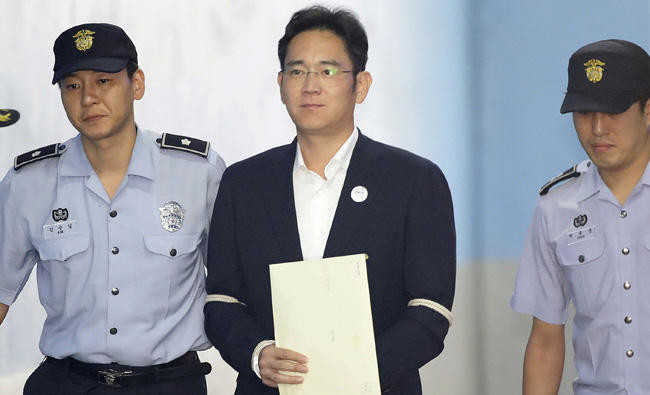
Lee Jae-yong, center, vice chairman of Samsung Electronics Co., arrives for his trial at Seoul Central District Court in Seoul, South Korea, on Friday. (Chung Sung-Jun/Pool Photo via AP)
Updated 25 August 2017
Follow

Samsung heir found guilty of bribery, sentenced to five years in prison

SEOUL: The heir to the Samsung business empire, which includes the world’s biggest smartphone maker, was sentenced Friday to five years in prison for bribery and other offenses in connection with the scandal that brought down South Korean president Park Geun-Hye.
Lee Jae-Yong’s penalty could leave the giant firm rudderless for years and hamper its ability to make key investment decisions.
The vice-chairman of Samsung Electronics, 49, arrived at Seoul Central District Court on a justice ministry bus handcuffed, bound with white rope around his dark jacket, and carrying an envelope of documents.
Lee was found guilty of bribery, embezzlement, perjury and other charges centered on payments and promises by Samsung totalling 43.3 billion won (around $40 million) to Park’s secret confidante Choi Soon-Sil.
The court found the money was in return for policy favors including government support for Lee’s hereditary succession at the group, after his father was left bedridden by a heart attack in 2014.
The defense had denied the charges, saying Samsung was pressured by Park to make the donations under duress — and that Lee was not aware of them and did not approve them. Four other top Samsung executives were also convicted and received sentences of up to four years.
Lee’s lawyers said he would appeal.
The demonstrators who mounted giant candlelit protests against Park last year also targeted Lee and other chiefs of the chaebols, as the family-controlled conglomerates that dominate Asia’s fourth-largest economy are known.
South Korea’s GDP is still growing but social and economic frustrations have mounted over the benefits not being equally shared.
Around 800 riot police were deployed around the court to prevent possible clashes between rival sets of demonstrators, Yonhap said.
It was deluged with hundreds of applications for the 30 seats in courtroom 417 available to members of the public, which were allocated by lottery.
Park’s own trial began in the same room in May, and it also saw Lee’s father Lee Kun-Hee convicted of tax and other offenses in 2008, receiving a suspended sentence.

Reform the chaebols
The verdict could add impetus to new President Moon Jae-In’s campaign pledges to reform the chaebols.
The firms have long had murky connections with political authorities in South Korea, and past trials of their leaders have often ended with light or suspended sentences, with courts citing their contributions to the economy.
The Lee clan directly owns about five percent of Samsung Electronics shares, but maintains its grip on the wider group through a byzantine web of cross-ownership stakes involving dozens of companies.
The court said Park was aware that Lee wanted state approval for a controversial merger of two Samsung units in 2015, seen as a key step to ensuring his accession.
The deal was opposed by shareholders who said it wilfully undervalued shares of one of the firms. But it eventually went through after the national pension fund — a major Samsung shareholder — approved it.
Analysts differ on the potential impact of the verdict and sentence on Samsung.
Lee has been Samsung’s de facto leader since his father fell ill, but his lawyers and ex-members of the former elite Future Strategy Office (FSO), which dictated the vast group’s overall direction and major business decisions, sought to portray him as naive and inexperienced.
“Samsung will not be doomed without Jay Lee,” said Geoffrey Cain, the author of a forthcoming book on the group. “It’s up to the specialists to make their own decisions.”
Samsung appears to have been unaffected by Lee’s absence so far — he was detained in custody in February — with flagship subsidiary Samsung Electronics making record profits on the back of strong demand for its memory chips.
But Chung Sun-Sup, the head of corporate analysis firm chaebul.com, said major chaebol decisions on large-scale acquisitions or investments “are often endorsed by the patriarch of a ruling family,” and with Lee in prison the firm “may move more slowly than before.”
Its shares have soared in recent months, but were down 1.05 percent on Friday afternoon after the verdict.
The ruling is seen as a strong indicator of the likely outcome in Park’s trial, as some of the charges against the ousted head of state her are inextricably linked to the accusations Lee faced.

Saudi Aramco achieves significant progress in its gas production plan

Updated 26 February 2026
Follow

Saudi Aramco achieves significant progress in its gas production plan

RIYADH: Saudi Aramco has announced the achievement of significant progress in its plan to expand gas production, with the start of production at the Jafurah field, the largest unconventional gas field in the Middle East, and the commencement of operational activities at the Tanajib Gas Plant, one of the largest gas plants in the world.

The oil giant aims to increase its sales gas production capacity by approximately 80 percent by 2030 compared to 2021 production levels, reaching nearly 6 million barrels of oil equivalent per day from total gas and associated liquids production, according to the Saudi Press Agency.

This is expected to generate additional operating cash flows ranging between $12 billion and $15 billion in 2030, subject to future demand for sales gas and liquids prices.

President and CEO of Saudi Aramco, Amin Al-Nasser, said: “We are proud to commence production at the Jafurah field and begin operations at the Tanajib Gas Plant. These are major achievements for Saudi Aramco and the future of energy in the Kingdom. Our ambitious gas program is expected to become a key source of profitability.”

He affirmed that these mega-projects contribute to meeting the growing domestic demand for gas, supporting industrialization and development in several key sectors, in addition to producing significant quantities of high-value liquids.

Al-Nasser expressed his gratitude for the support, trust, and attention that Saudi Aramco receives from the Custodian of the Two Holy Mosques, King Salman bin Abdulaziz Al Saud, and His Royal Highness Prince Mohammed bin Salman bin Abdulaziz Al Saud, crown prince and prime minister, noting that this has had the most profound impact on the company’s achievements and distinguished projects that serve the Kingdom’s Vision 2030.

The gas extracted from the Jafurah field is expected to support the Kingdom’s growth targets in key sectors such as energy, artificial intelligence, major industries, and petrochemicals, potentially providing a major boost to the Kingdom’s economy and strengthening its position among the world’s top ten gas producers.

Saudi Aramco began first producing unconventional shale gas from the Jafurah field in December 2025, with technology playing a pivotal role in unlocking the potential of the Jafurah field and establishing it as a global benchmark for unconventional gas development. 

Since its inception, the project has leveraged technology to help reduce drilling and stimulation costs and enhance well productivity, contributing to its strong economic prospects.

The Jafurah area covers 17,000 sq. km and is estimated to contain 229 trillion standard cubic feet of raw gas and 75 billion barrels of condensates. The Jafurah field project aims to produce 2 billion standard cubic feet per day of sales gas, 420 million standard cubic feet per day of ethane, and approximately 630,00 barrels per day of gas liquids and condensates by 2030.

The Tanajib Gas Plant is a key pillar in Aramco’s strategy to increase gas processing capacities and diversify its energy product portfolio, helping to foster long-term economic growth. 

Operations began in December 2025, and its raw gas processing capacity is expected to reach 2.6 billion standard cubic feet per day in 2026. The start of operations at the Tanajib Plant coincided with the commencement of production from the Marjan field expansion and development program. 

The plant is distinguished by its digital integration, enhanced operational efficiency, capability to execute complex projects, and optimal use of resources. It processes raw gas associated with crude oil production from the offshore Marjan and Zuluf fields.

Aramco’s gas expansion is expected to create thousands of direct and indirect job opportunities, generating significant added value and strengthening its position as a reliable energy provider. 

It also helps meet the growing demand for natural gas and enhances its supply to national industries. 

The expansion strategy supports efforts aimed at achieving the optimal energy mix for local electricity generation, advancing the Kingdom’s liquid fuel displacement program, which will have a positive environmental impact, supporting the Kingdom’s ambition to achieve net-zero emissions by 2060, enhancing energy security, and contributing to building a more diversified national economy.