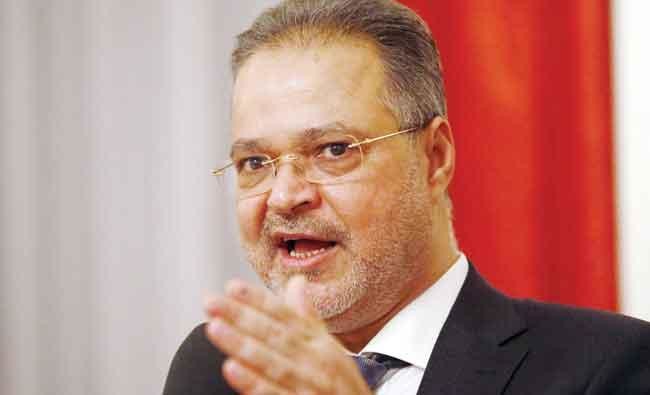
UNITED NATIONS: Yemen’s foreign minister blamed Iran and its support for Houthi Shiite rebels on Monday for causing the country’s civil war and said it can’t be part of the solution.
Abdulmalik Al-Mekhlafi said at a press conference that Iranian weapons are still being smuggled into Yemen.
Saudi Arabia’s UN ambassador, Abdallah Al-Mouallimi, whose country supports Yemen’s internationally recognized government, said Iran isn’t a neighbor or part of the Arabian Peninsula and he had a more direct message: “Iran should get the hell out of the area, period.”
The Saudi and Yemeni officials spoke to reporters after a presentation to UN diplomats on the path to peace and humanitarian aid to Yemen.
Yemen, which is on the southern edge of the Arabian Peninsula, has been engulfed in civil war since September 2014, when the Houthis swept into the capital of Sanaa and overthrew President Abed-Rabbo Mansour Hadi’s internationally recognized government.
In March 2015, a Saudi-led coalition began a campaign in support of Hadi’s government and against Houthi forces allied with ousted President Ali Abdullah Saleh. Since then, the Iranian-backed Houthis have been dislodged from most of the south, but remain in control of Sanaa and much of the north.
The war in Yemen has killed over 10,000 civilians and displaced 3 million people. UN humanitarian chief Stephen O’Brien said Friday that 17 million Yemenis don’t know where their next meal is coming from, nearly 7 million are facing the threat of famine and almost 16 million lack access to clean water and sanitation. The World Health Organization said last week that 2,000 people have been killed and an estimated 500,000 infected in a cholera outbreak.
Al-Mekhlafi said that “the Yemeni government ... will not be an obstruction to peace.” But he said the Houthis and Saleh “cannot monopolize power.”
The two diplomats reiterated Yemeni and Saudi support for a proposal by UN envoy Ismail Ould Cheikh Ahmed to reopen Sanaa airport for commercial flights and to hand over the port of Hodeida to a committee of “respected Yemeni security and economic figures” that would use the port revenues to pay civil servants.
The Houthis have not accepted the proposal, but Cheikh Ahmed said Friday he hopes their leaders will accept his invitation to meet in a third country to discuss the proposals.
The Saudi ambassador warned diplomats to beware of three “fallacies” about Yemen.
First, Al-Mouallimi said, supporting a cessation of hostilities “actually means the de facto partition of Yemen and the consolidation of a reactionary movement that is tied with Iran in the north part of Yemen and a weak Yemeni state in the southern part of Yemen.”
“This is no recipe for sustainable peace,” he said, stressing that any cease-fire has to be linked to implementation of a 2015 UN Security Council resolution demanding that the Houthis withdraw from all areas they captured, hand over arms seized from military and security institutions, and stop all actions falling within the authority of the legitimate government.
Al-Mouallimi said the second fallacy “is that we must all sit around the table and talk.” He said there have been talks “everywhere,” including Geneva, Kuwait, Moscow and Saudi Arabia. Yemen’s recognized government has shown willingness to move forward with a political settlement, Al-Mouallimi said, while the Houthis have rejected Cheikh Ahmed’s proposal and refused to meet him.
The third fallacy, he said, is that people often seem to think that “a disastrous humanitarian situation, a catastrophic spread of cholera” afflict all of Yemen. But “all of that is concentrated in one part of Yemen which is controlled by the Houthis,” he said. Al-Mouallimi said the entire world, especially Saudi Arabia, is ready to provide aid but he said the Houthis are unable or “sometimes maybe unwilling” to manage and distribute aid.
Looking ahead, Yemen’s foreign minister predicted that “in the end,” the parties will get to the place where they started — when the end of a national dialogue in January 2014 all political parties agreed on a road map for a political transition.
But unfortunately, to get there Yemenis will have “paid a high price for peace,” Al-Mekhlafi said.


Yemen blames Iran for war, says it can’t be part of solution
Yemen blames Iran for war, says it can’t be part of solution


How the RSF is targeting the disabled in Sudan
- Atrocities of the RSF in El Fasher were outlined in a damning report released by Human Rights Watch last month, in what the UN body called “hallmarks of genocide”
- According to the report, RSF members targeted, abused, and killed people with disabilities during and after their brutal takeover of North Darfur’s capital
PORT SUDAN: Long before checkpoints were erected, disabled civilians in El Fasher, the main city of Darfur in western Sudan, were already trapped.
When war erupted between Sudan’s army and the Rapid Support Forces, a paramilitary force, in April 2023, most residents could still flee advancing front lines. For many people with mobility impairments, visual disabilities or chronic illnesses, however, escape was never simple.
When the RSF encircled El Fasher in May 2024, that limited mobility hardened into confinement. The siege not only isolated a city; it immobilized a segment of its population first.
“We were watching others leave, but we had nowhere to go,” said Mariam M., a resident who uses crutches and fled the city three months ago. “Every time the shelling moved closer, my family would ask how we would carry me if we had to run.”
As time passed, people stopped talking about escape, understanding that if the fighters reached their neighborhoods, they would need to face them.
The atrocities of the RSF in El Fasher were outlined in a damning report released by Human Rights Watch last month, in what the UN body called “hallmarks of genocide.”
According to the report, RSF members targeted, abused, and killed people with disabilities during and after their brutal takeover of North Darfur’s capital.
El Fasher was the last major urban center in Darfur outside full RSF control. Its capture promised strategic depth: access to cross-border routes into Chad and Libya, leverage over humanitarian corridors, and symbolic dominance in a region historically resistant to paramilitary expansion. Rather than risk immediate, costly urban combat, the RSF tightened the perimeter and applied pressure gradually.
For ambulant residents, shrinking markets and fuel shortages meant hardship. For those using wheelchairs or crutches, it meant disappearance from the public space, although over 20 percent became affected by some level of disability.
As fuel ran out, transport halted. As hospitals collapsed, prosthetics could not be repaired, infections went untreated, and temporary injuries became permanent impairments. When electricity failed, assistive devices that required charging stopped working.
Water shortages forced people to travel farther for basic survival — a distance some simply could not cover.
The siege functioned as attrition warfare that exhausted supply lines, fragmented civilian life, and weakened military defenders indirectly. But attrition accumulated unevenly. In a city where medical care had already been degraded by months of national conflict, the blockade multiplied disabilities — through untreated shrapnel wounds, malnutrition-related weakness, preventable amputations, and trauma.
At the same time, diplomatic efforts lagged behind events on the ground. The UN Security Council struggled to unify around enforcement measures, while competing mediation tracks diluted leverage. Allegations that the RSF continued to receive external support complicated calls for accountability.
In that vacuum, siege warfare dominated. For civilians whose disabilities made flight impossible, the absence of sustained international pressure translated into prolonged exposure.
Humanitarian agencies negotiated access with the same armed actors accused of abuses, producing delayed convoys, selective permissions, and corridors that opened and closed unpredictably.
Inclusive relief — ramps, assistive devices, rehabilitation support — requires logistical planning and sustained pressure. Those needing the most tailored assistance were the least likely to receive it.
By the time the final assault unfolded, the people of El Fasher were already hugely impacted by siege conditions, mostly deepening their already bad health conditions. When fighters later scrutinized civilians at improvised checkpoints, visible impairments were the physical residue of many months of collapse.
In an environment saturated with fear of hidden combatants, a missing limb could be misread as a battlefield wound. A limp could be recast as evidence. A cognitive disability could be dismissed as a mental illness. The long encirclement had stripped institutions away; what remained was judgment delivered in seconds, based on the body alone.
Fatima M., a 33-year-old teacher, could not run. She moved on aluminum crutches, the rubber tips slipping on broken pavement. She joined a cluster of civilians heading north, toward what they hoped was an open road.
Instead, they met a checkpoint forming in real time — pickup trucks, mounted guns, young men shouting instructions no one could fully hear over the panic. “If you cannot run, you are not a ‘civilian’ to them; you are a target who is too slow to escape,” she said.
What happened next followed a pattern that survivors would later describe with chilling consistency.
Men with visible impairments were separated first. Missing limbs drew suspicion, while cognitive disabilities were met with mockery. Fighters accused some of being wounded soldiers from the Sudanese Armed Forces hiding among civilians. Others were dismissed as “useless.”
Several were shot where they stood, Fatima M. described. Their bodies were left in the road as convoys were ordered forward. “They didn’t see people in us, but I begged them to spare me,” she said. “I saw them shoot a man just because his legs wouldn’t move as fast as their shouting.”
Such accounts are consistent with HRW’s report. Emina Cerimovic, associate disability rights director at HRW, said: “We heard how (the RSF) accused some victims, particularly those missing a limb, of being injured fighters and summarily executed them. Others were beaten, abused, or harassed because of their disability, with fighters mocking them as ‘insane’ or for not being a ‘complete person.’”
The atrocities in El Fasher represent just one grim facet of a nationwide crisis for Sudan’s estimated 4.6 million people with disabilities, who comprise about 15 percent of the 33.7 million individuals requiring humanitarian aid amid the ongoing war, a likely underestimate.
Since the conflict erupted, over 40,000 injuries have been reported, with civilians bearing the brunt through direct attacks, explosive remnants, and sieges that exacerbate vulnerabilities like untreated wounds, leading to permanent disabilities.
Another challenge is that most displacement and casualty reporting categorizes civilians by age and gender, not by functional impairment. Disability is rarely tracked systematically in conflict assessments.
When it is not counted, it is not prioritized in ceasefire terms, evacuation corridors, or accountability debates. Violence against disabled civilians can therefore remain statistically submerged — visible in testimony, absent in negotiation frameworks.
Until today, despite mounting documentation of atrocities, accountability in Sudan remains partial and politically constrained. The UN Security Council has imposed targeted sanctions on select commanders, and investigations continue at the international level, but enforcement is uneven and slow. Broader measures — including comprehensive arms embargo enforcement or coordinated asset tracking — remain fragmented.
“It is clear that we need a ceasefire in Sudan,” Antonio Guterres, the UN Secretary-General, said, stressing the need for stronger external pressure but without directly addressing parties’ battlefield calculus. “The flow of weapons and fighters from external parties must be cut off.”
Mediation efforts are similarly splintered. The African Union has called for inclusive ceasefire talks, while parallel initiatives in regional capitals compete for influence rather than consolidate leverage.
External backing — alleged by UN experts to be flowing into Sudan despite embargo frameworks — further complicates negotiations. No single diplomatic track has secured sustained compliance from the warring parties.
For Darfur in 2026, this means entrenched instability. With El Fasher under RSF control, displacement remains high, humanitarian access fragile, and reconstruction distant.
Without unified pressure and credible accountability mechanisms, humanitarian organizations and activists warn that conflict risks hardening into a protracted territorial stalemate — one in which civilian protection, including for disabled communities, remains secondary to military consolidation.