Iraqi forces close in on Daesh-held Tal Afar

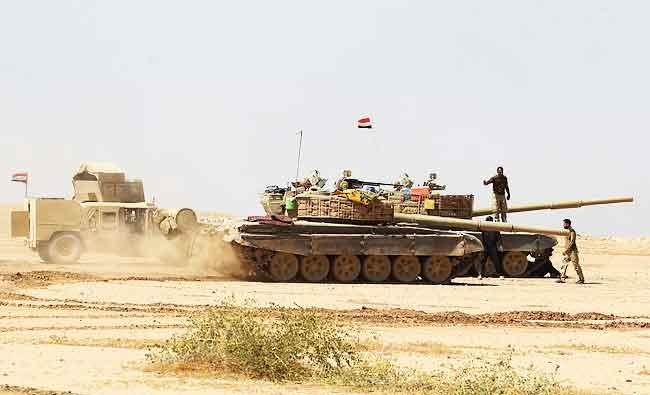
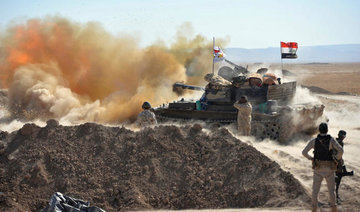
Iraqi forces, backed by Shiite fighters from the Popular Mobilization Forces, advance towards the towards the city of Tal Afar, the main remaining stronghold of the Islamic State group, after the government announced the beginning of an operation to retake it from the jihadists, on Monday. (AFP)
Updated 22 August 2017
Follow

Iraqi forces close in on Daesh-held Tal Afar

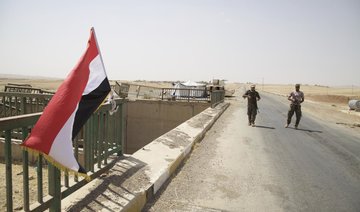
TAL AL-HESSAN, Iraq: Iraqi forces closed in Monday on Tal Afar on the second day of an offensive against the last major bastion of Daesh in the country’s north, seizing several villages around the city.
In the desert plains around Tal Afar, convoys of tanks and armored vehicles could be seen heading for the terrorist-held city, raising huge clouds of dust.
The offensive launched at dawn Sunday comes only weeks after Iraqi forces retook second city Mosul from Daesh and as the extremists also face assaults on their positions in neighboring Syria.
Tal Afar was once a major supply hub between Mosul and the Syrian border and capturing it would be another major blow to Daesh’s self-declared “caliphate” that once controlled large areas straddling Syria and Iraq.
The Iraqi Army, federal police and counter-terrorism forces backed by 20,000 fighters from the Hashed Al-Shaabi paramilitary group launched the offensive on Tal Afar.
They are battling Daesh on three fronts — the west, south and southeast — and commanders have told AFP they expect to tighten the noose on the militants by edging closer to the gates of the city.
The federal police said its forces had retaken five villages on the western front, with its chief Raed Shakir Jawdat saying they were only “a few hundred meters from Al-Kifah,” the nearest western neighborhood of the city.


IMF approves reviews, unlocks $240m in funding for Jordan

Updated 55 min 38 sec ago
Follow

IMF approves reviews, unlocks $240m in funding for Jordan

  • The decision allows Jordan to draw about $130 million under the EFF and about $110 million under the RSF

AMMAN: The International Monetary Fund’s executive board has completed the fourth review of Jordan’s Extended Fund Facility and the first review under the Resilience and Sustainability Facility, unlocking immediate access to about $240 million to support the kingdom’s economic program.

The decision allows Jordan to draw about $130 million under the EFF and about $110 million under the RSF, bringing total disbursements under the IMF arrangement to about $733 million.

In a statement issued on Saturday, the IMF said Jordan’s economy “remains resilient,” supported by sound macroeconomic policies and strong international backing.

Growth accelerated to 2.7 percent in the first half of 2025 and is expected to reach about 3 percent in the coming years, driven by major investment projects, deeper regional integration and continued structural reforms.

Inflation remains anchored at about 2 percent, while the current account deficit is projected to narrow to below 5 percent of GDP over the medium term. The IMF also noted that Jordan’s banking sector is stable and international reserves remain strong.

Fiscal performance continues to align with program targets, underpinned by robust revenue collection and disciplined current spending. The authorities remain committed to reducing public debt to 80 percent of GDP by 2028 through gradual fiscal consolidation, while protecting social and development spending and reducing losses at public utilities.

The IMF said progress under the RSF is ongoing, with reforms addressing vulnerabilities in the water and electricity sectors and strengthening health emergency preparedness. All reform measures scheduled for the current review have been completed.

Commenting after the board discussion, IMF Deputy Managing Director Kenji Okamura said Jordan’s continued macroeconomic stability amid persistent external headwinds reflects the authorities’ commitment to sound policies, supported by strong international assistance.

He said growth continues to recover, inflation remains low and reserve buffers are strong, stressing the importance of maintaining prudent fiscal and monetary policies amid regional tensions and global uncertainty.

Okamura added that accelerated structural reforms are essential to foster job-rich growth, improve the business environment, enhance labour market flexibility, tackle youth unemployment and low female labour force participation, and attract private investment.

He also underlined the importance of sustained donor support to help Jordan manage external challenges and the economic cost of hosting large numbers of refugees, while noting that progress under the RSF would help address long-term vulnerabilities and strengthen balance-of-payments stability.