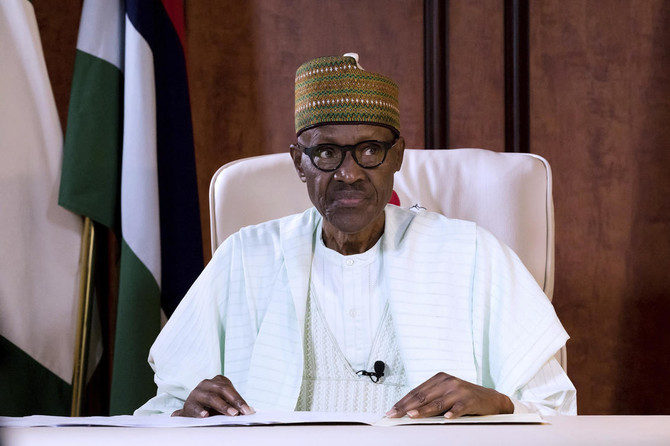
Nigerian president vows to step up fight against Boko Haram

In this photo released by the Nigeria State House, Nigeria's President Muhammadu Buhari looks on during a broadcast to the Nation at the Presidential palace in Abuja, Nigeria, Monday, Aug. 21, 2017. Nigeria's President Muhammadu Buhari said his government will reinvigorate its campaign against the Islamic extremist insurgency in the country's northeast as he spoke to the nation for the first time Monday after returning from London where he spent more than three months for medical treatment. (Bayo Omoboriowo/Nigeria State House via AP)
Updated 21 August 2017
Follow

Nigerian president vows to step up fight against Boko Haram

ABUJA, Nigeria: Nigeria’s President Muhammadu Buhari said his government will reinvigorate its campaign against the Islamic extremist insurgency in the country’s northeast as he spoke to the nation for the first time Monday after returning from London where he spent more than three months for medical treatment.
“Terrorists and criminals must be fought and destroyed relentlessly so that the majority of us can live in peace and safety,” said Buhari in a televised speech on Monday. “Therefore we are going to reinforce and reinvigorate the fight not only against elements of Boko Haram which are attempting a new series of attacks on soft targets, kidnappings, farmers versus herdsmen clashes, in addition to ethnic violence fueled by political mischief makers. We shall tackle them all.”
Buhari returned Saturday to Abuja, though he didn’t make any comments upon his arrival to Abuja. Though he looked slimmer than his early days in office, his appearance was healthier than it had seemed in previous months as he walked from the airplane, and video footage later Saturday showed him shaking hands, smiling and laughing with dignitaries on his return.
In his address, Buhari, 74, did not say what illness caused him to leave Nigeria in May for the lengthy treatment in Britain. He thanked Nigerians for their prayers.
“I am pleased to be back on home soil among my brothers and sisters,” Buhari said.
The government of Africa’s most populous nation has never said what exactly has been ailing Buhari and his long absences have led some to call for his replacement and for the military to remind its personnel to remain loyal.
Earlier this year Buhari spent seven weeks in London for treatment and said he had never been so sick in his life.
In his address, Buhari talked about political divisions, urging that Nigeria must be united. He said that while he was in London he kept in touch with daily events at home.
“Nigerians are robust and lively in discussing their affairs, but I was distressed to notice that some of the comments, especially in the social media have crossed our national red lines by daring to question our collective existence as a nation. This is a step too far,” he said.
Observers have feared that political unrest could erupt in Nigeria, particularly in the predominantly Muslim north, should Buhari not finish his term in office, which ends in 2019. The previous president was a Christian from the south, as is Vice President Yemi Osinbajo, who has served as acting president during Buhari’s time abroad.
Nigeria’s ongoing challenges include the deadly Boko Haram insurgency, a weak economy and one of the world’s worst humanitarian crises, with millions malnourished in the northeast.
Buhari called on Nigerians to come together to face challenges of “economic security, political evolution and integration as well as lasting peace.”
Ending his first national address for months, Buhari said “I remain resolutely committed to ensuring that these goals are achieved and maintained. I am so glad to be home.”
This isn’t the first time Nigeria has faced a leader’s long absences. When former President Musa Yar’Adua was ill abroad for months before coming home to die in 2009, northerners blocked his southern Vice President Goodluck Jonathan from assuming power, creating a months-long political paralysis.
Jonathan was eventually confirmed, but his subsequent successful run for election angered many Muslims, breaking an unwritten agreement that power rotates between northerners and southerners.
Buhari will submit a letter to the National Assembly Monday to reassure them he is back in office, said Femi Adesina, special assistant to the president on media and publicity, speaking on a local news program after Buhari’s address.


Tens of thousands protest in Minneapolis over fatal ICE shooting

Updated 11 January 2026
Follow

Tens of thousands protest in Minneapolis over fatal ICE shooting

  • Federal-state tensions escalated further on Thursday when a US Border Patrol agent in Portland, Oregon, shot and wounded a man and woman in their car after an attempted vehicle stop

MINNEAPOLIS: Tens of thousands of people marched through Minneapolis on Saturday to decry the fatal shooting of a woman by a US immigration agent, part of more than 1,000 rallies planned nationwide this weekend against the ​federal government’s deportation drive. The massive turnout in Minneapolis despite a whipping, cold wind underscores how the fatal shooting of 37-year-old Renee Good by an Immigration and Customs Enforcement officer on Wednesday has struck a chord, fueling protests in major cities and some towns. Minnesota’s Democratic leaders and the administration of President Donald Trump, a Republican, have offered starkly different accounts of the incident.

HIGHLIGHTS

• Minneapolis police estimate tens of thousands present at protests on Saturday

• Mayor urges protesters to remain peaceful and not ‘take the bait’ from Trump

• Over 1,000 ‘ICE Out’ rallies planned across US

• Minnesota Democrats denied access to ICE facility outside Minneapolis

Led by a team of Indigenous Mexican dancers, demonstrators in Minneapolis, which has a metropolitan population of 3.8 million, marched toward the residential street where Good was shot in her car.

’HEARTBROKEN AND DEVASTATED’
The boisterous crowd, which the Minneapolis Police Department estimated in the tens of thousands, chanted Good’s name and slogans such as “Abolish ICE” and “No justice, no peace — get ICE off our streets.”
“I’m insanely angry, completely heartbroken and devastated, and then just like longing and hoping that things get better,” Ellison Montgomery, a 30-year-old protester, told Reuters.
Minnesota officials have called the shooting unjustified, pointing to bystander video they say showed Good’s vehicle turning away from the agent as he fired. The Department of Homeland Security, ‌which oversees ICE, ‌has maintained that the agent acted in self-defense because Good, a volunteer in a community network that monitors and ‌records ⁠ICE operations ​in Minneapolis, drove ‌forward in the direction of the agent who then shot her, after another agent had approached the driver’s side and told her to get out of the car.
The shooting on Wednesday came soon after some 2,000 federal officers were dispatched to the Minneapolis-St. Paul area in what DHS has called its largest operation ever, deepening a rift between the administration and Democratic leaders in the state. Federal-state tensions escalated further on Thursday when a US Border Patrol agent in Portland, Oregon, shot and wounded a man and woman in their car after an attempted vehicle stop. Using language similar to its description of the Minneapolis incident, DHS said the driver had tried to “weaponize” his vehicle and run over agents.
The two DHS-related shootings prompted a coalition of progressive and civil rights groups, including Indivisible and the American Civil Liberties Union, to plan more than 1,000 events under the banner “ICE Out For Good” on Saturday and Sunday. The rallies have ⁠been scheduled to end before nightfall to minimize the potential for violence.
In Philadelphia, protesters chanted “ICE has got to go” and “No fascist USA,” as they marched from City Hall to a rally outside a federal detention facility, according to ‌the local ABC affiliate. In Manhattan, several hundred people carried anti-ICE signs as they walked past an immigration ‍court where agents have arrested migrants following their hearings.
“We demand justice for Renee, ICE ‍out of our communities, and action from our elected leaders. Enough is enough,” said Leah Greenberg, co-executive director of Indivisible.

DEMONSTRATIONS MOSTLY PEACEFUL

Minnesota became a major flashpoint in ‍the administration’s efforts to deport millions of immigrants months before the Good shooting, with Trump criticizing its Democratic leaders amid a massive welfare fraud scandal involving some members of the large Somali-American community there.
Minneapolis Mayor Jacob Frey, a Democrat who has been critical of immigration agents and the shooting, told a press conference earlier on Saturday that the demonstrations have remained mostly peaceful and that anyone damaging property or engaging in unlawful activity would be arrested by police.
“We will not counter Donald Trump’s chaos with our own brand of chaos,” Frey said. “He wants us to take the bait.”
More ​than 200 law enforcement officers were deployed Friday night to control protests that led to $6,000 in damage at the Depot Renaissance Hotel and failed attempts by some demonstrators to enter the Hilton Canopy Hotel, believed to house ICE agents, the City of Minneapolis said in a statement.
Police ⁠Chief Brian O’Hara said some in the crowd scrawled graffiti and damaged windows at the Depot Renaissance Hotel. He said the gathering at the Hilton Canopy Hotel began as a “noise protest” but escalated as more than 1,000 demonstrators converged on the site, leading to 29 arrests.
“We initiated a plan and took our time to de-escalate the situation, issued multiple warnings, declaring an unlawful assembly, and ultimately then began to move in and disperse the crowd,” O’Hara said.

HOUSE REPRESENTATIVES TURNED AWAY FROM ICE FACILITY
Three Minnesota congressional Democrats showed up at a regional ICE headquarters near Minneapolis on Saturday morning, where protesters have clashed with federal agents this week, but were denied access. Legislators called the denial illegal.
“We made it clear to ICE and DHS that they were violating federal law,” US Representative Angie Craig told reporters as she stood outside the Whipple Federal Building in St. Paul with Representatives Kelly Morrison and Ilhan Omar.
Federal law prohibits DHS from blocking members of Congress from entering ICE detention sites, but DHS has increasingly restricted such oversight visits, prompting confrontations with Democratic lawmakers.
“It is our job as members of Congress to make sure those detained are treated with humanity, because we are the damn United States of America,” Craig said.
Referencing the damage and protests at Minneapolis hotels overnight, DHS spokesperson Tricia McLaughlin said the congressional Democrats were denied entry to ensure “the safety of detainees and staff, and in compliance with the agency’s mandate.” She said DHS policies require members of Congress to notify ICE ‌at least seven days in advance of facility visits.