


Qatar unveils sixth FIFA World Cup 2022 stadium design

The stadium is due to hold 40,000 fans during the tournament itself, but will be reduced to a 20,000-seat venue once the tournament is over.
Updated 20 August 2017
Follow

Qatar unveils sixth FIFA World Cup 2022 stadium design

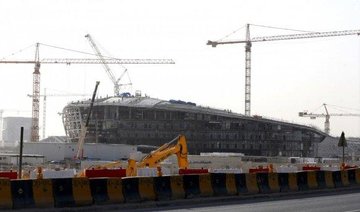
DUBAI: The authority responsible for delivering Qatar’s World Cup stadiums has revealed designs for the Al-Thumama Stadium – the sixth proposed 2022 FIFA World Cup venue.
The stadium has been designed by Qatari architect Ibrahim Jaidah, who is the chief architect of Arab Engineering Bureau (AEB) and is based on the traditional ‘gahfiya’ headdress.
A contract has already been awarded for the stadium’s construction by the Supreme Committee for Delivery and Legacy (SC) to a joint venture between Qatar-based contractor Al-Jaber Engineering and Turkey’s Tekfen Construction. It was awarded in February.
The stadium is due to hold 40,000 fans during the tournament itself, but will be reduced to a 20,000-seat venue once the tournament is over, with the excess seating donated to a country in need of sporting infrastructure, SC said in its statement.
It will be built on pitches currently used by the Qatar Football Association in the Al-Thumama district, which is located in the south of Doha, about 12 kilometers from Hamad International Airport.

Hassan Al-Thawadi, SC Secretary General, said: “We’ve always been very careful to combine the past with the future in our designs. The gahfiya is a continuation of that theme. It’s a blend of our heritage and culture, and a commitment to the future.”
He also described Jaidah as “a well-known architect in Qatar”.
“Our vision with this World Cup was always to complement and assist in developing local talent,” Al-Thawadi said.
Jaidah described his design as “a nod to the past, while offering an exciting glimpse into Qatar’s tomorrow”.
“In Qatari culture, the gahfiya forms an important part of every young boy’s pathway to adulthood,” he said. “This rite of passage inspired my vision for the stadium’s design. It is an arena that symbolizes Qatar’s youth and its emergence as a major player on the global sporting scene.”
Once the tournament is complete, the surrounding site will undergo a conversion to house a boutique hotel and a sports clinic, while the surrounding precinct will have facilities for other sports including handball, tennis and swimming.

Decision to boycott India match puts pressure on Pakistan at the Twenty20 World Cup

Updated 2 sec ago
Follow

Decision to boycott India match puts pressure on Pakistan at the Twenty20 World Cup

  • Pakistan government has instructed the national team to boycott its Feb. 15 Group A game against its sporting and political archrival
ISLAMABAD: Pakistan will be in the spotlight more for its decision to boycott its marquee Twenty20 World Cup group-stage game against India rather than how well the team performs in the 20-team tournament starting Saturday.
The Pakistan government instructed the national team to boycott its Feb. 15 Group A game against its sporting and political archrival, a decision that shook the cricket world. It was announced moments after Pakistan had swept title contenders Australia 3-0 at Lahore in its final preparation for the tournament.
“It’s not our decision, we can’t do anything,” Pakistan captain Salman Ali Agha said in reference to Pakistan’s boycott. “We will do whatever our government and the chairman (Pakistan Cricket Board) tell us.”
Pakistan Prime Minister Shehbaz Sharif on Wednesday confirmed the boycott was a way of showing solidarity with Bangladesh after it was ousted from the tournament.
One of the three Pakistan opponents in Group A is the United States, which eliminated Pakistan after the group stage of the 2024 tournament in Texas with its thrilling win in a super over. Netherlands also has a history of surprising much tougher opponents when in 2022 it beat South Africa.
Six current players — Babar Azam, Fakhar Zaman, wicketkeeper-batter Usman Khan, Naseem Shah, Shadab Khan and Shaheen Shah Afridi — were in the playing XI in that game against the US.
Namibia is the other Associate country in the group, and Pakistan can’t afford a loss against any of its opponents after already conceding two points to India if it proceeds with the boycott.
Pakistan opens its tournament against Netherlands at Colombo, Sri Lanka on Saturday. It plays the United States next Tuesday, Feb. 10, then potentially has an eight-day break — the India game was scheduled for Feb. 15 — until it takes on Namibia on Feb. 18.
Pakistan’s squad has been transformed under coach Mike Hesson, a New Zealander who took over last year, and has since introduced an aggressive brand of cricket to compete against stronger T20 nations.
In the last two series, captain Agha showed plenty of intent to score at a brisk pace at No. 3 in Sri Lanka and at home against Australia.
Babar’s strike rate of 128.38 saw the leading run-scorer in the shortest format missing out on a large part of Pakistan preparations for the T20 World Cup before he was recalled in the home series against South Africa in late October.
Babar’s experience of batting on slow pitches earned him a place in the squad despite a below-par run for Sydney Sixers in Australia’s Big Bash League, where he scored 202 runs in 11 games.
Pakistan plans to continue with its tried and tested opening pair of Saim Ayub and Sahibzada Farhan while Babar could anchor the innings at No. 4.
Pakistan is scheduled to play all its games in Sri Lanka, including semifinals and the final if goes that far in the tournament. And with the wickets expected to help the spinners, Pakistan has loaded its 15-member squad with variety of slow bowlers.
Spinner Usman Tariq has a unique bowling action and his long pause just before delivery of the ball surprised the Australians. Leg-spinners Shadab Khan and Abrar Ahmed; left-arm spinner Mohammad Nawaz and the offspin of Ayub in the power play will give Pakistan plenty of options.
Pakistan left out Haris Rauf, despite the fast bowler finishing among the top wicket-takers in Australia’s BBL, because selectors believe it’s the spinners who will be playing a dominant role in Sri Lanka.
Shah, Afridi and Salman Mirza are the three specialist fast bowlers in the squad with all-rounder Faheem Ashraf the other seam option.
Pakistan has a rich history in the T20 World Cup and it could be a team to watch despite the off-field distractions. It has featured in three finals, winning the title in 2009, and also reached the semifinals three other times.