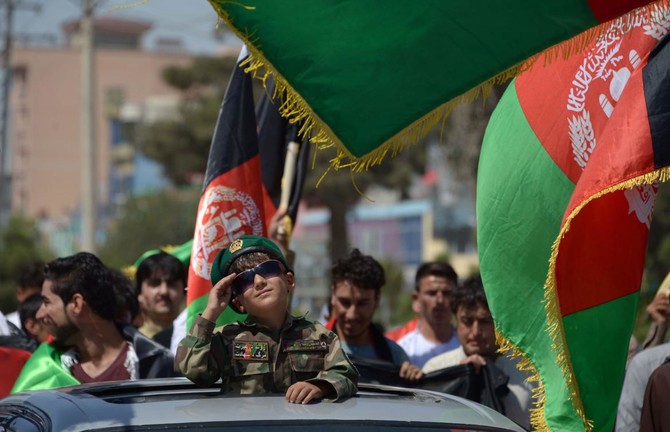
KABUL: Afghan security forces were on high alert Saturday as the war-weary country, reeling from a number of high-profile deadly attacks, marked its independence day with muted celebrations.
There was an increased police presence in the capital Kabul where President Ashraf Ghani hosted a private ceremony for Afghan dignitaries.
“All of our police units are on the highest state of alert and they are placed everywhere across the city,” Kabul police spokesman Abdul Basir Mujahid told AFP.
“We have increased the number of police checkpoints in and around the diplomatic quarters (too),” he added, amid fears that the Taliban would mark the anniversary with a large-scale attack.
August 19 commemorates the signing of the Treaty of Rawalpindi in 1919, which granted Afghanistan full independence from Britain, although the country was never part of the British empire, after three bloody wars.
While Afghanistan’s red, black and green tricolor flag adorned many Kabul streets, the day was largely going unobserved by ordinary Afghans, who are frustrated by the deteriorating security situation and the lack of progress by the US-led international coalition forces.
As in recent years there are no public ceremonies planned in the capital.
The city has been on edge since a massive truck bomb ripped through its diplomatic quarter during morning rush hour on May 31, killing about 150 and wounding around 400 people, mostly civilians, in an unclaimed attack.
Taliban insurgents are currently at the peak of their summer fighting season and have launched several deadly assaults around the country in recent weeks.
Ghani welcomed dozens of Afghan officials for a morning ceremony at the presidential palace and laid a wreath at the independence minaret inside the defense ministry compound.
“A very happy Independence Day to everyone in AFG,” Ghani said on Twitter.
“This day was earned with lots of sacrifices. We must pay homage & celebrate this legacy.”
While some Afghans changed their Facebook profile pictures to the Afghan flag or to Amanullah Khan, the king who secured Afghanistan’s independence, others lamented that the fight against the Taliban, now in its 16th year, meant there was little to celebrate.
“What independence day are we talking about when we are still at war with terrorism and don’t seem to be winning against it?” one user wrote on the social media site.
The day got under way as US President Donald Trump wrapped up a meeting of his national security team at Camp David on Friday as he tries to forge a new strategy for Afghanistan.
Trump must decide if he wants to continue on the current course, which relies on a much reduced US-led NATO force to help Afghan partners push back the Taliban, or try a new approach, such as sending more troops or even withdrawing altogether.
General John Nicholson, the top US commander in Afghanistan, offered his congratulations on “98 years of independence.”
“We look forward to many years of continued friendship and cooperation,” he said in a statement.
Afghan pop star Aryana Sayeed, who has been likened to Kim Kardashian for her skin-tight clothing and selfies, has said she will stage a concert despite threats from conservatives who oppose women performing in public.
“The concert will one hundred percent be held on Saturday evening,” she told Tolo News late Friday.

High security as Afghanistan marks independence day
Louvre Museum closed as workers launch rolling strike
- After the memo, French President Emmanuel Macron announced a massive renovation plan for the museum, expected to cost €700 million to €800 million (up to $940 million)
PARIS: The Louvre closed its doors to thousands of disappointed visitors on Monday as staff launched a rolling strike to protest working conditions at the Paris landmark, two months after a shocking robbery.
Staff assembled outside the museum’s world-famous glass pyramid, blocking the main entrance and holding signs, as security agents turned tourists away.
“The Louvre on strike,” said a banner.
FASTFACTS
• Staff assembled outside the museum’s world-famous glass pyramid, blocking the main entrance and holding signs, as security agents turned tourists away.
• The Louvre has become a symbol of so-called ‘over-tourism,’ with the 30,000 daily visitors facing what unions call an ‘obstacle course’ of hazards. course’ of hazards.
“All together all together,” striking staff shouted. “Who does the Louvre belong to? To us!“
Workers are demanding extra staff and measures to tackle overcrowding, adding to the woes of the world’s most visited museum just as France gears up for the Christmas holidays.
“We are angry,” Elize Muller, a security guard, told reporters. “We disagree with the way the Louvre has been managed.”
The strike comes nearly two months after the museum was victim of an embarrassing daylight heist that saw crown jewels worth $102 million stolen.
A notice in the museum’s courtyard said the Louvre would remain closed on Monday.
At a general meeting, around 400 employees voted unanimously to launch a strike, which can be renewed, to protest the “deterioration” of working conditions, the CGT and CFDT unions said.
Another general meeting was scheduled to take place Wednesday. The museum is closed on Tuesdays.
“I’m very disappointed, because the Louvre was the main reason for our visit in Paris, because we wanted to see the ‘Mona Lisa’,” said 37-year-old Minsoo Kim, who had traveled from Seoul with his wife for their honeymoon.
Natalia Brown, a 28-year-old tourist from London, said she understands “why they’re doing it,” but called it “unfortunate timing for us.”
Rachel Adams, a 60-year-old real estate agent from Utah, said she had heard of the plans to strike.
“I think that the Louvre makes a lot of money and they should be handling their finances quite a bit better. They had the big water leak. I mean, this is important stuff.”
Speaking on the eve of the action, Christian Galani, from the hard-left CGT union, said the strike would have broad support across the museum’s 2,200-strong workforce.
“We’re going to have a lot more strikers than usual,” Galani said.
“Normally, it’s front-of-house and security staff. This time, there are scientists, documentarians, collections managers, even curators and colleagues in the workshops telling us they plan to go on strike.”
All have different grievances, adding up to a picture of staff discontent inside the institution, just as it finds itself in a harsh public spotlight following the shocking robbery on Oct. 19.
Reception and security staff complain they are understaffed and required to manage vast flows of people, with the home of Leonardo da Vinci’s “Mona Lisa” welcoming several million people beyond its planned capacity each year.
A spontaneous walk-out protest in June led the museum to temporarily close.
The Louvre has become a symbol of so-called “over-tourism,” with the 30,000 daily visitors facing what unions call an “obstacle course” of hazards, long queues, and sub-standard toilets and catering.
Documentarians and curators are increasingly horrified by the state of disrepair inside the former royal palace, with a recent water leak and the closure of a gallery due to structural problems underlining the difficulties.
“The building is not in a good state,” chief Louvre architect Francois Chatillon admitted in front of lawmakers last month.
Under-fire Louvre boss Laurence des Cars, who faces persistent calls to resign, warned the government in January in a widely publicized memo about leaks, overheating and the declining visitor experience.
After the memo, French President Emmanuel Macron announced a massive renovation plan for the museum, expected to cost €700 million to €800 million (up to $940 million).
Questions continue to swirl since the break-in over whether it was avoidable and why the national treasure appeared to be poorly protected.
Two intruders used a portable extendable ladder to access the gallery containing the crown jewels, cutting through a glass door with angle grinders in front of startled visitors before stealing eight priceless items.
Investigations have since revealed that only one security camera was working outside when they struck, that guards in the control room did not have enough screens to watch the coverage in real time, and that police were initially misdirected.