PARIS: Twenty years ago on August 31, 1997, Britain’s Princess Diana died in a high-speed car crash in Paris.
For the next week, up to her spectacular funeral, Britain was plunged into an unprecedented outpouring of popular grief which shook the monarchy.
Here is how the week unfolded:
Divorced for the past year from heir to the throne Prince Charles, Diana, 36, and her new millionaire lover, Egyptian Dodi Al-Fayed, are stalked by a posse of press photographers over the summer as they holiday in the Mediterranean.
They arrive in the afternoon of August 30 in Paris and dine in the evening at the Hotel Ritz, in the luxurious Place Vendome. They try to leave discreetly shortly after midnight in a Mercedes.
Chased by paparazzi on motorcycles, the powerful sedan careers at high speed into a pillar in an underpass near the Alma Bridge opposite the Eiffel Tower on the north bank of the River Seine.
Diana is pulled out of the Mercedes, which has been reduced to twisted metal, by rescue workers.
Al-Fayed and their chauffeur, who the probe shows had a high level of alcohol in his blood, die instantly. Their bodyguard is seriously injured.
Seven photographers are arrested. From the next day, photographs of the crash will be offered to magazines for a million dollars each.
Diana is taken to Pitie-Salpetriere university hospital where at 4:00 am (0200 GMT) she dies of massive chest injuries after two hours of desperate surgery.
France’s ambassador to Britain telephones Queen Elizabeth II’s aides at Balmoral, in Scotland, where the Queen, her husband the Duke of Edinburgh, Charles as well as the couple’s two children, William, 15 and Harry, 12, are holidaying over the summer.
Britain awakes in mourning. Under a grey sky hundreds of tearful Londoners start to lay flowers in front of Buckingham Palace and Kensington Palace, the princess’s residence.
A tearful young Labour Prime Minister Tony Blair pays homage to “the people’s princess.”
The world reacts with dismay. US president Bill Clinton says he is “profoundly saddened.”
In India Mother Teresa prays for Diana, just days before her own death, and US rock star Michael Jackson cancels a concert in Belgium in shock.
The press is the first to be accused. Diana’s brother Charles Spencer says newspapers have blood on their hands.
Embarrassed, the British tabloid press elevates Diana to the status of an icon.
“Born a Lady. Became our Princess. Died a Saint,” writes the Daily Mirror.
The popular fervor grows. At Saint James’s Palace, where Diana’s body is taken, it takes eleven hours to reach condolence books.
“The vision of the bouquets of flowers is amazing: a veritable sea, almost a hundred meters long,” AFP writes.
The organization of the funeral proves complex.
Since her divorce Diana is no longer known as “Her Royal Highness” and does not have the right to a state funeral, although she still had the title of princess.
But Britons call for a tribute worthy of their “queen of hearts.”
Anger mounts at the silence of the royal family, still holed up in Balmoral.
Newspapers, furious that the Union Jack flag is not flying at half-mast over Buckingham Palace, call on the Queen to address her subjects.
The Sun tabloid asks : “Where is our Queen ? Where is our flag ?” It says not flying the flag is a “stark insult to Diana’s memory .”
The Queen decides on September 5 to pay homage to her former daughter-in-law, whom she did not like, in a televised speech for only the second time in her reign. She then publicly bows before Diana’s coffin.
“If they (the royals) fail to heed her lesson, they will bury not just Diana on Saturday — but their future too,” The Guardian broadsheet warns, as nearly a quarter of Britons call for the abolition of the monarchy in a poll.
The next day, nearly a million people watch as the funeral procession passes in a deep silence punctuated by sobs and tolling bells.
Their heads bowed, the two princes follow the coffin, accompanied by Prince Charles, the Duke of Edinburgh and her brother Earl Spencer, under the eyes of 2.5 billion television viewers around the world.
At Westminster Abbey, 2,000 invitees, including US First Lady Hillary Clinton, Blair, opera singer Luciano Pavarotti, former Conservative Prime Minister Margaret Thatcher and US film star Tom Cruise attend the ceremony.
Elton John adapts his song “Candle in the Wind,” rewriting the lyrics in homage to Diana.
In the afternoon, the princess is buried discreetly on a small island at Althorp, Diana’s ancestral home.


![]()
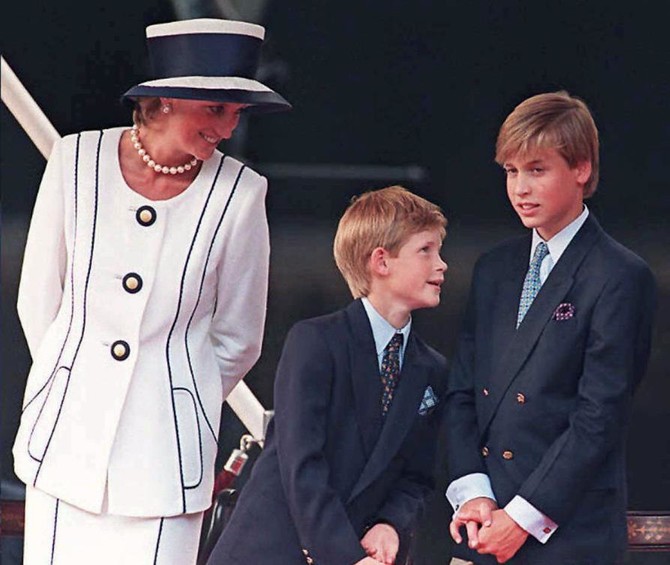
Diana’s death: Week of grief shakes the monarchy
Diana’s death: Week of grief shakes the monarchy

Latest updates





© 2026 SAUDI RESEARCH & PUBLISHING COMPANY, All Rights Reserved And subject to Terms of Use Agreement.