Hamas guard killed in rare suicide attack in Gaza Strip

1 / 2
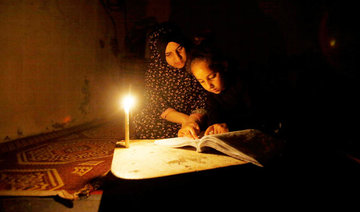
A child cries during the funeral of Nidal Al-Jaafari, a 28-year-old Hamas commander, who was killed in a suicide attack near the Gaza Strip’s crossing with Egypt. (AFP)
2 / 2
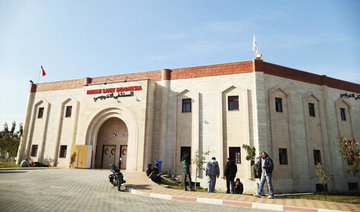
A member of Palestinian security forces loyal to Hamas patrols the southern Gaza Strip town of Rafah near the border with Egypt on August 17, 2017. A suicide bomber killed a Hamas guard in southern Gaza, officials said, in what was seen as a rare Islamist attack against the Palestinian group that has run the impoverished enclave for a decade. (AFP)
Updated 18 August 2017
Follow

Hamas guard killed in rare suicide attack in Gaza Strip

CAIRO: The Hamas-run Interior Ministry in the Gaza Strip said it has stepped up patrols on the territory’s southern border after a suicide bomber blew himself up Thursday morning while trying to cross into Egypt.
“Security forces stopped two persons who approached the border. One of them blew himself up and was killed. The other was wounded,” the ministry said in a statement.
Several Hamas security personnel were injured, and hospital officials said one of them died of his wounds.
Security sources quoted by Reuters said the suicide bomber was a member of a Salafi group that is a rival to Hamas.
A Hamas official speaking to Arab News avoided calling the assailant a member of a Salafi group based in Gaza, referring to him as “a person of deviant ideology.” The term is occasionally used by Hamas to describe Daesh members and other extremists.
“We condemn this hideous crime committed against our security forces by outlaws,” said Mosheer Al-Masry.
“We offer our condolences to the family of the martyred security victim, and we vow not to allow anyone to harm the security of our people in Gaza,” he added. “Our people reject deviant thoughts, which don’t serve our just Palestinian cause.”
There was no immediate claim of responsibility. It is the first time Hamas has been targeted in a suicide attack.
Egypt on Thursday opened the Rafah border crossing, Gaza’s main outlet to the outside world, for a fourth day to allow Muslims to embark on the Hajj pilgrimage in Saudi Arabia.
While Cairo has not yet commented on the suicide attack, some Egyptian analysts link it to the opening of the Rafah crossing.
“There’s a correlation that suggests that attacks near our borders increase whenever the Rafah crossing is open,” said Mohammed Noureddine, a former deputy of Egypt’s interior minister.
“Hamas beefed up border security in coordination with Egyptian authorities in an attempt to strengthen ties with Egypt,” he told Arab News.
“Despite the attack, Egyptian authorities won’t go back on the decision to open the border crossing in both directions for humanitarian cases.”
Hamas has sought to secure Gaza’s borders in order to improve relations with neighboring Egypt, which is battling a Daesh affiliate in the Sinai Peninsula bordering Gaza. Hamas has largely observed a truce with Israel since the 2014 Gaza war.


Syria’s growth accelerates as sanctions ease, refugees return

Updated 06 December 2025
Follow

Syria’s growth accelerates as sanctions ease, refugees return

  • Economy grows much faster than World Bank’s 1% estimate, fueling plans for currency’s relaunch

NEW YORK: Syria’s economy is growing much faster than the World Bank’s 1 percent estimate for 2025 as refugees flow back after the end of a 14-year civil war, fueling plans for the relaunch of the country’s currency and efforts to build a new Middle East financial hub, central bank Governor AbdulKader Husrieh has said.

Speaking via video link at a conference in New York, Husrieh also said he welcomed a deal with Visa to establish digital payment systems and added that the country is working with the International Monetary Fund to develop methods to accurately measure economic data to reflect the resurgence. 

The Syrian central bank chief, who is helping guide the war-torn country’s reintegration into the global economy after the fall of Bashar Assad’s regime about a year ago, described the repeal of many US sanctions against Syria as “a miracle.”

The US Treasury on Nov. 10 announced a 180-day extension of the suspension of the so-called Caesar sanctions against Syria; lifting them entirely requires approval by the US Congress. 

Husrieh said that based on discussions with US lawmakers, he expects the sanctions to be repealed by the end of 2025, ending “the last episode of the sanctions.”

“Once this happens, this will give comfort to our potential correspondent banks about dealing with Syria,” he said.

Husrieh also said that Syria was working to revamp regulations aimed at combating money laundering and the financing of terrorism, which he said would provide further assurances to international lenders. 

Syria’s central bank has recently organized workshops with banks from the US, Turkiye, Jordan and Australia to discuss due diligence in reviewing transactions, he added.

Husrieh said that Syria is preparing to launch a new currency in eight note denominations and confirmed plans to remove two zeroes from them in a bid to restore confidence in the battered pound.

“The new currency will be a signal and symbol for this financial liberation,” Husrieh said. “We are glad that we are working with Visa and Mastercard,” Husrieh said.