ANKARA: As a projection of its expanded geopolitical and economic presence in East Africa, Turkey will open its largest overseas military training camp in the Somali capital Mogadishu in September. It will be the first of its kind for the Somali national army, which is being restructured.
Construction began in March 2015. At the cost of some $50 million, the base will host three military schools, dormitories and depots over an area of 400 hectares.
For training exercises with up to 10,000 Somali soldiers in early September, some 200 Turkish soldiers will be deployed at the base, which will be able to train more than 1,500 troops at a time.
But such a military engagement carries risks. It is not clear whether Turkish troops will be involved in combat missions against the militant group Al-Shabab, which controls most of south-central Somalia.
Turkey has been very active in Somalia since 2011, helping the country strengthen its public institutions and alleviate a severe famine.
On Aug. 15, Turkish Airlines carried more than 60 tons of food aid to Mogadishu, to be distributed to 12 locations in Somalia. More than 60 tons of food aid and medical supplies were sent to Mogadishu in April.
Prof. Sedat Aybar, director of the Africa Research Center at Istanbul Aydin University, said Turkey has contributed positively to Somali development.
“In terms of building up hard power, establishing a military base is a serious effort, but the outcomes are unknown in the short run,” he told Arab News.
“However, given the situation in Somalia, this effort is more likely to provide positive returns for Somalis,” he added.
“A NATO member and an inspiring candidate for full EU membership, Turkey’s efforts in Somalia are more likely to generate international coordination and cooperation, rather than creating conflict and turmoil.”
Aybar said establishing a Turkish military base in Somalia has become even more significant since the announcement by President Donald Trump that US aid to Africa will be reduced.
“Many countries in Africa are aid-dependent, and American aid is an important part of their functioning as nation states,” said Aybar.
“Turkey, being one of the major donor countries to Somalia, is going one step further by establishing a military capacity there,” he added.
“This is particularly important as development requires building up a military capacity that doesn’t fully exist in Somalia.”
Aybar said Turkey, as a mid-sized regional power, gets involved in development in Africa by taking part in the continent’s new security architecture. “This is expected to provide positive returns for the Turkish defense industry.”
Hasan Ozturk, an Africa expert from the Istanbul-based think tank BILGESAM, said the camp’s strategic location is telling, as it is very close to the entry point of the Gulf of Aden, north of Mogadishu.
“For years, Turkey has been providing military training to officers of many African Union (AU) countries, including Somalia. It became very costly to host and train them each time in Turkey,” Ozturk told Arab News.
“Such training will also help Turkey’s broader international trade priorities, as the training will involve anti-piracy efforts, to which Turkey has contributed in the past.”
Ibrahim Nassir, an Africa expert at the Ankara Center for Crisis and Policy Studies, said the camp will boost Turkey’s soft power in the region and enhance its status as an essential player in regional security.
He added that Somalia’s president is very keen to fight terrorism, and that has reduced the number of terrorist attacks in his country.
Nassir said there is no security risk for the military camp because security has improved in parts of Somalia, especially Mogadishu.
“On top of that, Turkey has soldiers and military bases in many countries, and there are no terrorist attacks on its troops,” he said.
“This indicates that many nations trust the Turkish armed forces due to their belligerence against imperialism and injustices around the world.”


![]()
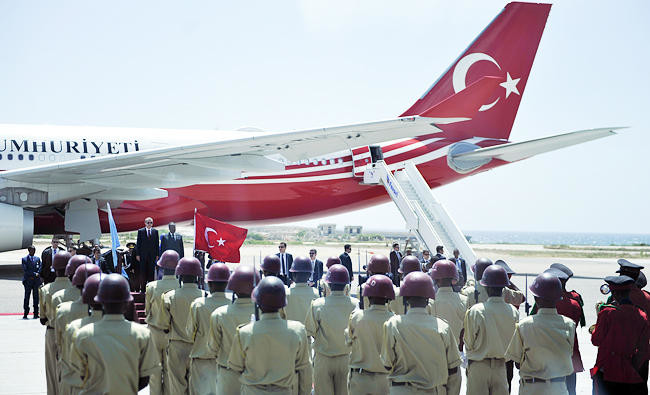
Turkish military base in Somalia: Risks and opportunities
Turkish military base in Somalia: Risks and opportunities

Latest updates


Recommended


© 2026 SAUDI RESEARCH & PUBLISHING COMPANY, All Rights Reserved And subject to Terms of Use Agreement.