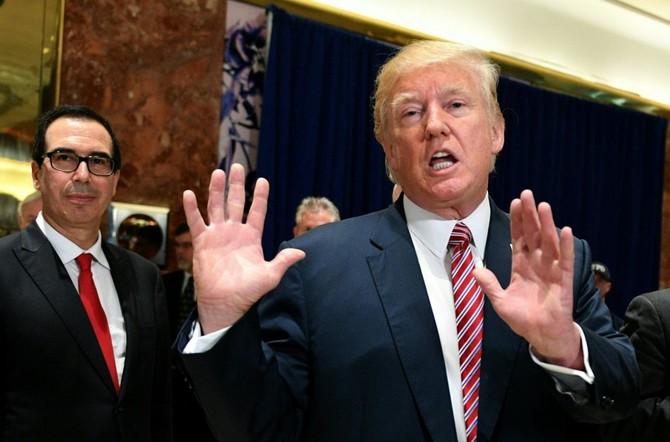
WASHINGTON/NEW YORK: US President Donald Trump inflamed tension after a deadly rally by white nationalists in Virginia by insisting that counter protesters were also to blame, drawing condemnation from some Republican leaders and praise from white supremacists.
In a combative news conference, Trump backed off from his Monday statements explicitly denouncing the Ku Klux Klan, neo-Nazis and white supremacists for the violence that erupted at a “Unite the Right” rally in Charlottesville, and reverted to his weekend contention that “many sides” were to blame.
“You had a group on one side that was bad,” Trump said on Tuesday. “And you had a group on the other side that was also very violent. And nobody wants to say that. But I’ll say it right now.”
Trump later said, “I think there is blame on both sides and I have no doubt about it,” adding that there were “very fine people” on both sides.
At the weekend rally against the removal of a statue of Robert E. Lee, commander of the pro-slavery Confederate army during the US Civil War, many participants were seen carrying firearms, sticks, shields, and lit torches. Some wore helmets.
Counter-protesters came equipped with sticks, helmets and shields.
James Fields, a 20-year-old Ohio man who is said to have harbored Nazi sympathies, was charged with murder after the car he was driving plowed into a crowd of counter protesters, killing 32-year-old Heather Heyer on Saturday and injuring 19.
A memorial service for Heyer is planned in Charlottesville on Wednesday.
Trump’s remarks drew swift criticism from many Republican leaders.
“No, not the same,” Republican presidential candidate and former Massachusetts governor, Mitt Romney, wrote on Twitter. “One side is racist, bigoted, Nazi. The other opposes racism and bigotry. Morally different universes.”
US Sen. Marco Rubio of Florida, who vied with Trump for the Republican presidential nomination, also responded in a series of Twitter posts.
“The organizers of events which inspired and led to #charlottesvilleterroristattack are 100 percent to blame for a number of reasons,” Rubio began.
“Mr. President, you can’t allow #WhiteSupremacists to share only part of the blame. They support idea which cost nation and world so much pain … the #WhiteSupremacy groups will see being assigned only 50 percent of the blame as a win,” Rubio added.
Former Ku Klux Klan leader David Duke applauded Trump for his “honesty & courage” on Twitter. Richard Spencer, the head of a white nationalist group, wrote on Twitter that he was “proud of him for speaking the truth.”
Richard Trumka, the president of the AFL-CIO labor federation representing 12.5 million workers, resigned from Trump’s American Manufacturing Council, joining a series of chief executives in doing so.
White House officials hoping to put the controversy behind them, worried the conference would revive and intensify the controversy. Asked about next steps, one official said: “I think next steps are just to stop talking.”
Hours later, the White House sent its regular “evening communications briefing” of talking points on the “news of the day” to Republican lawmakers, copies obtained by multiple news organizations, including CNN and the Atlantic, showed.
The first summary point read: “The President was entirely correct — both sides of the violence in Charlottesville acted inappropriately, and bear some responsibility.”


![]()
Trump blames ‘both sides’ for Virginia violence as many Republicans balk
Trump blames ‘both sides’ for Virginia violence as many Republicans balk

Latest updates


© 2026 SAUDI RESEARCH & PUBLISHING COMPANY, All Rights Reserved And subject to Terms of Use Agreement.