Deaths rise among Indonesian drug dealers amid fears of Philippines-style campaign

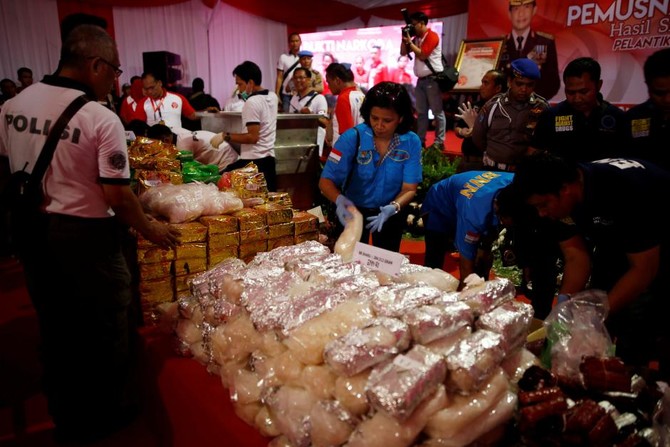
Officers from various Indonesian drug enforcement agencies prepare confiscated narcotics, including 1.4 tonnes of methamphetamine and a large amount of ecstasy pills, to be destroyed in an incinerator following a ceremony in Jakarta, Indonesia August 15, 2017. (REUTERS)
Updated 16 August 2017
Follow

Deaths rise among Indonesian drug dealers amid fears of Philippines-style campaign

JAKARTA: The number of suspected drug dealers killed by Indonesian police has more than tripled so far this year from the whole of 2016, activists said on Wednesday, raising concerns the country may be headed toward a bloody Philippines-style war on narcotics.
At least 60 suspected dealers have died so far this year, up from last year’s 18, Amnesty International said.
“While Indonesian authorities have a duty to respond to increasing rates of drug use in the country, shooting people on sight is never a solution,” said Usman Hamid, Director of Amnesty International Indonesia.
The rights group added that all the deaths involved police allegedly acting in self-defense or because the suspects resisted arrest, but that no independent investigations had been conducted.
A spokesman for the national narcotics agency said officers had to prioritize their own safety and those of others if there was resistance from drug dealers.
“If firearms are used, it’s because of the consideration of personal safety of the officers and others at the scene,” Sulistiandriatmoko said in a text message.
He declined to comment on the number of deaths.
Authorities estimate there are around 6.4 million drug users in the country of 250 million people, and the use of crystal methamphetamine has soared in recent years.
President Joko Widodo has called for a “merciless” crackdown on the narcotics trade, which he believes has reached full-blown emergency status.
“We have firmly declared a war against drug dealers who are ruining the future of our younger generation,” Widodo said on Wednesday in a state of the nation speech marking the 72nd anniversary of independence from Dutch colonialists.
Widodo has also told law enforcement officers to shoot drug traffickers if they resisted arrest.
The chief of anti-narcotics police, Budi Waseso, told Reuters last month that Indonesia would not replicate the bloody war on drugs in the Philippines under President Rodrigo Duterte, though he praised its aims.
More than 8,000 people have died in the Philippines’ war on drugs since Duterte took office last year, a third in raids and sting operations by police who say they acted in self-defense.
Duterte has refused to back down despite overwhelming international criticism.


Hungary to release 1.8 million barrels of crude oil from strategic reserves

Updated 5 sec ago
Follow

Hungary to release 1.8 million barrels of crude oil from strategic reserves

  • Croatia’s JANAF pipeline operator, however, said there was no need for Budapest to tap its reserves
  • Hungary and Slovakia have been trying to secure supply since flows were halted on January 27

BUDAPEST: Hungary’s government will release about 1.8 million barrels of crude oil from its strategic reserves after a drone attack on the Druzhba pipeline late last month stopped oil flow, according to a government decree published late on Thursday.
Croatia’s JANAF pipeline operator, however, said there was no need for Budapest to tap its reserves after Hungary’s oil company MOL said on Friday JANAF must allow transit of Russian seaborne oil to Hungary and Slovakia during the Druzhba outage.
“At this ⁠moment, a significant ⁠quantity of non-Russian crude oil is being transported via JANAF’s pipeline for MOL Group, while three additional tankers carrying non-Russian oil, also for MOL Group, are on their way to the Omisalj Terminal,” JANAF said in a statement.
“There was no need to tap into (their) reserves since oil transport via the JANAF pipeline toward MOL’s refineries is being carried out continuously and without ⁠delays.”
Hungary and Slovakia, which have the only remaining refineries in the EU using Russian oil through Druzhba, have been trying to secure supply since flows were halted on January 27 following what Ukraine said was a Russian drone attack that damaged pipeline infrastructure.
Both countries have blamed Ukraine for the delay in restarting the flows for political reasons.

SCRAMBLE FOR CRUDE SUPPLIES
MOL is entitled to priority access to released crude oil reserves, and it will have access to the freed reserves until April 15 and has to return them by August 24, the Hungarian government decree said.
At the end of January, ⁠Hungary had ⁠enough crude oil and petroleum product reserves to cover 96 days, according to data on the Hungarian Hydrocarbon Stockpiling Association’s website.
As the two countries scramble to ensure supplies, MOL ordered tankers delivering Saudi, Norwegian, Kazakh, Libyan and Russian oil to supply its Hungarian and Slovak refineries and halted diesel deliveries to Ukraine earlier this week.
MOL said that first shipments were expected to arrive at the port of Omisalj in Croatia in early March. After that, it will take a further 5-12 days for the crude oil to reach its refineries.
The Slovak government has also declared an oil emergency situation and has pledged to release 1.825 million barrels of oil following a request from Slovakia’s Slovnaft refinery, which is owned by MOL.