WASHINGTON: It took US President Donald Trump two days to do what both Republicans and Democrats said should have come fast and easy.
In his carefully worded statement Monday, Trump condemned members of the Ku Klux Klan, neo-Nazis and white supremacists as “repugnant.” He vowed that his administration would crack down on those who perpetrate “racist violence.” He called for national unity.
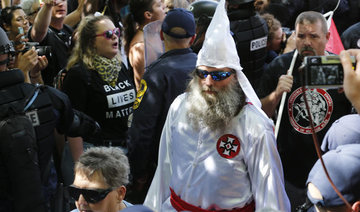
It was the type of statement Americans have come to expect from their presidents after racially charged incidents, like the deadly violence that erupted Saturday in Charlottesville, Virginia. But Trump struggled mightily to meet the moment, glaringly omitting any direct condemnation of white supremacists in his initial comments on the incident and decrying bigotry “on many sides.”
As the most unconventional president in modern American history, Trump has at times thrived off low expectations. He is often cheered by Republicans when he fulfills basic functions of the office. And GOP lawmakers in particular have often tried to explain away his missteps as a function of his lack of experience in Washington and politics.
But he has found himself with few allies after his botched handling of the Charlottesville violence. Several Republicans challenged Trump directly to be more strident in calling out white nationalists and neo-Nazis. Colorado Sen. Cory Gardner said the president needed to “step up” and call the groups “evil.”
The president got to that place on Monday, declaring, “racism is evil, and those who cause violence in its name are criminals and thugs.”
It is unclear whether his cleanup efforts will ease the political pressure he has faced in recent days. In addition to the disapproval from his own party, three members of a White House advisory council — Merck CEO Kenneth Frazier, Under Armor CEO Kevin Plank and Intel CEO Brian Krzanich — announced they were resigning from the panel in protest.
Later Monday, Trump tried to pin the blame for the controversy on one of his favorite targets: The media. He tweeted that the media “will never be satisfied ... truly bad people.”
The trouble for Trump is that his struggle in responding to the Charlottesville violence seems to fit a pattern of uncharacteristic caution when it comes to handling racial tensions and condemning the fringe groups that have rallied around his candidacy.
Indeed, it was striking that one of the few signs of support for Trump after his comments Saturday came from the white supremacist website Daily Stormer. The website noted that Trump avoided reporters’ questions about whether he condemned the groups leading the protests. “Really, really good. God bless him,” the website wrote.
Trump denies that he is racist or sympathetic to such groups. Son-in-law Jared Kushner, the grandson of Holocaust survivors, and daughter Ivanka, who converted to Judaism, are among those who have defended the president against those charges.
Still, he has a history of engaging in high profile, racially fraught battles.
Early in his career as a developer, Trump fought charges of bias against blacks seeking to rent at his family-owned apartment complexes. He long promoted the lie that the nation’s first black president, Barack Obama, was not born in the US. As a candidate, he proposed temporarily banning Muslims from the US. He retweeted a post from accounts that appeared to have ties to white nationalist groups. And he was slow to reject the endorsement of former KKK leader David Duke.
Some of the president’s friends and advisers have argued that Trump is simply refusing to bend to liberals’ desire for political correctness. A boastful, proudly disruptive politician, Trump often has been rewarded for saying impolite and impolitic things. Some supporters cheer him for being someone who says what they cannot.
Democrats frequently assert that Trump sees a political advantage in courting the support of the far right. Indeed, he has benefited politically from the backing of media outlets such as Breitbart or InfoWars. They have consistently promoted Trump and torn down his opponents, sometimes with biased or inaccurate reports.
Charlottesville’s mayor, Democrat Mike Signer, said Sunday that Trump made a choice during his campaign to “go right to the gutter, to play on our worst prejudices.”
“I think you are seeing a direct line from what happened here this weekend to those choices,” Signer said on CBS’ “Face the Nation.”
White House Senior Adviser Steve Bannon ran Breitbart before joining Trump’s campaign, and several of the president’s other aides believe Bannon continues to have influence over the website. In “Devil’s Bargain,” a new book about his role in the Trump campaign, Bannon is quoted as saying that attempts by Democratic presidential nominee Hillary Clinton to tie Trump to the alt-right and nationalists did not move voters.
“We polled the race stuff and it doesn’t matter,” Bannon said, according to the book.

Trump’s slow walk to condemning white supremacists
Bangladesh PM names cabinet after election win
- Tarique Rahman was sworn into office on Tuesday after a landslide election victory
- The 50-member cabinet was announced in a gazette notification issued late Tuesday
DHAKA: Bangladesh’s Prime Minister Tarique Rahman has named a former commerce minister to steer the country’s troubled economy and kept the defense portfolio for himself as he formed his first cabinet.
Rahman was sworn into office on Tuesday after a landslide election victory, taking over from the interim administration that had led the country of 170 million people since a deadly 2024 uprising that toppled the autocratic government of Sheikh Hasina.
The 50-member cabinet announced in a gazette notification issued late Tuesday includes Amir Khasru Mahmud Chowdhury, 76, a businessman and veteran lawmaker who has now returned to the finance ministry.
Chowdhury is tasked with reviving growth after months of turmoil that rattled investor confidence in the world’s second-largest garment exporter.
He had previously served in the cabinet of Rahman’s late mother, three-time prime minister Khaleda Zia, but was forced to resign in 2004.
According to media reports, his resignation came after he had granted permission for Taiwan to open a commercial office in Dhaka. Chowdhury has not spoken publicly about the issue.
He was also arrested several times during Sheikh Hasina’s 15-year rule, as her government regularly targeted opposition leaders in cases often decried as politically motivated.
Rahman, 60, has appointed himself defense minister, as his government faces a daunting list of challenges including improving security and healing rifts in a country polarized by years of bitter rivalry.
Bangladesh is squeezed between India — where border tensions are high — and Myanmar, where clashes have spilled over into frontier areas.
Bangladesh is home to more than a million Rohingya refugees who have fled Myanmar.
Khalilur Rahman is the foreign minister, an experienced diplomat and former UN official who holds degrees from universities in Dhaka and the United States.
Khalilur Rahman held the security portfolio in the caretaker government and helped mediate trade talks with the United States.
He faces the tricky task of balancing regional relations after ties with neighbor India soured during the interim government, and Dhaka deepened engagement with New Delhi’s arch-enemy Pakistan.
India’s Foreign Minister Subrahmanyam Jaishankar congratulated his counterpart on Wednesday, saying in a statement that they would work together to “advance our cooperation.”
Prime Minister Rahman is expected to chair his first cabinet meeting later on Wednesday.
Other members of the cabinet include veteran politicians, former ministers and lawmakers, as well as academics and several party workers.
Rahman was sworn into office on Tuesday after a landslide election victory, taking over from the interim administration that had led the country of 170 million people since a deadly 2024 uprising that toppled the autocratic government of Sheikh Hasina.
The 50-member cabinet announced in a gazette notification issued late Tuesday includes Amir Khasru Mahmud Chowdhury, 76, a businessman and veteran lawmaker who has now returned to the finance ministry.
Chowdhury is tasked with reviving growth after months of turmoil that rattled investor confidence in the world’s second-largest garment exporter.
He had previously served in the cabinet of Rahman’s late mother, three-time prime minister Khaleda Zia, but was forced to resign in 2004.
According to media reports, his resignation came after he had granted permission for Taiwan to open a commercial office in Dhaka. Chowdhury has not spoken publicly about the issue.
He was also arrested several times during Sheikh Hasina’s 15-year rule, as her government regularly targeted opposition leaders in cases often decried as politically motivated.
Rahman, 60, has appointed himself defense minister, as his government faces a daunting list of challenges including improving security and healing rifts in a country polarized by years of bitter rivalry.
Bangladesh is squeezed between India — where border tensions are high — and Myanmar, where clashes have spilled over into frontier areas.
Bangladesh is home to more than a million Rohingya refugees who have fled Myanmar.
Khalilur Rahman is the foreign minister, an experienced diplomat and former UN official who holds degrees from universities in Dhaka and the United States.
Khalilur Rahman held the security portfolio in the caretaker government and helped mediate trade talks with the United States.
He faces the tricky task of balancing regional relations after ties with neighbor India soured during the interim government, and Dhaka deepened engagement with New Delhi’s arch-enemy Pakistan.
India’s Foreign Minister Subrahmanyam Jaishankar congratulated his counterpart on Wednesday, saying in a statement that they would work together to “advance our cooperation.”
Prime Minister Rahman is expected to chair his first cabinet meeting later on Wednesday.
Other members of the cabinet include veteran politicians, former ministers and lawmakers, as well as academics and several party workers.
© 2026 SAUDI RESEARCH & PUBLISHING COMPANY, All Rights Reserved And subject to Terms of Use Agreement.