BEDMINSTER, US: President Donald Trump is drawing criticism from Republicans and Democrats for not explicitly denouncing white supremacists in the aftermath of violent clashes in Virginia, with lawmakers saying he needs to take a public stand against groups that espouse racism and hate.
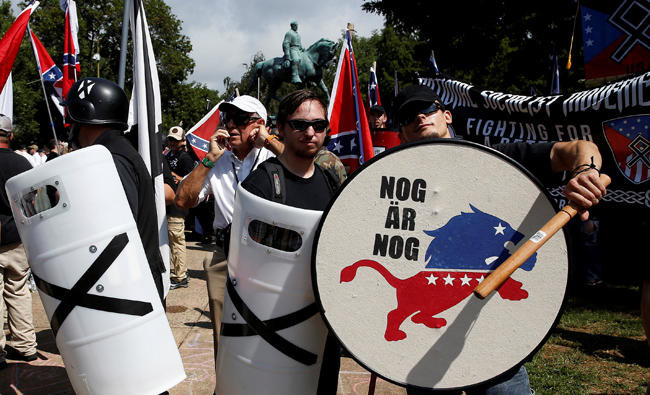
Trump, while on a working vacation at his New Jersey golf club, addressed the nation Saturday soon after a car plowed into a group of anti-racist counter-protesters in Charlottesville, a college town where neo-Nazis and white nationalists had assembled for march. The president did not single out any group, instead blaming “many sides” for the violence.
“Hate and the division must stop, and must stop right now,” he said. “We have to come together as Americans with love for our nation and ... true affection for each other.”
Trump condemned “in the strongest possible terms this egregious display of hatred, bigotry and violence on many sides, on many sides.” He added: “It’s been going on for a long time in our country. Not Donald Trump. Not Barack Obama. It’s been going on for a long, long time.”
On Sunday, the White House issued a statement seeking to expand on Trump’s remarks:
“The president said very strongly in his statement yesterday that he condemns all forms of violence, bigotry and hatred and of course that includes white Supremacists, KKK, neo-Nazi and all extremist groups,” according to a White House spokesperson. “He called for national unity and bringing all Americans together.”
The White House would not attach a staffer’s name to the statement.
The president on Saturday did not answer questions from reporters about whether he rejected the support of white nationalists or whether he believed the car crash was an example of domestic terrorism. Aides who appeared on the Sunday news shows said the White House did believe those things, but many fellow Republicans demanded that Trump personally denounce the white supremacists.
Sen. Cory Gardner, R-Colorado, tweeted: “Mr. President — we must call evil by its name. These were white supremacists and this was domestic terrorism.”
Added Sen. Marco Rubio, R-Fla.: “Nothing patriotic about #Nazis,the #KKK or #WhiteSupremacists It’s the direct opposite of what #America seeks to be.”
GOP Chris Christie of New Jersey, a staunch Trump supporter, wrote: “We reject the racism and violence of white nationalists like the ones acting out in Charlottesville. Everyone in leadership must speak out.”
On the Democrat side, Senate Minority Leader Charles Schumer of New York said “of course we condemn ALL that hate stands for. Until @POTUS specifically condemns alt-right action in Charlottesville, he hasn’t done his job.”
And Democratic Gov. Terry McAuliffe of Virginia, who spoke to Trump in the hours after the clashes, said he twice “said to him we have to stop this hateful speech, this rhetoric.” He urged Trump “to come out stronger” against the actions of white supremacists.
Trump’s national security adviser, H.R. McMaster, said Sunday that he considered the attack in Charlottesville to be terrorism:
“I certainly think anytime that you commit an attack against people to incite fear, it is terrorism,” McMaster told ABC’s “This Week.”
“It meets the definition of terrorism. But what this is, what you see here, is you see someone who is a criminal, who is committing a criminal act against fellow Americans.”
The president’s homeland security adviser, Tom Bossert, defended the president’s statement by suggesting that some of the counter-protesters were violent too.
When pressed, he specifically condemned the racist groups. The president’s daughter and White House aide, Ivanka Trump, tweeted Sunday morning: “There should be no place in society for racism, white supremacy and neo-nazis.”
White nationalists had assembled in Charlottesville to vent their frustration against the city’s plans to take down a statue of Confederal Gen. Robert E. Lee. Counter-protesters massed in opposition. A few hours after violent encounters between the two groups, a car drove into a crowd of people peacefully protesting the rally. The driver was later taken into custody.
Alt-right leader Richard Spencer and former Ku Klux Klan member David Duke attended the demonstrations. Duke told reporters that the white nationalists were working to “fulfill the promises of Donald Trump.”
Trump’s speech also drew praise from the neo-Nazi website Daily Stormer, which wrote: “Trump comments were good. He didn’t attack us. He just said the nation should come together. Nothing specific against us. ... No condemnation at all.”
The website had been promoting the Charlottesville demonstration as part of its “Summer of Hate” edition.
Mayor Michael Signer, a Democrat, said he was disgusted that the white nationalists had come to his town and blamed Trump for inflaming racial prejudices with his campaign last year.
“I’m not going to make any bones about it. I place the blame for a lot of what you’re seeing in American today right at the doorstep of the White House and the people around the president,” he said.
Trump, as a candidate, frequently came under scrutiny for being slow to offer his condemnation of white supremacists. His strongest denunciation of the movement has not come voluntarily, only when asked, and he occasionally trafficked in retweets of racist social media posts during his campaign. His chief strategist, Steve Bannon, once declared that his former news site, Breitbart, was “the platform for the alt-right.”


![]()
Trump faulted for not explicitly rebuking white supremacists
Trump faulted for not explicitly rebuking white supremacists


Latest updates


© 2026 SAUDI RESEARCH & PUBLISHING COMPANY, All Rights Reserved And subject to Terms of Use Agreement.