Taliban ‘open letter’ to Trump urges US to leave Afghanistan

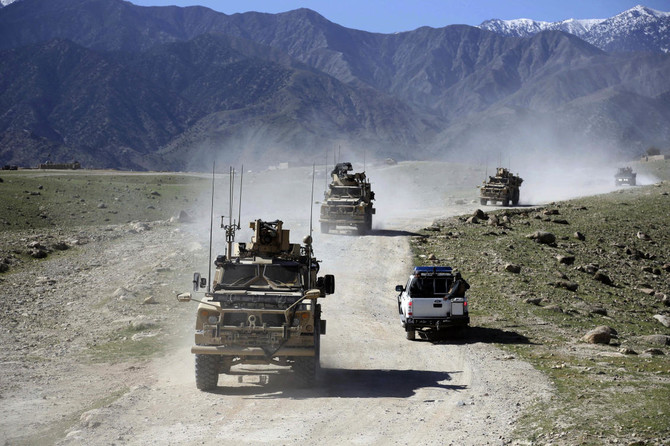
In this Saturday, April 17, 2017 file photo, U.S. forces and Afghan commando patrol Pandola village near the site of a U.S. bombing in the Achin district of Jalalabad, east of Kabul, Afghanistan. The Taliban have sent an "open letter" to President Donald Trump, reiterating their calls for America to leave Afghanistan after 16 years of war. (File photo by AP)
Updated 15 August 2017
Follow

Taliban ‘open letter’ to Trump urges US to leave Afghanistan

ISLAMABAD: The Afghan Taliban on Tuesday released an “open letter” to President Donald Trump, reiterating their calls for the withdrawal of US troops from Afghanistan after 16 years of war.
In a long and rambling note in English that was sent to journalists by Zabihullah Mujahid, the Taliban spokesman, the insurgents said Trump has recognized the errors of his predecessors by seeking a review of the US strategy for Afghanistan.
However, Mujahid said Trump should not hand control of the US Afghan policy to the military but rather announce the withdrawal of US forces — and not an increase in troops as the administration has planned.
The 1,600-word note said a US withdrawal would “truly deliver American troops from harm’s way” and bring about “an end to an inherited war.”
The United States now has about 8,400 troops in Afghanistan.
Trump has so far resisted the Pentagon’s recommendations to send almost 4,000 more to expand training of Afghan military forces and bolster US counterterrorism operations. The deployment has been held up amid broader strategy questions, including how to engage regional powers in an effort to stabilize Afghanistan.
What is evident is that the Afghan government has struggled to halt Taliban advances on its own and is now also battling an Islamic State affiliate that has carved out a foothold mostly in eastern Afghanistan. In its most recent report, the US Special Inspector General for Afghanistan Reconstruction said the Taliban hold sway in nearly 50 percent of the country.
The Taliban letter sought to flatter Trump for initiating the Afghan policy review while warning against handing it to “warmongering generals.”
“We have noticed that you have understood the errors of your predecessors and have resolved to thoroughly rethinking your new strategy in Afghanistan,” it said, addressing Trump. “You must also not hand over the Afghan issue to warmongering generals, but must make a decision where history shall remember you as an advocate of peace.”
The letter also offered a long list of complaints against Afghanistan’s US-orchestrated unity government and referenced a newly formed coalition of disgruntled warlords formed at a meeting last month in Turkey as an opposition bloc to Afghan President Ashraf Ghani.
Ghani has been under pressure from critics who have described him as divisive and accused him of stoking ethnic rivalries.
The opposition bloc includes Uzbek warlord and Afghanistan’s first vice president, Rashid Dostum, who has been criticized by the US for human rights abuses and is currently living in Turkey. Atta Mohammed Noor, a Tajik warlord and governor of northern Balkh province and Mohammed Mohaqiq, an ethnic Hazara lawmaker are also in the bloc.


Peru Congress to debate impeachment of interim president

Updated 6 sec ago
Follow

Peru Congress to debate impeachment of interim president

LIMA: Peru’s Congress is set to consider Tuesday whether to impeach interim president Jose Jeri, the country’s seventh head of state in 10 years, accused of the irregular hiring of several women in his government.
A motion to oust Jeri, 39, received the backing of dozens of lawmakers on claims of influence peddling, the latest of a series of impeachment bids against him.
The session, set for 10:00 am local time (1500 GMT), is expected to last several hours.
Jeri, in office since October, took over from unpopular leader Dina Boluarte who was ousted by lawmakers amid protests against corruption and a wave of violence linked to organized crime.
Prosecutors said Friday they were opening an investigation into “whether the head of state exercised undue influence” in the government appointments of nine women on his watch.
On Sunday, Jeri told Peruvian TV: “I have not committed any crime.”
Jeri, a onetime leader of Congress himself, was appointed to serve out the remainder of Boluarte’s term, which runs until July, when a new president will take over following elections on April 12.
He is constitutionally barred from seeking election in April.
The alleged improper appointments were revealed by investigative TV program Cuarto Poder, which said five women were given jobs in the president’s office and the environment ministry after visiting with Jeri.
Prosecutors spoke of a total of nine women.
Jeri is also under investigation for alleged “illegal sponsorship of interests” following a secret meeting with a Chinese businessman with commercial ties with the government.

- Institutional crisis -

The speed with which the censure process is being handled has been attributed by some political observers as linked to the upcoming presidential election, which has over 30 candidates tossing their hat into the ring, a record.
The candidate from the right-wing Popular Renewal party, Rafael Lopez Aliaga, who currently leads in polls, has been among the most vocal for Jeri’s ouster.
If successfully impeached, Jeri would cease to exercise his functions and be replaced by the head of parliament as interim president.
But first a new parliamentary president would have to be elected, as the incumbent is acting in an interim capacity.
“It will be difficult to find a replacement with political legitimacy in the current Congress, with evidence of mediocrity and strong suspicion of widespread corruption,” political analyst Augusto Alvarez told AFP.
Peru is experiencing a prolonged political crisis, which has seen it burn through six presidents since 2016, several of them impeached or under investigation for wrongdoing.
It is also gripped by a wave of extortion that has claimed dozens of lives, particularly of bus drivers — some shot at the wheel if their companies refuse to pay protection money.
In two years, the number of extortion cases reported in Peru jumped more than tenfold — from 2,396 to over 25,000 in 2025.