Pakistan marks 70 years of independence with fireworks, air show

1 / 5
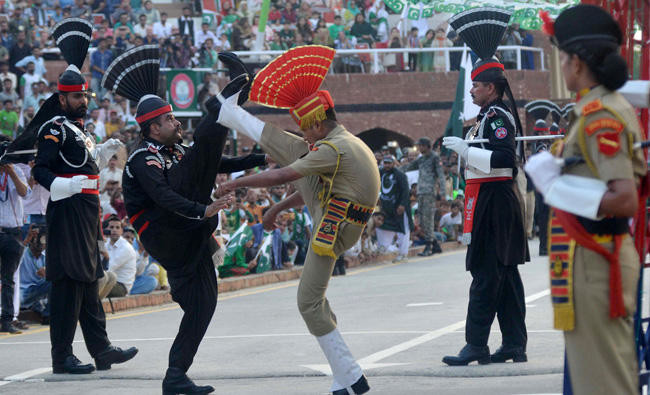
Pakistani Rangers (black) and Indian Border Security Force personnel (brown) perform during the daily beating of the retreat ceremony at the India-Pakistan Wagah Border Post, some 35km west of Amritsar, on Monday. Pakistan celebrates its independence on August 14, one day before India's independence day on August 15. (AFP / Narinder Nanu)
2 / 5
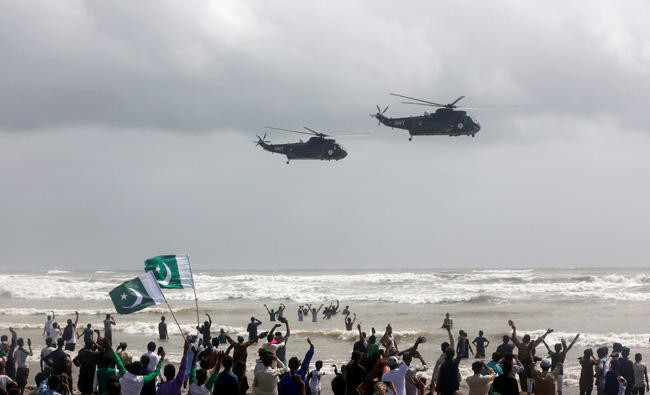
People wave as Pakistan Navy pilots demonstrate their skills during an air show to celebrate the country's Independence Day in Karachi, Pakistan, on Monday. (REUTERS/Akhtar Soomro)
3 / 5
Pakistani Rangers (black) and Indian Border Security Force personnel (brown) perform perform during the daily beating of the retreat ceremony at the India-Pakistan Wagah Border Post, some 35km west of Amritsar, on AMonday. (AFP / Narinder Nanu)
4 / 5
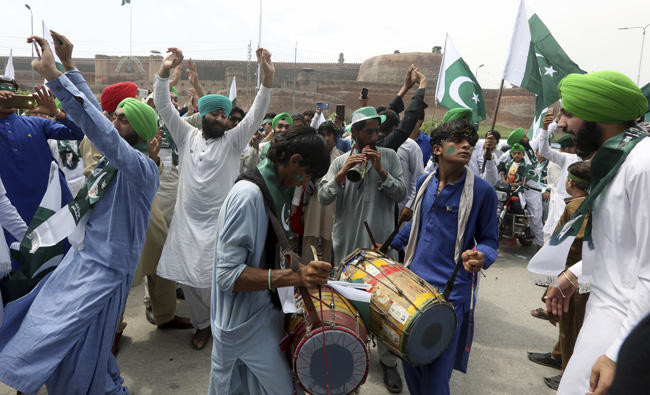
People from Pakistani Sikh community celebrate the 70th Independence Day in Peshawar, Pakistan, Monday. (AP Photo/Muhammad Sajjad)
5 / 5
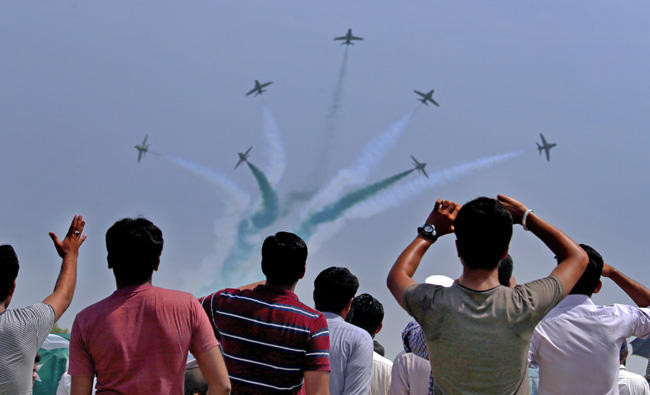
Spectators watch Pakistan Air Force fighter jets demonstrate an aerobatic maneuver during an air show to celebrate the 70th Independence Day in Islamabad, Pakistan, on Monday. (AP Photo/Anjum Naveed)
Updated 15 August 2017
Follow

Pakistan marks 70 years of independence with fireworks, air show

ISLAMABAD: Pakistan on Monday celebrated 70 years of independence from British India with a patriotic display including a giant flag and a show of airpower, as the military’s top brass vowed to wipe out terrorists hours before a new bomb attack killed six soldiers.
Celebrations began at the stroke of midnight with firework shows in major cities.
At the highly symbolic Wagah eastern border crossing with India, army chief General Qamar Javed Bajwa raised a massive national flag on a 400 foot (122-meter) pole as crowds chanted patriotic slogans.
Following the chest-thumping performance Bajwa said the country was making progress and promised to “go after each and every terrorist in Pakistan.”
“We have made a few mistakes in the past, but we are on the road to development under the guidance of our constitution,” he added.
Later Monday a roadside bomb in restive Balochistan province’s Harnai district killed six paramilitary soldiers and wounded two others, a spokesman for the troops said. The separatist Baluch Liberation Army claimed responsibility in a telephone call to AFP.
The attack came days after a powerful bomb targeted a military vehicle in the provincial capital Quetta late Saturday, killing 14 people including several troops.
The military later said the blast, claimed by the Daesh group, was intended to mar independence day celebrations.
Pakistan also faces fresh political turmoil after the Supreme Court last month sacked Prime Minister Nawaz Sharif following an investigation into corruption allegations against his family.
In Islamabad his newly-elected successor Shahid Khaqan Abbasi, along with top generals and foreign dignitaries, presided over a 31-gun salute and flag-raising ceremony to mark the holiday.
“The independence that we got 70 years ago was the fruit of the exemplary struggle of our ancestors,” said Abbasi in an address to the nation.
“Thousands of Muslims have made sacrifices for our future and the future of our children.”
Further south in Karachi the day began with a changing of the guard at the mausoleum of the country’s founder Mohammad Ali Jinnah, where politicians and military commanders laid floral wreaths.
The skies above the capital were later streaked with multicolored smoke as the air force hosted Pakistan’s largest air show to date.
Fighter jets criss-crossed over the leafy capital in aerobatic maneuvers as thousands packed shoulder-to-shoulder applauded from a park below. Planes from close allies Saudi Arabia and Turkey also took part.
In Lahore students cruised through the eastern city’s streets on motorbikes waving flags and screaming “Long live Pakistan!“
Up north in the Swat valley near the restive border with Afghanistan celebrations were more subdued, with events at schools canceled due to “prevailing law and order” issues.
In nearby Peshawar, the capital of Khyber Pakhtunkhwa province, Christians held special services at a church and freed doves to mark the holiday.
“Four years back my father and brother died in this church in a suicide attack, but I am still here praying for my beloved country,” schoolteacher Neelam Anwar told AFP.
In August 1947 the British Raj was dismantled with the subcontinent divided into two independent states — Hindu-majority India and Muslim-majority Pakistan.
Millions were uprooted in one of the largest mass migrations in history, with experts estimating at least one million died in the communal violence unleashed by partition.
The carnage sowed the seeds of the acrimony that led to three wars, and generations later this defining moment in the subcontinent’s history is still polarized by nationalism and rancour.
The countries still wrangle over a large part of their shared border, especially in disputed Kashmir. They even recognize their independence from British rule on separate days, with Pakistan claiming August 14 and India celebrating the following day.


Rohingya refugees hope new leaders can pave a path home

Updated 29 December 2025
Follow

Rohingya refugees hope new leaders can pave a path home

  • Some 1.7 million Rohingya Muslims displaced in Myanmar's military crackdown live in squalid camps in Cox’s Bazar, Bangladesh

COX’S BAZAR, Bangladesh: Rohingya refugees living in squalid camps in Bangladesh have elected a leadership council, hoping it can improve conditions and revive efforts to secure their return home to Myanmar.
Spread over 8,000 acres in Cox’s Bazar in Bangladesh, the camps are home to 1.7 million members of the stateless group, many of whom fled a 2017 military crackdown that is now subject to a genocide probe at the UN court.
In July, the refugees held their first elections since their influx began eight years ago, resulting in the formation of the United Council of Rohang (UCR).
“They are working to take us home,” said Khairul Islam, 37, who back home had a thriving timber business.
The new council has brought him a glimmer of hope amid an uncertain future.
“We can hardly breathe in these cramped camp rooms... all our family members live in a single room,” he said.
“It’s unbearably hot inside. Back in Myanmar, we didn’t even need a ceiling fan. In summer, we used to sit under tall trees,” Islam said, his eyes welling up.
More than 3,000 voters from across 33 refugee camps cast their ballots to elect an executive committee and five rotating presidents to focus on human rights, education and health.
Addressing a gathering at one of the camps, UCR president Mohammad Sayed Ullah urged refugees not to forget the violence that forced the mostly Muslim group to flee Myanmar’s Rakhine state.
“Never forget that we left our parents’ graves behind. Our women died on the way here. They were tortured and killed... and some drowned at sea,” said Sayed Ullah, dressed in a white full-sleeved shirt and lungi.
“We must prepare ourselves to return home,” he said, prompting members of the audience to nod in agreement.

A seat at the table 

“UCR wants to emerge as the voice of the Rohingyas on the negotiation table,” Sayed Ullah later told AFP.
“It’s about us, yet we were nowhere as stakeholders.”
The council is not the first attempt to organize Rohingya refugees.
Several groups emerged after 2017, including the Arakan Rohingya Society for Peace and Human Rights, once led by prominent activist Mohib Ullah.
But he was murdered in 2021.
And even before that, many organizations were shut down after a major 2019 rally, when the Rohingya said they would go home only with full rights and safety guarantees.
“Some newspapers misrepresented us, claiming we wanted to stay permanently in Bangladesh,” Sayed Ullah said.
“Many organizers were detained. The hardest blow was the assassination of Mohib Ullah.”
But trust is slowly building up again among the Rohingya crammed in the camps in Cox’s Bazar.
“Of course we will return home,” said 18-year-old Mosharraf, who fled the town of Buthidaung with his family.
“UCR will negotiate for better education. If we are better educated, we can build global consensus for our return,” he told AFP.

Security threats 

Many refugees have started approaching the body with complaints against local Rohingya leaders, reflecting a slow but noticeable shift in attitudes.
On a recent sunny morning, an AFP reporter saw more than a dozen Rohingya waiting outside the UCR office with complaints.
Some said they were tortured while others reported losing small amounts of gold they had carried while fleeing their homes.
Analysts say it remains unclear whether the new council can genuinely represent the Rohingya or if it ultimately serves the interests of Bangladeshi authorities.
“The UCR ‘elections’ appear to have been closely controlled by the authorities,” said Thomas Kean, senior consultant at the International Crisis Group.
Security threats also loom large, undermining efforts to forge political dialogue.
Armed groups like the Arakan Rohingya Salvation Army and Rohingya Solidarity Organization continue to operate in the camps.
A report by campaign group Fortify Rights said at least 65 Rohingyas were killed in 2024.
“Violence and killings in the Rohingya camps need to stop, and those responsible must be held to account,” the report quoted activist John Quinley as saying.