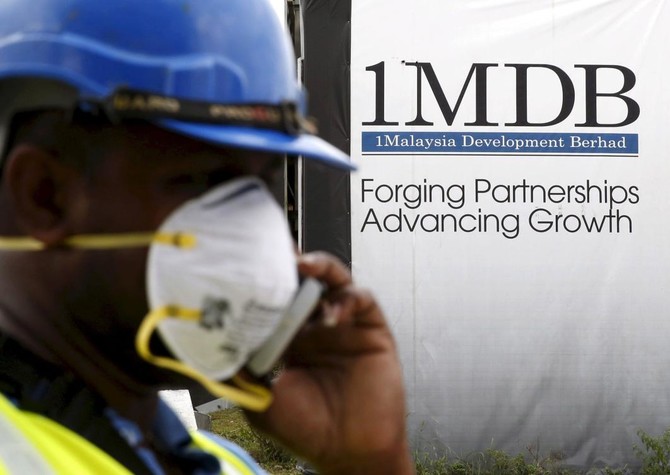
KUALA LUMPUR: State fund 1Malaysia Development Berhad (1MDB) has remitted the equivalent of $350 million (SR1.31 billion) to Abu Dhabi’s government-owned International Petroleum Investment Co. (IPIC), it said on Friday.
“All funds paid to IPIC are from proceeds of the ongoing rationalization program,” 1MDB said in a statement.
Abu Dhabi this week extended a deadline for the troubled Malaysian fund to make a $603 million debt payment, provided at least $310 million was paid by Aug. 12.
The balance of the payment obligation to IPIC was now due on August 31, 1MDB added.
The US Justice Department is conducting a criminal probe 1MDB and has asked for a stay on its civil lawsuits in connection with $1.7 billion in assets allegedly bought with money stolen from the scandal-hit state fund.
A total of $4.5 billion was misappropriated from 1MDB by high-level officials of the fund and their associates, according to dozens of civil lawsuits filed by the US Justice Department in the past two years.
1MDB did not immediately respond to an e-mailed request for comment.
The department wants to delay the civil proceedings, saying that any disclosures would have an “adverse effect” on the government’s ability to conduct its criminal probe, according to the latest court filing lodged at the Central District Court in California on Thursday.
The criminal investigation was started before the civil lawsuits, the department said. It said the investigation was “global in scope”, with crimes committed over several years in numerous countries.
In a declaration included in the filing, a Federal Bureau of Investigation agent said that disclosures were “likely to reveal potential targets and subjects of the investigation”.
“Such disclosures could result in the destruction of evidence, flight of potential subjects and targets, or the identification and intimidation of potential witnesses,” the agent said.

Malaysia’s 1MDB says $350 million paid to Abu Dhabi for debt deal
Oman property price index jumps 17.3% in Q3
JEDDAH: Oman’s real estate price index recorded a 17.3 percent increase in the third quarter of 2025 compared with the same period in 2024, according to official data.
The commercial property price index rose 14.6 percent, driven by a 19 percent increase in commercial land prices, while the cost of commercial shops fell by 8.5 percent, as per the country’s National Centre for Statistics and Information, or NCSI, based on figures from the Ministry of Housing and Urban Planning.
Industrial land prices posted a moderate increase of 5.5 percent, while residential property prices recorded stronger growth of 18.7 percent year on year, the Oman News Agency reported.
The rise in Oman’s real estate price index comes amid broader momentum across Gulf property markets, where residential activity remained resilient in the third quarter of 2025. Higher demand in major cities across the region, supported by population growth and ongoing infrastructure investment, helped underpin price gains, even as some markets faced tighter financing conditions.
“As for the residential property price index, it achieved clear growth in the third quarter of 2025, with a rate of 18.7 percent compared to the third quarter of 2024, as residential land prices increased by 19.6 percent, residential apartments by 22.4 percent, in addition to the growth of villa prices by 16.5 percent, while the prices of other houses decreased by 0.5 percent,” the ONA report stated.
Oman’s residential land prices climbed 19.6 percent, with apartments rising by 22.4 percent, while villas increased by 16.5 percent. Prices of other types of houses saw a slight decline of 0.5 percent.
At the governorate level, Muscat recorded the highest increase in residential land prices at 48.3 percent, followed by Musandam at 29.7 percent, Al-Dakhiliyah at 12.3 percent, Al-Batinah South at 8.7 percent, North Al Batinah at 8.1 percent, and Dhofar at 4 percent.
On the other hand, some governorates saw declines in residential land prices, with Al-Dhahirah down 25.8 percent, Al-Buraimi down 24.6 percent, Al-Wusta down 13.3 percent, Al-Sharqiyah North down 4 percent, and Al-Sharqiyah South down 2.2 percent.
“This increase reflects continued demand in Oman’s real estate market, with residential properties in Muscat and Musandam driving much of the growth,” the ONA report added.
The data also show clear differences across regions, with price gains concentrated in major urban areas. Strong demand in Muscat and coastal governorates was supported by population growth, investment, and infrastructure spending, while some interior regions recorded declines as market activity softened.