DUBAI: The Gulf states cannot compromise with terrorism and cannot allow countries such as Qatar to support it, a leading Emirati businessman and commentator said on Wednesday.
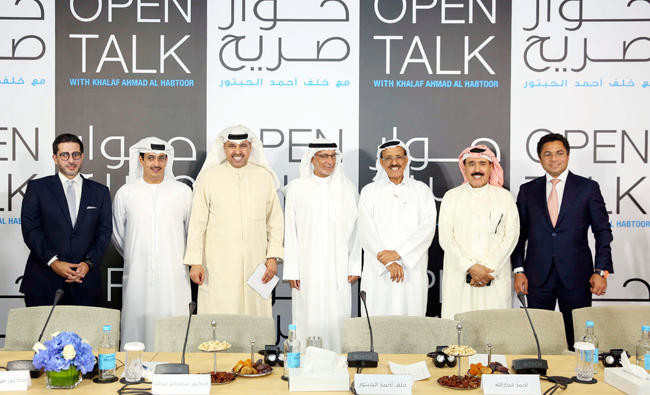
“If you support terrorism, you get punished, you are either our friend or foe,” Khalaf Ahmad Al-Habtoor told a discussion forum in Dubai.
“We commend our leaders for their patience with Qatar for more than 20 years, and are waiting for its leaders to get back on the right track. We have to be clear, we are against terrorism and we hope that Qatar comes around to its Khaleeji home.”
The Anti-Terror Quartet, comprising Saudi Arabia, the UAE, Bahrain and Egypt, severed diplomatic relations with Qatar in June and imposed a trade and travel boycott to protest at Doha’s support and funding of extremists.
“The boycott against the Qatari government is not against the Qatari people,” Al-Habtoor said. “We don’t have any evil intentions toward the people. We are not trying to harm them, they are our brothers and our neighbors.”
Al-Habtoor is the founder and chairman of Al-Habtoor group of companies, a conglomerate based in Dubai with interests from engineering and construction to hospitals and hotels. He is also a political commentator and Arab News columnist.
The businessman was speaking at a forum at his company headquarters to discuss the Qatar boycott and the output of the Qatar-owned broadcaster Al Jazeera. The panelists were Faisal J. Abbas, editor in chief of Arab News; Dr. Abdulkhaleq Abdullah, a professor of political science; Dr. Abdullah Al-Mutawa, director of Al Arabiya News in Dubai; Ahmed Al-Jarallah, editor in chief of the Kuwaiti newspapers Arab Times and Al-Seyassah; Dr. Fahd Al-Shelaimi, chairman of the Gulf Forum for Peace and Security; and prominent Egyptian lawyer Khaled Abou Bakr.
“Egypt is the country that suffered the most from Qatar,” Abou Bakr told the forum. “We have shed our own blood because of them. Mothers have lost their sons and this has all been supported by Qatari funds.”
Tarek Al-Zarouni, a former Al Jazeera reporter and the author of “Alone in Al Jazeera,” told the forum via teleconference: “Al Jazeera is Qatar’s Trojan horse, the main supporter of terrorism, shaming Islam by making Yusuf Al-Qaradawi the mufti of the country.
“Al-Qaradawi has a weekly presence on the news channel and he has the Foreign Ministry’s support. He is a symbol of terrorism. We need a strong media apparatus to broadcast facts, a soft power to fight against Al Jazeera.”

No compromise with Qatar and terror: Emirati tycoon
Iran war chokes aid corridors, obstructing global relief efforts
- “People in dire need of assistance will have to wait longer for food,” said Bauer
- Tents, tarpaulins and lamps destined for Gaza and the West Bank have become stuck in the supply chain, the IOM said
GENEVA: Key humanitarian air, sea and land routes are being constricted by disruption from the war in the Middle East, delaying life-saving shipments to some of the world’s worst crises, 10 aid officials have told Reuters.
The US–Israeli war on Iran entered its seventh day on Friday, convulsing global markets and disrupting supply chains with airspace closures and the halt of shipping through the critical Strait of Hormuz.
Aid to Gaza and Sudan is grinding to a halt and costs are soaring for help to the hundreds of millions suffering hunger crises around the world.
“People in dire need of assistance will have to wait longer for food,” said Jean-Martin Bauer, Director of Food Security at the World Food Programme.
Already, tents, tarpaulins and lamps destined for the Israeli-occupied Palestinian territories of Gaza and the West Bank have become stuck in the supply chain, the International Organization for Migration said.
DUBAI AID HUB HOBBLED BY AIR AND SEA RESTRICTIONS
Aid groups say higher operational costs are straining budgets already facing massive donor cuts. The IOM said shipping firms were demanding emergency surcharges of approximately $3,000 per container.
Humanitarian groups stocking goods for rapid regional deployment at warehouses in Dubai’s Humanitarian Hub face challenges moving supplies onto transit routes.
The International Federation of Red Cross and Red Crescent Societies cannot move trauma kits to help the Iranian Red Crescent with search and rescue from its Dubai hub, where they sit in a estimated 1 million Swiss franc ($1.28 million) pre-positioned emergency stockpile, said Cecile Terraz, a director at the IFRC.
The group cannot move stock through Jebel Ali port — the region’s largest container terminal, which was set on fire by the debris of an intercepted missile — from where cargo normally moves onto planes or into the Strait of Hormuz.
The World Health Organization’s Dubai hub operations are also frozen, regional director Hanan Balkhy said, obstructing 50 emergency requests from 25 countries and hampering operations such as polio vaccination.
Ripple effects farther afield are also likely.
Famine-struck Sudan is particularly exposed due to additional restrictions since February 28 on the Suez Canal and the Bab el-Mandeb Strait at the southern entrance to the Red Sea, the UNHCR said.
“We are particularly concerned about Africa,” said a spokeswoman, adding that some cargoes were being sent around the Cape of Good Hope. The route takes up to three weeks longer.
Costs for fuel, transportation and insurance are also rising, and Terraz said the IFRC may have to cut deliveries to the Iranian Red Crescent.
Emma Maspero, senior manager in Copenhagen of the supply division of the UN children’s body UNICEF, said she hoped flights carrying perishable humanitarian goods such as vaccines could be prioritized amid the airspace restrictions.